ZEC Mining Guide 2026: Best Zcash ASIC Miners, Profitability, and ROI
ZEC mining in 2026 is no longer just a question of whether Zcash can rally. For hardware buyers, the better question is whether an Equihash ASIC can produce enough coin value to justify power cost, machine cost, hosting, and operational risk. This guide explains how to evaluate ZEC mining with the Bitmain Antminer Z15 Pro, how it compares with older Zcash ASICs, and what miners should check before buying.
Quick Answer: Is ZEC Mining Still Worth Considering in 2026?
ZEC mining can still be worth considering for miners who understand three things clearly: Equihash ASICs are specialized machines, profitability changes quickly with ZEC price and network difficulty, and electricity cost is often the difference between a strong ROI case and a weak one. The most important step is to run the exact machine, power rate, and coin-price assumptions through a live calculator before ordering hardware.
For buyers comparing current options, the Bitmain Antminer Z15 Pro is the main high-performance ZEC miner to evaluate at BT-Miners. Miners who want a lower-cost entry point can also compare it with the Bitmain Antminer Z15.
Why ZEC Uses Different Mining Hardware Than Bitcoin
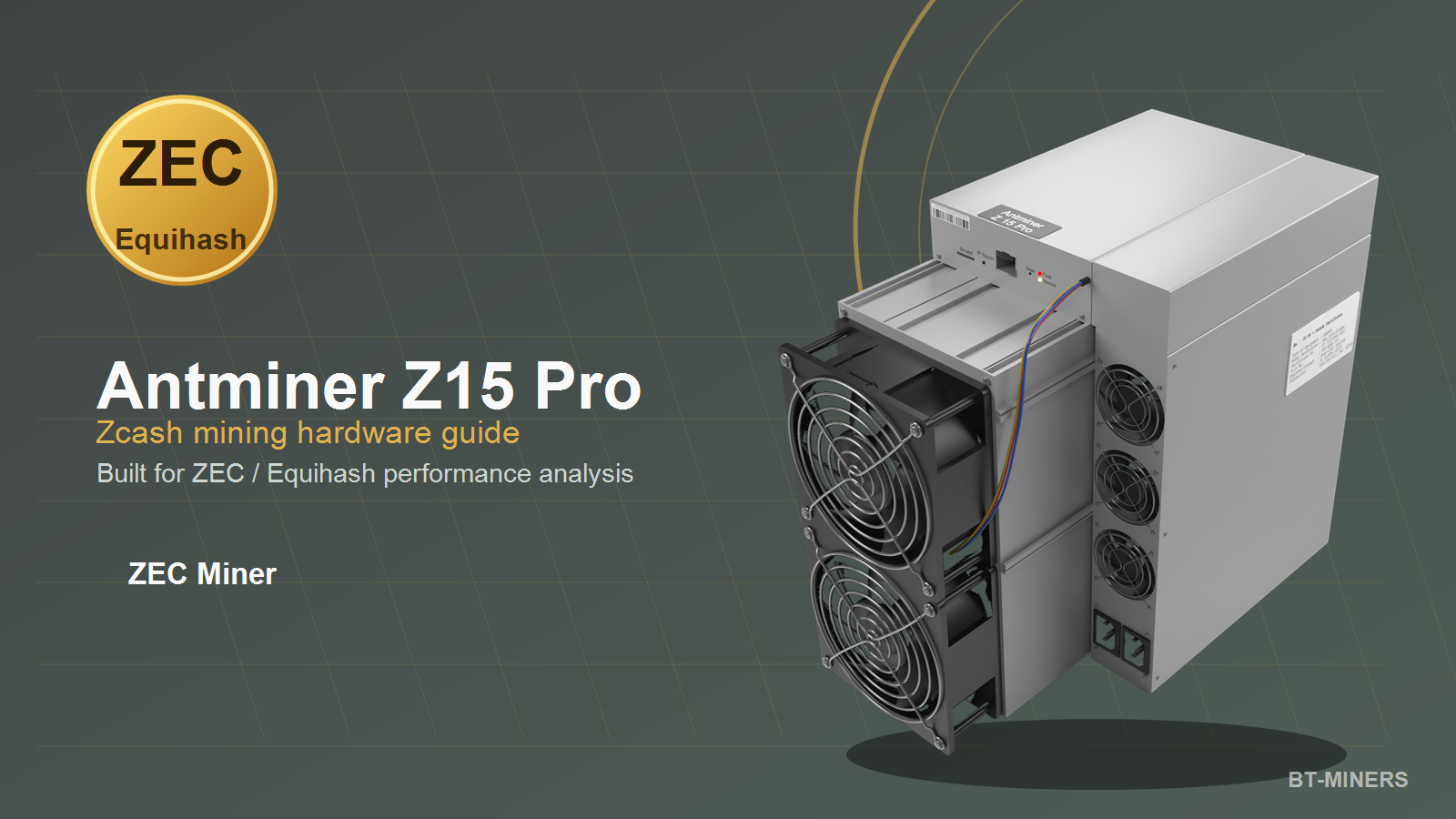
Zcash uses the Equihash mining algorithm, while Bitcoin uses SHA-256. That distinction matters because a Bitcoin ASIC cannot mine ZEC efficiently, and a ZEC miner is not designed for BTC mining. The hardware, firmware, pool setup, and profitability model are all different.
This is also why ZEC mining images and product pages should use Zcash or Equihash context, not Bitcoin logos or BTC-only visual language. If the machine is an Antminer Z15 Pro, the right frame is ZEC mining hardware, not Bitcoin mining hardware.
Antminer Z15 Pro: The Key ZEC Miner to Watch
The Antminer Z15 Pro is built for Equihash mining and is commonly evaluated by miners who want stronger ZEC output than older-generation Zcash ASICs. The model listed at BT-Miners is positioned as a high-hashrate Zcash miner, which makes it a natural fit for buyers who are serious about ZEC rather than casually testing the network.
The practical buying question is not only hashrate. A miner should compare total machine cost, power draw, electricity rate, expected pool revenue, shipping timing, hosting availability, and the likelihood that network difficulty changes after more miners come online.
Z15 Pro vs Z15: Which Type of Buyer Fits Each Machine?
The Z15 Pro is better suited for buyers who want more hashrate per unit and are planning around a serious ZEC mining setup. It usually makes more sense when the buyer has a competitive power rate, reliable ventilation, and a clear plan for monitoring uptime.
The standard Antminer Z15 can make sense for buyers who want exposure to Equihash mining with a smaller initial hardware commitment. It may be easier to justify for testing, learning, or building a smaller ZEC position, but every buyer still needs to check real-time profitability before assuming ROI.
—— For machine comparisons and mining setup instructions, please refer to this article: Antminer Z15 vs Z15 PRO: The Ultimate 2025 Equihash Mining Comparison
How to Calculate ZEC Mining Profitability
Start with the basics: machine hashrate, power consumption, electricity price, ZEC price, pool fees, and current network difficulty. Then model several scenarios instead of relying on one optimistic number. A good ZEC mining plan should include a base case, a bearish case, and a bullish case.
The easiest starting point is the BT-Miners ZEC mining calculator. Use it to compare expected daily revenue across machines, and then adjust for your real power rate and hosting costs. If your local electricity price is high, BT-Miners hosting services may be worth comparing against a home or warehouse deployment.
Power, Heat, and Hosting Considerations
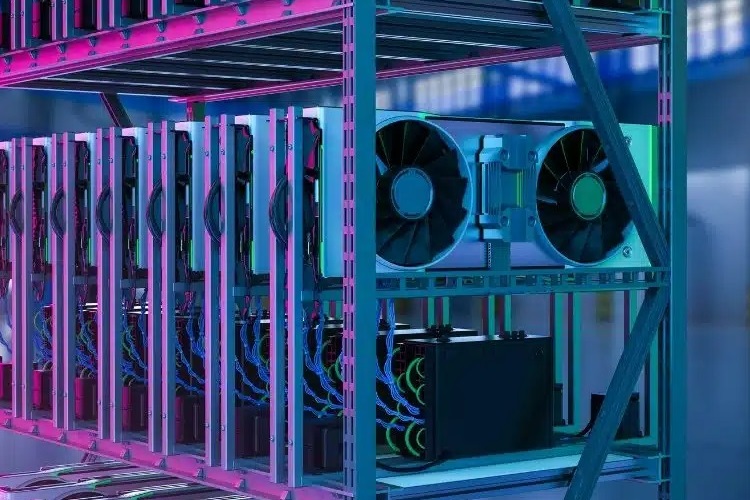
ZEC miners are still ASIC miners, which means heat, noise, airflow, power cabling, and uptime matter. A strong paper ROI can disappear quickly if the machine is throttling, frequently offline, or running in a space with inadequate cooling.
Before buying, confirm your electrical capacity, outlet type, airflow path, ambient temperature, and monitoring plan. For larger deployments, hosting can simplify these issues because power, cooling, and maintenance are handled in a facility designed for ASIC operation.
Risks ZEC Miners Should Watch
- ZEC price volatility: Zcash can move sharply, so revenue estimates should be treated as variable.
- Network difficulty changes: More active Equihash hashrate can reduce coin output per machine.
- Electricity cost: A small change in power price can materially change ROI.
- Hardware availability: Delivery timing and inventory matter when market conditions are moving quickly.
- Liquidity and strategy: Decide whether mined ZEC will be sold regularly or held as a longer-term treasury position.
FAQ: ZEC Mining and Antminer Z15 Pro
Can a Bitcoin miner mine ZEC?
No. Bitcoin miners are built for SHA-256, while ZEC uses Equihash. A ZEC mining setup requires Equihash-compatible hardware such as the Antminer Z15 Pro or Antminer Z15.
Is the Antminer Z15 Pro only for Zcash?
The Antminer Z15 Pro is designed for Equihash mining, so it is commonly used for Zcash and other compatible Equihash coins. Buyers should always confirm current coin support and pool compatibility before deployment.
What is the most important number for ZEC mining ROI?
Electricity cost is usually the most important controllable number. ZEC price and network difficulty move with the market, but your power rate determines whether the machine can stay competitive across weaker periods.
Should I host a ZEC miner or run it myself?
Self-hosting can work if you have enough power, cooling, and noise tolerance. Hosting may be better for buyers who want professional uptime, better electrical infrastructure, and less day-to-day maintenance.
Bottom Line
ZEC mining in 2026 can be attractive, but it should be approached as a hardware and power-cost decision, not only a coin-price bet. The Antminer Z15 Pro gives serious Equihash miners a stronger ZEC-focused option, while the standard Z15 may fit smaller deployments. Before buying either machine, compare live profitability, power cost, hosting options, and your plan for handling mined ZEC.
Disclaimer: This article is for informational purposes only and does not constitute financial or investment advice.