Best ZEC Pool for Antminer Z15 Pro in 2026: NiceHash vs Luxor vs Unmineable
⚠️ Disclaimer: Mining profitability fluctuates with electricity costs, cryptocurrency prices, and network difficulty. All figures reflect conditions as of May 25, 2026 (ZEC $673.24, BTC $77,438.54). Past performance does not indicate future results. Conduct your own due diligence before purchasing mining equipment.
A question circulating on Reddit this week cuts straight to a real operational decision that every Antminer Z15 Pro owner eventually faces: which platform delivers the best practical return for ZEC mining, and when does BTC payout convenience justify a higher or more variable cost? At current assumptions of $56.89/day gross revenue, 2,780W power draw, and $0.07/kWh electricity, the Z15 Pro remains a high-output Equihash ASIC. Pool choice will not change the core economics as much as ZEC price, network difficulty, uptime, or electricity rate, but it does change payout currency, cash-flow predictability, and annual platform cost.
Quick verdict: Unmineable is the lower-fee convenience option for miners who want BTC or multi-coin payouts. Luxor is better framed as the native-ZEC, FPPS-style choice for miners who value payout smoothing and ZEC exposure. NiceHash is not a traditional ZEC pool; it is a marketplace for selling Equihash hashpower for BTC, which can be useful when buyer demand is strong.
Why Pool Selection Has a Measurable Impact
Most buyers focus on hashrate, power consumption, and purchase price when evaluating a miner. Pool selection is typically an afterthought — a stratum address to paste into a config file. That instinct is understandable: platform costs ranging from about 1% to 3% sound trivial against a machine generating $56.89/day gross.
The numbers look different over a full operating year. A Z15 Pro running continuously generates approximately $20,765 gross annually at current ZEC prices. A 1% platform-cost difference on that revenue equals about $208/year. Over 12 months, pool selection is the difference between keeping that margin or paying it away as overhead.
Beyond fees, the more consequential decision for many miners is payout currency. Luxor pays in ZEC. Unmineable can pay in BTC or many other supported coins, while NiceHash pays miners in BTC for marketplace hashpower. If you expect ZEC to appreciate, retaining native ZEC payouts has an upside case. If you want BTC accumulation without touching an exchange, auto-convert pools simplify the workflow at a cost. Neither choice is inherently superior — it depends on your portfolio strategy and operational preferences.
Pool #1 – Luxor: Native ZEC Mining with FPPS-Style Payout Smoothing
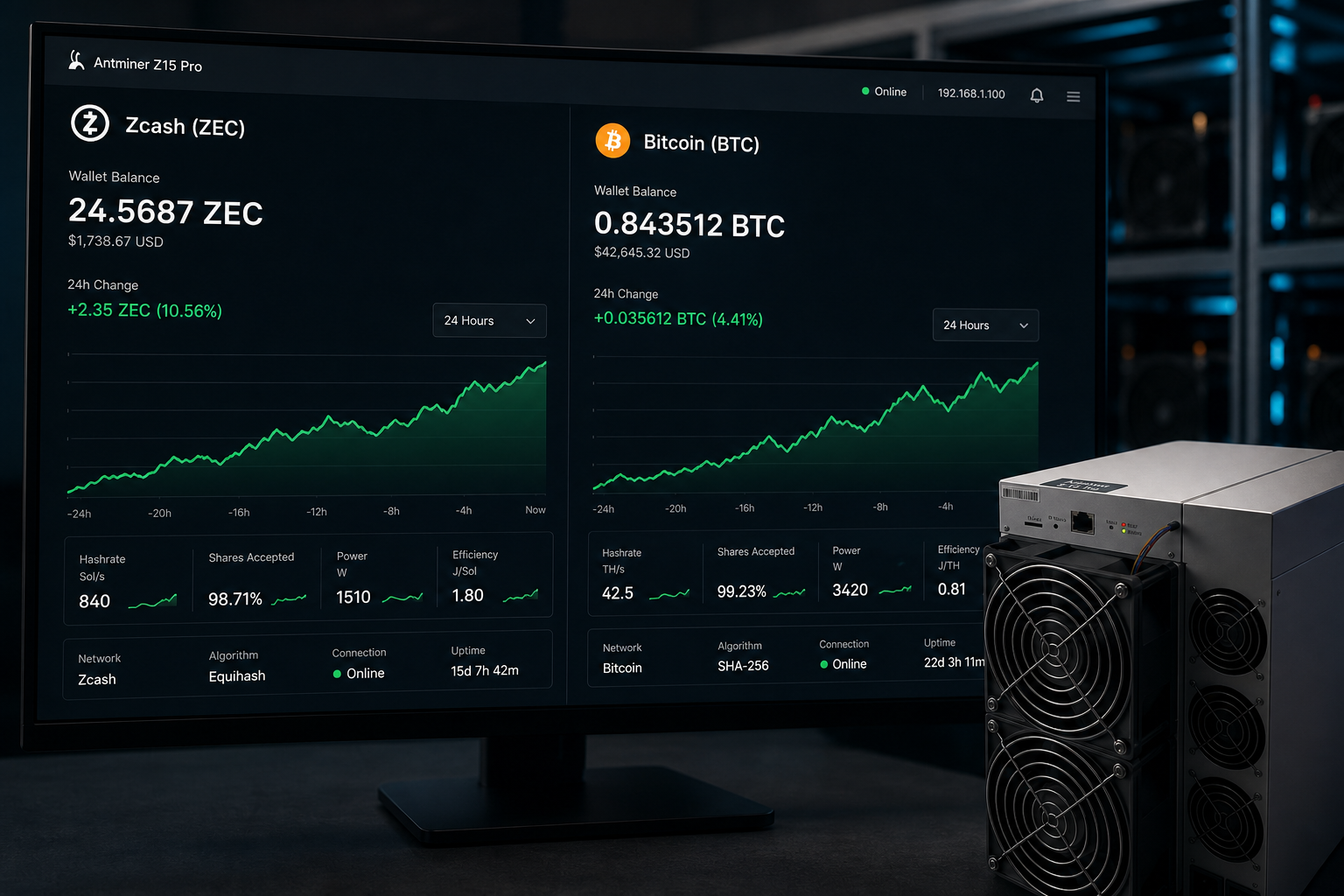
Luxor is a US-based mining pool and infrastructure provider that serves professional ASIC operators. Equihash is the proof-of-work algorithm used by Zcash (ZEC), and ASIC miners like the Z15 Pro are purpose-built to compute it efficiently. Luxor is best understood here as the native-ZEC option: miners keep direct ZEC exposure and use Luxor infrastructure rather than auto-converting earnings into BTC.
Based on Luxor documentation reviewed on May 25, 2026, its ZCash mining setup page lists a 3.00% discount to FPPS, and its payments page lists a 0.1 ZEC minimum payout threshold plus a ZEC withdrawal fee. Because pool policies can change, miners should confirm the current Luxor dashboard terms before pointing production hashrate at the pool.
Key Specifications
- Published cost: 3.00% discount to FPPS, based on Luxor documentation reviewed May 25, 2026
- Payout currency: ZEC (native)
- Minimum payout: 0.1 ZEC, based on Luxor payments documentation
- Payout style: FPPS-style smoothing for more predictable revenue than luck-based mining
- Stratum servers: North America and Europe endpoints
- Dashboard: Hashrate monitoring, worker stats, and earnings history
What to Consider
Luxor can still make sense for miners who want native ZEC payouts, professional infrastructure, and predictable accounting. The tradeoff is cost: at a 3% FPPS discount, Luxor is not the lowest-cost option in this comparison. If your goal is simply to maximize fee-adjusted daily revenue or accumulate BTC automatically, Unmineable or NiceHash may fit better depending on your payout preference.
For miners with low-cost electricity who want direct ZEC exposure and are comfortable with Luxor’s payout threshold, Luxor remains a credible ZEC-focused option. For miners optimizing strictly around platform fee, it should no longer be described as the cheapest choice without checking current terms.
Pool #2 – Unmineable: Mine Equihash, Get Paid in BTC or Other Coins
Unmineable operates as an auto-conversion pool: your Z15 Pro mines through an Equihash endpoint, and the platform pays out in BTC or another supported coin instead of requiring you to manage ZEC manually. The result is BTC accumulation without running your own exchange workflow.
Key Specifications
- Fee: 1.0% standard, or 0.75% when a valid referral code is used
- Payout currency: BTC, ETH, ZEC, or many other supported options
- Minimum payout: varies by selected payout coin; confirm the current coin page before mining
- Payout model: pool-style variable payouts rather than Luxor-style FPPS smoothing
- ASIC Equihash stratum: stratum+tcp://equihash.unmineable.com:3333 or :13333, based on unMineable ASIC setup documentation
What to Consider
Unmineable is attractive when the operator wants payout flexibility more than native ZEC exposure. The standard 1% fee is lower than the Luxor and NiceHash cost assumptions used in this comparison, and the referral-rate option can reduce that further. The tradeoff is that revenue may feel less predictable than an FPPS-style pool, and auto-conversion means your final return depends on the platform’s payout and conversion mechanics.
For a Z15 Pro owner who wants BTC payouts without an exchange account, Unmineable is the most direct competitor to NiceHash. It keeps the workflow simple while avoiding the additional marketplace-demand variable that comes with selling hashrate on NiceHash.
Note: Always use the Equihash ASIC stratum for Z15 Pro setup. RandomX endpoints are for different hardware and should not be used with an Equihash ASIC.
Pool #3 — NiceHash: Selling Equihash Hashpower for BTC
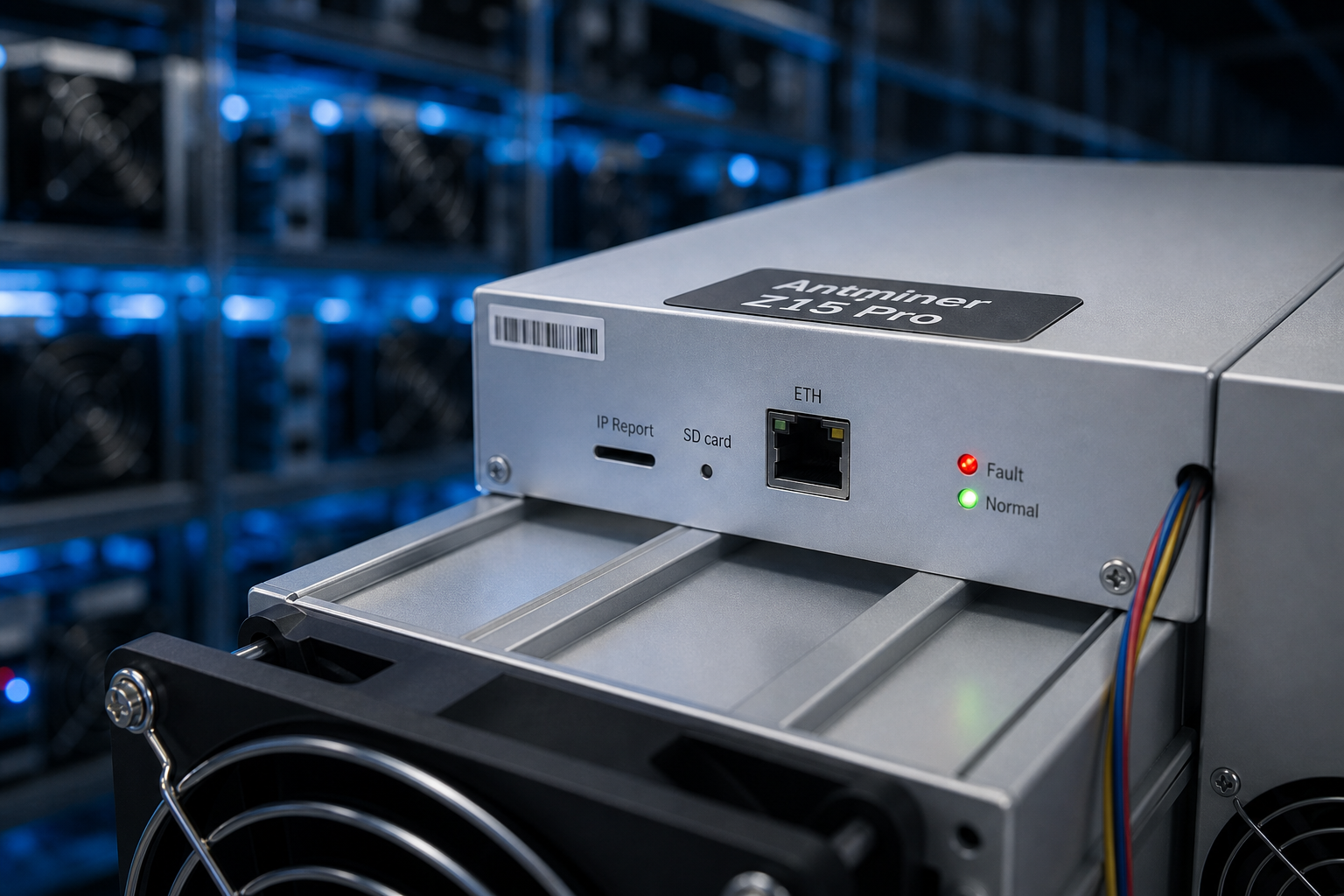
NiceHash operates differently from the other two. Rather than mining ZEC directly, your Z15 Pro sells its Equihash hashpower on NiceHash’s marketplace to buyers who use that capacity for their own purposes. You receive BTC payment based on the real-time market price those buyers are willing to pay for Equihash throughput.
Key Specifications
- Effective cost assumption: about 2% for this comparison, with final earnings driven by marketplace pricing and NiceHash fee policy
- Payout currency: BTC
- Minimum withdrawal: varies by withdrawal route; confirm the current NiceHash fee schedule before mining
- Payout model: Marketplace pricing (varies with Equihash buyer demand)
- Stratum: equihash.eu.nicehash.com / equihash.usa.nicehash.com
What to Consider
NiceHash’s marketplace model means earnings can fluctuate based on buyer demand for Equihash capacity, independently of ZEC price movements. During periods of high Equihash demand — often correlated with ZEC price rallies — NiceHash rates can be competitive. During low-demand periods, the marketplace rate may underperform direct ZEC mining. This introduces a second variable that Luxor and Unmineable do not expose you to.
The 2% effective cost assumption is lower than the Luxor 3% FPPS-discount assumption but higher than Unmineable’s standard 1% fee. The real question is not only fee level; it is whether NiceHash marketplace demand is strong enough to match or beat direct ZEC-implied returns after fees.
NiceHash’s primary use case is for miners who want BTC payouts, prefer not to manage exchange accounts, and value having a single platform handle hardware monitoring, profitability reporting, and payouts. For a dedicated ZEC ASIC like the Z15 Pro, NiceHash’s algorithm-switching feature (useful for GPU miners) adds no value — the hardware is Equihash-only.
Side-by-Side Pool Comparison
| Feature | Luxor | Unmineable | NiceHash |
|---|---|---|---|
| Primary role | Native ZEC pool | Auto-conversion pool | Hashpower marketplace |
| Cost assumption | 3.00% FPPS discount | 1.0% standard / 0.75% referral | ~2.0% effective assumption |
| Payout currency | ZEC | BTC, ZEC, or many other options | BTC |
| Payout style | FPPS-style smoothing | Variable pool payout / auto-conversion | Marketplace rate |
| Minimum payout | 0.1 ZEC per Luxor docs | Varies by payout coin | Varies by withdrawal route |
| ZEC price exposure | Full if ZEC is held | Depends on payout coin | None after BTC payout |
| Equihash demand exposure | No direct marketplace exposure | No direct marketplace exposure | Yes |
| Estimated annual platform cost | ~$623/yr | ~$208/yr standard | ~$415/yr |
| Best fit | Native ZEC + payout smoothing | Lower-fee BTC or multi-coin payouts | BTC payout via hashpower marketplace |
Net Revenue Impact: Z15 Pro Across Electricity Rates
The table below shows estimated daily net earnings after platform costs and electricity, based on current assumptions of ZEC at $673.24, Z15 Pro specifications of 840 KSol/s and 2,780W, and $56.89 gross/day. The current BT-Miners product page lists the Z15 Pro from US$4,900, so the ROI table below uses a USD 4,900 purchase price.
| Platform | Cost assumption | $0.04/kWh | $0.07/kWh | $0.10/kWh | $0.12/kWh | $0.15/kWh |
|---|---|---|---|---|---|---|
| Luxor | 3.0% | $52.51 | $50.51 | $48.51 | $47.18 | $45.18 |
| Unmineable | 1.0% | $53.65 | $51.65 | $49.65 | $48.31 | $46.31 |
| NiceHash | 2.0% | $53.08 | $51.08 | $49.08 | $47.75 | $45.74 |
Note: Figures assume stable ZEC price and Equihash network difficulty. NiceHash marketplace rates can vary from ZEC spot-implied pricing during low-demand periods. Model your specific scenario using the BT-Miners profitability calculator.
ROI by Pool at a USD 4,900 Purchase Price
| Platform | $0.04/kWh | $0.07/kWh | $0.10/kWh | $0.12/kWh | $0.15/kWh |
|---|---|---|---|---|---|
| Luxor | 3.1 mo | 3.2 mo | 3.4 mo | 3.5 mo | 3.6 mo |
| Unmineable | 3.0 mo | 3.2 mo | 3.3 mo | 3.4 mo | 3.5 mo |
| NiceHash | 3.1 mo | 3.2 mo | 3.3 mo | 3.4 mo | 3.6 mo |
The ROI gap across platforms is smaller than the impact of ZEC price, network difficulty, electricity rate, and uptime. A ZEC price retracement would extend payback across all platforms, while a sustained ZEC rally would shorten it. Pool selection mainly controls payout currency, payout consistency, and how much margin is lost to platform costs.
Which Pool Fits Your Strategy?
Choose Luxor if you want native ZEC payouts, FPPS-style revenue smoothing, and professional mining infrastructure. The key caveat is cost: with the current 3.00% FPPS-discount reference, Luxor should be framed as the predictable native-ZEC option, not the lowest-fee option.
Choose Unmineable if you want a lower standard fee and automatic BTC or multi-coin payouts without setting up your own exchange workflow. For Z15 Pro owners who want BTC-denominated treasury management, Unmineable is often the cleanest convenience path as long as you use the correct Equihash ASIC stratum.
Choose NiceHash if you want BTC payouts through a hashpower marketplace and are comfortable with marketplace-rate variability. NiceHash can be competitive when Equihash buyer demand is strong, but it is not a standard ZEC pool and should not be evaluated as one.
One variable not fully captured in static fee tables: Equihash buyer demand on NiceHash. During ZEC price rallies, buyers may bid more for Equihash hashpower, which can push NiceHash effective returns toward direct pool mining rates. During quiet markets, NiceHash rates can lag. Miners who need predictable accounting usually prefer pool-style payouts over marketplace-dependent pricing.
Bottom Line
The Antminer Z15 Pro generates positive modeled returns across all three platforms at the assumptions used here. Pool selection does not decide whether the hardware is profitable; ZEC price, network difficulty, uptime, and electricity cost matter more. What pool selection changes is payout currency, payout consistency, and annual platform cost.
Among these three options, Unmineable currently looks strongest for lower-fee BTC or multi-coin payout convenience. Luxor is the stronger fit for miners who want native ZEC and FPPS-style smoothing, even though the current published cost reference is higher. NiceHash is most relevant for miners who want BTC payout through a marketplace and are willing to monitor Equihash buyer demand.
If you are still evaluating whether the Z15 Pro fits your operation, run your electricity rate through the BT-Miners profitability calculator, compare available ZEC miners, and review the Z15 Pro hosting option if you prefer hosted deployment. If the entry price is a constraint, compare the Antminer Z15 standard, which mines the same Equihash algorithm at lower hashrate and lower upfront cost.
Sources Checked
- Luxor mining setup documentation
- Luxor revenue and payments documentation
- unMineable ASIC setup documentation
- BT-Miners Antminer Z15 Pro product page
FAQ: ZEC Mining Pools for Antminer Z15 Pro
Which pool is best for Antminer Z15 Pro ZEC mining in 2026?
There is no single best platform for every miner. Unmineable is the stronger lower-fee choice for BTC or multi-coin payout convenience, Luxor is better for native ZEC payouts with FPPS-style smoothing, and NiceHash is best viewed as a BTC-paying Equihash hashpower marketplace rather than a standard ZEC pool.
Does pool fee matter more than ZEC price?
No. Pool fee matters, but ZEC price, network difficulty, machine uptime, and electricity cost usually have a larger effect on final ROI. Fees should be compared after calculating gross and net mining revenue.
Can Antminer Z15 Pro mine Bitcoin?
No. Antminer Z15 Pro is built for Equihash mining, which is used by Zcash and related coins. Bitcoin uses SHA-256 hardware, so Bitcoin ASICs and ZEC ASICs are not interchangeable.
Which Unmineable stratum should Z15 Pro miners use?
Z15 Pro miners should use unMineable Equihash ASIC stratum, such as stratum+tcp://equihash.unmineable.com:3333 or :13333. RandomX endpoints are for different hardware and should not be used with an Equihash ASIC.
Should miners choose BTC payouts or ZEC payouts?
BTC payouts can simplify treasury management, while ZEC payouts preserve direct exposure to Zcash. The better choice depends on whether the miner wants operational simplicity, BTC accumulation, or coin-specific ZEC upside.
Page scope: pool-selection guidance for Equihash mining. Product details and current purchase options belong on the Antminer Z15 Pro product page and Antminer Z15 product page.