Monero Mining in 2025–2026: XMR Hardware, ROI & RandomX Guide
XMR Price Reality, RandomX Mining, and What to Expect From Antminer X5 & X9
1. Introduction: Why Monero Mining Still Deserves Attention
As the crypto mining industry moves from 2025 into 2026, the mindset of miners has become noticeably more pragmatic.
Instead of chasing short-term hype cycles or aggressively speculating on price spikes, many miners are now prioritizing network fundamentals, hardware efficiency, and long-term operational sustainability. This shift reflects a broader maturation of the mining market.
In this environment, Monero (XMR) continues to stand out. While other proof-of-work networks fluctuate between narratives, Monero has remained consistent in its purpose and design.
With dedicated Monero mining hardware such as Antminer X5 already deployed at scale—and the next-generation Antminer X9 approaching—miners are reassessing whether XMR still fits into a forward-looking mining strategy for 2026 and beyond.
2. What Is Monero (XMR)?
A Privacy-First Digital Currency
Monero (XMR) was launched in 2014 with a clear and focused mission: to function as private, fungible digital cash.
Unlike transparent blockchains where transaction data can be traced and analyzed, Monero is designed so that:
- Sender addresses are hidden
- Receiver addresses are hidden
- Transaction amounts remain confidential
This privacy-by-default approach ensures that every XMR coin is interchangeable, meaning there is no concept of “tainted” or “clean” coins. From a monetary perspective, this fungibility is a core requirement for any asset intended to function as real digital cash.
Why Monero Matters to Miners
For miners, Monero’s value lies less in speculation and more in continuity.
Over multiple market cycles, Monero has demonstrated:
- Consistent network usage
- Active protocol development
- Resistance to external pressure and censorship
- A strong, technically engaged community
Because of this, Monero mining tends to attract operators who are comfortable with longer time horizons, where stability and predictability matter more than rapid short-term returns.
3. How RandomX Mining Works
Understanding the RandomX Algorithm
Monero uses RandomX as its proof-of-work consensus algorithm.
RandomX was designed specifically to discourage extreme mining centralization. Instead of relying on simple, repetitive hashing operations, RandomX:
- Executes randomized programs
- Uses large memory datasets
- Emphasizes CPU-like computation and memory access
This design increases the complexity and cost of developing dominant mining architectures, helping to preserve a more balanced mining ecosystem over time.
How RandomX Influences Mining Efficiency
Because RandomX prioritizes memory usage and general computation, mining efficiency is determined by more than raw hashrate.
Key factors include:
- Memory bandwidth and latency
- Power efficiency under sustained load
- Thermal stability during long runtimes
Over time, dedicated Monero mining hardware has evolved to deliver consistent RandomX performance while maintaining predictable energy consumption—making it suitable for miners focused on multi-year operation rather than short-term experimentation.
4. XMR Price Performance in 2025: Stability Over Speculation
Throughout 2025, Monero’s price behavior reflected a maturing and more disciplined market.
Rather than extreme volatility, XMR traded within relatively defined ranges for much of the year. While short-term price movements still occurred, they were less disruptive to long-term mining operations compared to earlier cycles.
From a miner’s perspective, 2025 highlighted several important realities:
- Price stability reduced operational uncertainty
- Sideways markets rewarded efficient miners
- Long-term participation proved more resilient than speculative entry
For many operators, 2025 reinforced the idea that XMR mining is best approached as a steady process, not a timing game.
5. The Monero Mining Environment in 2025
Beyond price, the mining environment itself became more predictable in 2025.
Network difficulty adjustments were gradual rather than abrupt, and global hashrate growth reflected measured hardware deployment instead of sudden influxes. This allowed miners to better forecast costs, manage uptime, and plan equipment lifecycles.
Key characteristics of the 2025 environment included:
- Stable block production
- Gradual difficulty changes
- Reduced “hardware arms race” behavior
Such conditions favor miners who operate efficiently and maintain disciplined infrastructure management.
6. Antminer X5 in 2025: A Proven RandomX Miner
Antminer X5 became one of the most widely recognized Monero mining machines in 2025.
By this stage, X5 was no longer evaluated solely on specifications. Instead, miners assessed it based on months of continuous real-world operation.
Common observations from X5 deployments included:
- Stable RandomX hashrate over extended runtimes
- Predictable and manageable power consumption
- Consistent thermal behavior with proper airflow
- Minimal need for tuning or frequent intervention
For many miners, X5 represented a shift from experimentation toward repeatable, industrial-grade execution.
7. Antminer X9: Expectations Moving Into 2026
Antminer X9 enters the market as miners increasingly think in multi-year terms.
Interest in X9 is driven less by hype and more by efficiency economics. As mining margins compress, even incremental improvements in performance-per-watt can significantly influence long-term outcomes.
Miners considering X9 are often focused on:
- Extending hardware relevance into 2026 and beyond
- Reducing operational risk through efficiency gains
- Aligning new deployments with long-term infrastructure planning
While real-world data will ultimately determine X9’s impact, its anticipation reflects how much mining strategies have matured.
8. XMR Price Expectations for 2026: Cautious Optimism
Looking ahead to 2026, sentiment around XMR price is generally constructive but measured.
Rather than expecting dramatic price surges, many miners anticipate:
- Gradual range expansion compared to 2025
- Continued alignment with broader crypto market cycles
- Periods of consolidation punctuated by moderate upside
This outlook supports mining strategies based on steady accumulation and cost control, rather than reliance on short-term price appreciation.
9. Mining Profitability Going Into 2026: What Really Matters
As always, mining profitability is determined by multiple interacting factors rather than a single metric.
Heading into 2026, the most important considerations remain:
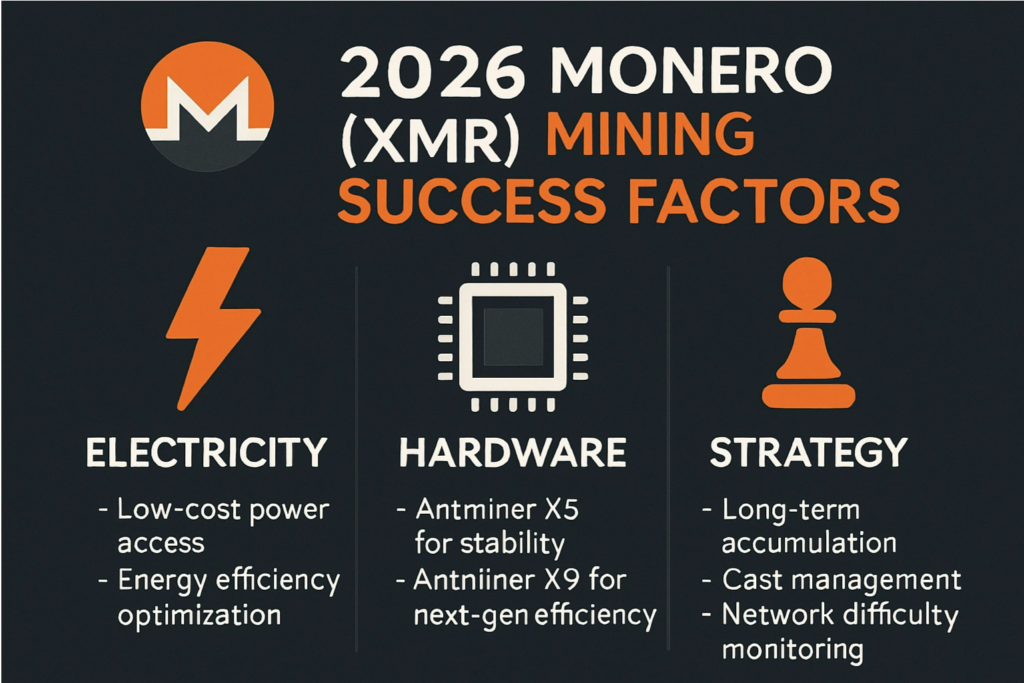
- Electricity cost and energy efficiency
- Hardware uptime and reliability
- Network difficulty trends
- Realistic assumptions about future price behavior
Many experienced miners now measure success not by peak-month profitability, but by whether an operation can remain viable through multiple market phases without excessive stress.
10. Antminer X5 vs X9: Choosing Based on Strategy
The decision between deploying X5 now or waiting for X9 reflects broader strategic priorities.
Antminer X5 may suit miners who:
- Want immediate exposure to XMR mining
- Prefer proven, well-understood hardware
- Value predictable performance
Antminer X9 may suit miners who:
- Are planning new deployments in 2026
- Prioritize efficiency and long-term relevance
- Are upgrading existing infrastructure
| Feature | Antminer X9 Monero Miner 1M | Antminer X5 Monero Miner 212K |
| Hashrate | ~1 MH/s (1000 KH/s) | ~212 KH/s |
| Algorithm | RandomX (Monero) | RandomX (Monero) |
| Power Consumption | ~2472 W | ~1350 W |
| Efficiency | ~2.47 J/Kh | ~6.37 W/KH |
| Cooling | Air cooling | Air cooling |
| Target Miner | High-performance mining rigs | Lower-power Monero setups |
| Relative Speed | ~4.7x faster hashing | Baseline |
Neither choice is universally better—the right option depends on timing, power cost, and risk tolerance.
11. Final Thoughts: Mining Monero With Clarity Into 2026
As the industry moves deeper into 2026, Monero mining continues to reward clarity and discipline over speculation.
Understanding what Monero represents, how RandomX shapes mining behavior, and how hardware choices align with long-term price expectations is essential for sustainable operation.
Whether running Antminer X5 today or preparing for Antminer X9, miners who plan thoughtfully and manage costs carefully are best positioned for the years ahead.
At BT-MINERS, we continue to monitor Monero mining hardware and network conditions closely—focusing on real-world performance and long-term sustainability rather than short-term narratives.
Thank you for your patient reading. For any inquiries or to explore these miners further, welcome to contact BT-MINERS.
12. Frequently Asked Questions
Is Monero mining still worth it in 2026?
For miners with efficient power access and realistic expectations, XMR mining remains a viable long-term strategy.
How does RandomX affect Monero mining hardware?
RandomX emphasizes memory and general computation, making efficiency and thermal stability more important than raw hashrate alone.
Should I deploy Antminer X5 now or wait for X9?
The choice depends on deployment timing, electricity cost, and whether you prioritize immediate operation or long-term efficiency.