Kaspa Mining in 2026: Is KAS Still Profitable? Complete ROI Analysis for Every Miner
⚠️ Disclaimer: Mining profitability estimates are based on current coin prices, network difficulty, and $0.07/kWh electricity cost. These figures change daily. Always conduct your own research before purchasing mining equipment.
Kaspa (KAS) was one of the most talked-about mining opportunities when dedicated ASIC hardware first arrived in 2023. The promise was compelling: a novel blockDAG architecture, fast block times, and a coin that seemed built for high-efficiency mining. Fast-forward to April 2026, and the reality looks very different. With KAS trading at $0.0346 and network difficulty at multi-year highs, the vast majority of Kaspa ASIC miners are now operating at a loss on standard electricity rates. This guide breaks down exactly where every major Kaspa miner stands today — and whether any unit still justifies a new purchase.
How the ASIC Era Transformed Kaspa Mining
Kaspa launched in 2021 on the GhostDAG proof-of-work protocol, initially accessible to GPU miners. The coin’s kHeavyHash algorithm was fast by design, but ASIC manufacturers moved quickly. By late 2023, hardware from Bitmain (KS-series), IceRiver, DragonBall, and Goldshell had flooded the market, collectively driving Kaspa’s network hashrate from a few petahashes to over 1 exahash per second within 18 months.
That hashrate explosion had a predictable effect: mining rewards per terahash collapsed. At the same time, KAS reached an all-time high above $0.20 in 2024 before retreating sharply. Today’s spot price of $0.0346 sits roughly 83% below that peak, squeezing gross revenue from every miner on the market.
The result is a bifurcated landscape. High-efficiency machines with favorable power draws can still generate positive returns at reasonable electricity rates. Legacy models and power-hungry mid-range units now consume more in electricity than they earn — a condition called mining below the shutdown threshold. Understanding where each machine sits on that line is critical before committing capital to Kaspa mining in 2026.
KAS Miner Profitability at $0.07/kWh: Full ROI Breakdown
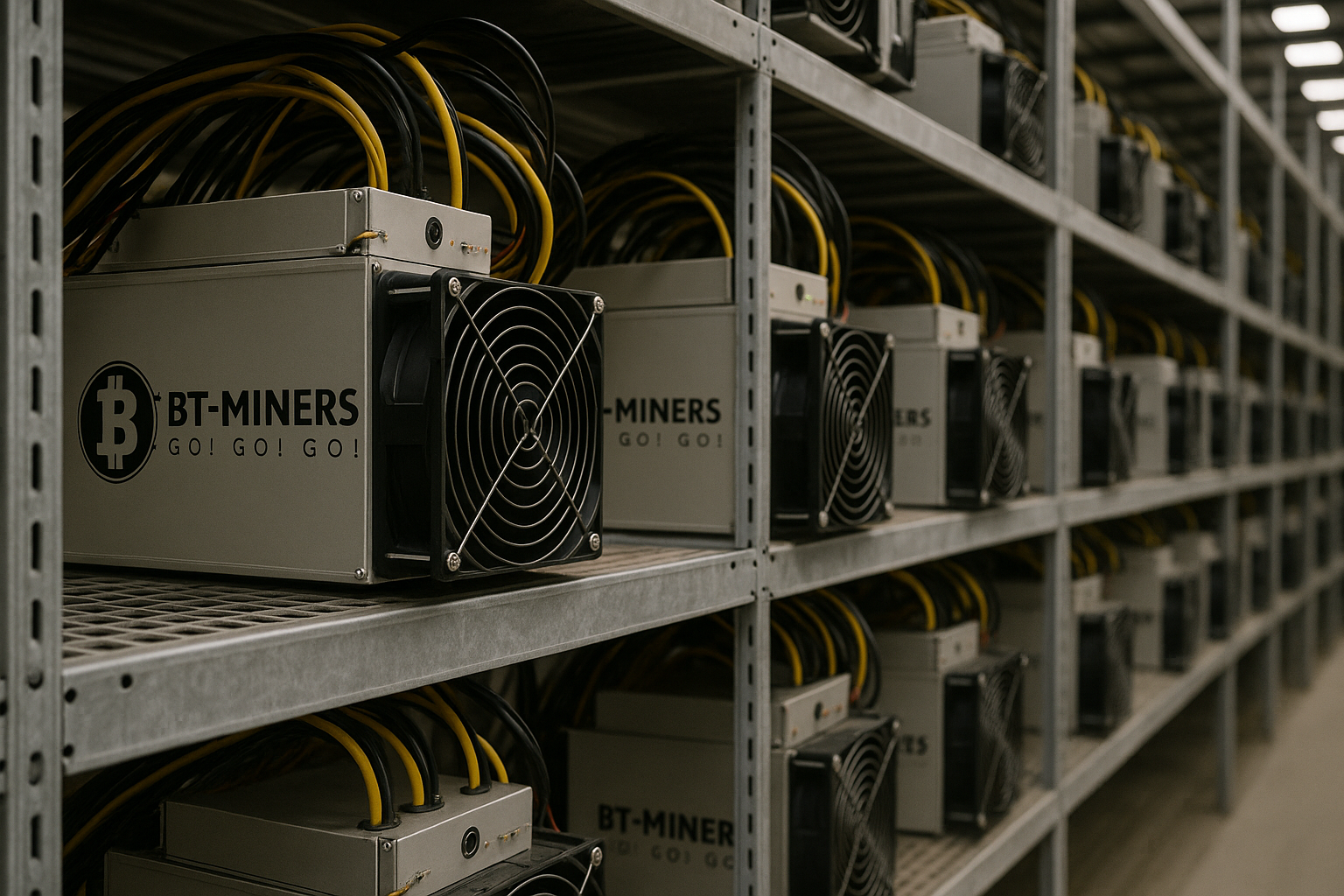
The table below covers all major Kaspa ASIC models currently available at BT-Miners, sorted by net daily profit. Electricity cost is calculated at $0.07/kWh — a standard residential and co-location benchmark. All net figures use the formula:
Net Daily = Gross Daily − (Power (W) × 24 ÷ 1000 × $0.07)
Data as of April 23, 2026. KAS price: $0.0346. Hardware prices subject to change.
| Miner Model | Hashrate | Power | Price | Gross/Day | Elec/Day | Net/Day | ROI |
|---|---|---|---|---|---|---|---|
| Antminer KS7 | 36 TH/s | 2,772 W | $1,700 | $7.60 | $4.66 | $2.94 | 19.3 months |
| IceRiver KS7 | 30 TH/s | 3,500 W | $1,990 | $6.33 | $5.88 | $0.45 | 147 months |
| Antminer KS5 Pro | 21 TH/s | 3,150 W | $1,450 | $4.43 | $5.29 | -$0.86 | Loss |
| Antminer KS5 | 20 TH/s | 3,000 W | $350 | $4.22 | $5.04 | -$0.82 | Loss |
| IceRiver KS5M | 15 TH/s | 3,400 W | $490 | $3.17 | $5.71 | -$2.54 | Loss |
| IceRiver KS5L | 12 TH/s | 3,400 W | $480 | $2.53 | $5.71 | -$3.18 | Loss |
| Antminer KS3 | 9.4 TH/s | 3,500 W | $1,300 | $1.98 | $5.88 | -$3.90 | Loss |
| IceRiver KS3 | 8 TH/s | 3,200 W | $1,950 | $1.69 | $5.38 | -$3.69 | Loss |
| Goldshell E-KA1M | 5.5 TH/s | 1,800 W | $990 | $1.16 | $3.02 | -$1.86 | Loss |
| Goldshell KA Box Pro | 1.6 TH/s | 600 W | $399 | $0.34 | $1.01 | -$0.67 | Loss |
Color key: Green = profitable at $0.07/kWh | Yellow = technically positive, impractical ROI | Red = operating at a net loss
The numbers are stark. Of the 23 Kaspa ASIC models tracked at BT-Miners, only the Antminer KS7 (36 TH/s) generates a meaningful positive return at standard electricity rates. The IceRiver KS7 technically earns $0.45/day net, but its 147-month ROI renders the purchase economically nonviable. Roughly 87% of KAS miners on the market are currently losing money at $0.07/kWh.
Why Most KAS ASICs Are Operating at a Loss in 2026
Three compounding factors explain the current situation: network difficulty growth, unfavorable power-to-hashrate ratios, and sustained coin price weakness.
Network Difficulty Outpaced Hardware Efficiency
When early KS3 and KS5-series machines launched in 2023–2024, Kaspa’s network hashrate was low enough for even moderate hardware to mine profitably. Manufacturers responded aggressively — releasing increasingly powerful units from KS5 at 20 TH/s, to KS6 variants at 10.5 TH/s, to the KS7 at 36 TH/s. Each new wave added to total network hashrate, forcing all previous-generation hardware into deeper negative territory. If network hashrate doubles while coin price stays flat, per-unit revenue halves. That math is unforgiving, and it has played out repeatedly in Kaspa’s ecosystem.
High Power Draw Is a Structural Problem
Most KAS miners in the 8–21 TH/s range consume between 3,000 W and 3,500 W — a power footprint comparable to a premium Bitcoin ASIC, but with a fraction of the gross revenue. At $0.07/kWh, a 3,400 W miner burns $5.71 per day in electricity alone. When KAS at $0.0346 yields only $1.27–$4.43/day gross for those models, the electricity cost swamps any potential earnings.
The Antminer KS7’s survival in positive territory is not because it earns dramatically more per terahash — it’s because Bitmain engineered a more efficient power-to-hashrate ratio: 2,772 W for 36 TH/s versus 3,000 W for only 20 TH/s on the KS5. That efficiency difference is the only reason it remains marginally viable.
KAS Price Has Not Recovered
At $0.0346, KAS is trading at roughly 17% of its 2024 peak. Mining revenue moves directly with coin price, so a sustained recovery toward $0.07–$0.10 would flip several KS5-series machines back into profitability. However, purchasing hardware in anticipation of a price recovery is a speculative bet — and any price surge would also attract additional mining activity, raising network difficulty and moderating the gain. The net improvement in profitability is typically smaller than the raw price move suggests.
What to Mine Instead: ZEC and XMR Offer 8–14 Month ROI in 2026
For miners who want a realistic capital recovery timeline in 2026, the strongest opportunities are in Zcash (ZEC) and Monero (XMR) — two established privacy coins with dedicated ASIC hardware offering payback measured in months, not years.
Data as of April 23, 2026. ZEC price: $320.00 | XMR price: $375.55. Electricity: $0.07/kWh. Hardware prices subject to change.
| Miner | Algorithm | Power | Price | Gross/Day | Elec/Day | Net/Day | ROI |
|---|---|---|---|---|---|---|---|
| Antminer Z15 Pro | Equihash (ZEC) | 2,780 W | $3,700 | $18.94 | $4.67 | $14.27 | 8.6 months |
| Antminer Z15 | Equihash (ZEC) | 1,510 W | $2,800 | $9.18 | $2.54 | $6.64 | 14.0 months |
| Antminer X9 | RandomX (XMR) | 2,472 W | $5,600 | $25.34 | $4.15 | $21.19 | 8.8 months |
The contrast with Kaspa is significant. The Antminer Z15 Pro returns capital in under 9 months at current ZEC prices and standard electricity rates. The Antminer X9 — the only dedicated Monero ASIC currently on the market — achieves a similar 8.8-month payback. Even the entry-level Antminer Z15 hits ROI inside 14 months.
Why do ZEC and XMR hold up better than KAS? Both coins have maintained healthier price levels relative to their network difficulty growth. ZEC’s Equihash algorithm has a more limited ASIC ecosystem, which restrains the hashrate arms race. XMR’s RandomX was explicitly designed to resist ASIC mining — the Antminer X9 is a rare exception, and its first-mover advantage on the algorithm translates directly to stronger per-unit earnings.
To model profitability at your specific electricity rate — from $0.04/kWh co-location to $0.12/kWh residential — use the BT-Miners Daily Income Calculator, which pulls live coin prices and updates in real time.
Should You Buy a KAS Miner in 2026?
The practical answer: only the Antminer KS7 is worth considering, and only if your electricity rate is $0.07/kWh or lower.
At a 19-month ROI, the KS7 is workable — particularly if you believe KAS has room to recover toward $0.05–$0.07. A recovery in that range would shorten payback to approximately 10–13 months and flip several other KS-series models back into positive territory. The risk is that you’re making a speculative bet on a specific coin recovery while locking capital in hardware that represents the lone exception in an otherwise unprofitable category.
For miners who want predictability at current prices, ZEC and XMR hardware offers meaningfully clearer outcomes. If you already own KAS miners that are currently losing money, the calculus is different: whether to power down, sell the hardware, or wait for a price recovery depends on your electricity cost, hardware resale value, and conviction in KAS’s long-term trajectory.
BT-Miners offers professional co-location hosting at electricity rates below $0.07/kWh, which can extend the viable window for marginal KAS hardware and improve net returns across all miner types. Contact our team to discuss hosting or to explore ZEC and XMR hardware options.
Frequently Asked Questions
Is Kaspa mining profitable in 2026?
Only the Antminer KS7 (36 TH/s, 2,772 W) generates a meaningful positive return at $0.07/kWh, earning approximately $2.94/day net with a ~19-month ROI. The majority of KAS ASIC models — including the KS5, KS5 Pro, KS3, and most IceRiver variants — are currently operating at a net loss due to high power consumption relative to gross revenue at today’s KAS price of $0.0346.
What happened to Kaspa mining profitability?
Two factors converged: KAS price declined roughly 83% from its 2024 peak, while network hashrate surged dramatically after multiple manufacturers released high-power ASIC hardware throughout 2023–2024. Per-unit mining rewards shrank while electricity costs stayed fixed, pushing most hardware below the profitability threshold.
What electricity rate is needed for KAS mining to break even?
For the Antminer KS7 (36 TH/s), the electricity breakeven is approximately $0.088/kWh. Below that rate, the KS7 earns a positive return. For most other KAS miners — the KS5, KS3, and IceRiver KS5M — the breakeven falls below $0.02–$0.03/kWh, rates generally unavailable for commercial or residential operations.
Which coins are better to mine than KAS in 2026?
Based on current prices and network difficulty, ZEC (Zcash) and XMR (Monero) both offer superior ROI timelines. The Antminer Z15 Pro returns capital in approximately 8.6 months at $0.07/kWh; the Antminer X9 achieves payback in roughly 8.8 months. INITVERSE (mined by the Matches INIBOX PRO) also delivers a strong ~5-month ROI at current conditions — the best in the market today.
Will KAS mining become profitable again?
A sustained KAS price recovery toward $0.07–$0.10 would restore profitability for a wider range of KAS ASICs. However, price rallies typically attract more mining activity, which raises network difficulty and partially offsets the gain. Miners with low electricity costs and existing hardware may choose to continue operating; new hardware purchases for KAS should be approached with caution unless you have strong conviction on a price recovery and electricity rates below $0.07/kWh.