Home Mining vs Co-Location Hosting in 2026: Which Maximizes Your ASIC ROI?
If you’re running an Antminer Z15 Pro on $0.12/kWh residential electricity, you’re leaving over $1,200 in annual profit on the table compared to co-location hosting. That gap is exactly what this guide quantifies — because the home-vs-hosting decision is one of the most financially significant choices any ASIC miner makes, yet most guides skip the actual numbers.
In April 2026, with ZEC at $320.00 and XMR at $375.55, the Z15 Pro and Antminer X9 are delivering some of the strongest ASIC ROIs on the market. Getting your operating cost structure right can mean the difference between a 9-month payback and a 14-month slog — and the decision of where your hardware runs is central to that outcome.
⚠️ Disclaimer: Mining profitability estimates are based on current coin prices (ZEC $320.00, XMR $375.55, as of April 24, 2026), current network difficulty, and electricity rates stated per scenario. These figures change daily. Always conduct your own research before purchasing mining equipment.
The Real Cost of Home ASIC Mining
The electricity bill is only one layer of the true cost of running an ASIC at home. Before any comparison with hosting is meaningful, you need to account for every cost component — upfront and ongoing.
Electricity: The Big Variable
Residential electricity rates in the US range from around $0.08/kWh in parts of the Pacific Northwest to $0.22/kWh in California and the Northeast. The national average sits at $0.12–$0.14/kWh. For high-wattage machines like the Antminer Z15 Pro (2,780W) or X9 (2,472W), this variation has a dramatic impact on net daily profit.
Data as of April 24, 2026. Hardware prices subject to change.
| Electricity Rate | Z15 Pro (2,780W) – Daily Cost | X9 (2,472W) – Daily Cost |
|---|---|---|
| $0.07/kWh | $4.67 | $4.15 |
| $0.10/kWh | $6.67 | $5.93 |
| $0.12/kWh | $8.01 | $7.12 |
| $0.15/kWh | $10.01 | $8.90 |
Hidden Infrastructure Costs
Beyond electricity, home miners typically face upfront and recurring costs that hosting customers avoid entirely:
- Dedicated 240V circuit installation: $300–$1,500 depending on panel capacity and distance. Many US homes require a panel upgrade to run even one 3kW ASIC continuously and safely.
- Cooling and ventilation: A Z15 Pro exhausts the equivalent heat of a space heater running 24/7. Routing hot exhaust outside requires ducting ($200–$800), or a dedicated portable A/C unit ($400–$1,200 purchase + ongoing power draw).
- Noise management: Industrial ASICs run at 70–85 dB — comparable to a running leaf blower. Soundproofing a utility room or garage costs $300–$1,200. Purpose-built enclosures run $500–$2,000.
- UPS and monitoring: An uninterruptible power supply to protect against brownouts adds $150–$400 upfront.
A conservative first-year estimate for home infrastructure: $1,000–$4,000 in one-time setup costs — before mining a single block. These costs are rarely factored into ROI projections, but they extend your real payback period meaningfully.
What Co-Location Hosting Offers

Co-location hosting means you own the hardware but it runs at a professional mining facility. The host provides physical space, power, cooling, internet, and basic monitoring. You pay either a flat monthly fee per machine or a per-kWh commercial rate plus a management fee.
Typical 2026 co-location cost models:
- All-inclusive flat rate: $50–$90/month per machine, covering power, cooling, rack space, and monitoring. Simplest to budget.
- Power pass-through: Commercial electricity at $0.055–$0.07/kWh plus $20–$50/month management fee. More favorable for high-wattage machines where the per-kWh savings compound.
What you gain with co-location:
- Commercial-grade cooling (extends hardware lifespan significantly)
- 24/7 on-site monitoring and reboots
- No noise, heat, or electrical strain on your home
- Redundant power and network uptime SLAs at professional facilities
- Zero upfront infrastructure investment
What you give up:
- Direct physical access to your hardware
- Trust requirement — you need a reliable, reputable operator
- Monthly management fees add overhead regardless of coin price
BT-Miners offers professional co-location hosting services — contact the team to discuss availability and pricing for your hardware configuration.
Side-by-Side ROI Comparison: Z15 Pro and X9 at Every Electricity Rate
The tables below show net daily profit and full ROI for the Antminer Z15 Pro and Antminer X9 — two of the strongest-performing ASICs currently available — across all common electricity scenarios, including co-location.
Net daily profit formula used throughout: Gross Daily − (Power (W) × 24 ÷ 1000 × $/kWh)
Data as of April 24, 2026. ZEC: $320.00. XMR: $375.55. Gross daily from bt-miners.com live feed. Co-location scenario: $0.065/kWh commercial power + $40/month management fee ($1.33/day). Hardware prices subject to change.
Antminer Z15 Pro — Net Daily Profit by Scenario
Machine price: $3,700 | Gross daily revenue: $18.94/day | Power draw: 2,780W
| Scenario | Daily Elec. Cost | Daily Mgmt Fee | Net Daily Profit | ROI (days) | ROI (months) |
|---|---|---|---|---|---|
| Home @ $0.07/kWh | $4.67 | — | $14.27 | 259 | 8.6 |
| Home @ $0.10/kWh | $6.67 | — | $12.27 | 301 | 10.0 |
| Home @ $0.12/kWh | $8.01 | — | $10.93 | 339 | 11.3 |
| Home @ $0.15/kWh | $10.01 | — | $8.93 | 414 | 13.8 |
| Co-Location @ $0.065 + $40/mo mgmt | $4.34 | $1.33 | $13.27 | 279 | 9.3 |
Antminer X9 — Net Daily Profit by Scenario
Machine price: $5,600 | Gross daily revenue: $25.34/day | Power draw: 2,472W
| Scenario | Daily Elec. Cost | Daily Mgmt Fee | Net Daily Profit | ROI (days) | ROI (months) |
|---|---|---|---|---|---|
| Home @ $0.07/kWh | $4.15 | — | $21.19 | 264 | 8.8 |
| Home @ $0.10/kWh | $5.93 | — | $19.41 | 288 | 9.6 |
| Home @ $0.12/kWh | $7.12 | — | $18.22 | 307 | 10.2 |
| Home @ $0.15/kWh | $8.90 | — | $16.44 | 341 | 11.4 |
| Co-Location @ $0.065 + $40/mo mgmt | $3.86 | $1.33 | $20.15 | 278 | 9.3 |
The crossover point is clear: if your home electricity rate is below $0.085/kWh, home mining wins on net daily profit. Above $0.10/kWh — which describes the majority of US residential customers — co-location delivers better economics while also eliminating all infrastructure overhead.
For the Z15 Pro specifically, a miner on $0.12/kWh at home earns $10.93/day net vs $13.27/day through co-location — a difference of $2.34/day or $854 per year per machine. That figure roughly equals the one-time infrastructure cost you also avoided.
Model your own electricity rate with the BT-Miners profitability calculator, which pulls live coin prices and updates in real time.
When Home Mining Is the Right Call
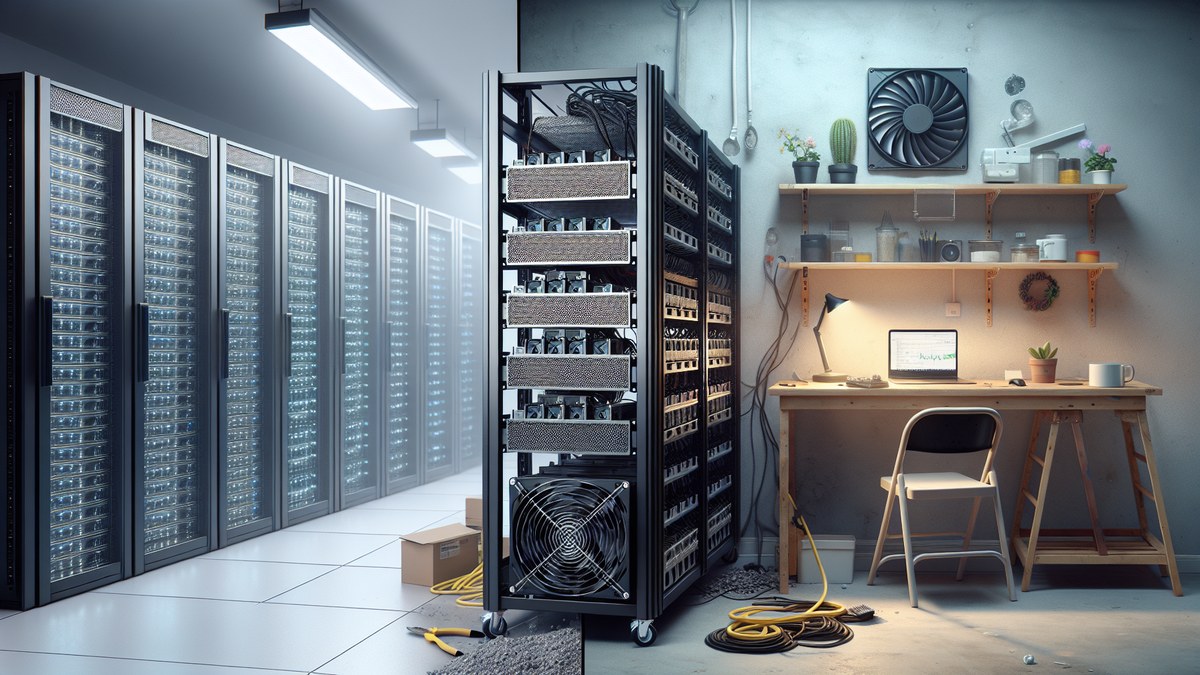
Home mining still makes strong economic sense under specific conditions. Don’t dismiss it outright — the numbers work very well when the circumstances align:
- Electricity under $0.08/kWh: Industrial power agreements, rural cooperative rates, net metering credits from solar, or naturally low-rate states (Idaho, Wyoming, Washington) can make home mining more profitable than co-location on a pure net-daily basis.
- Existing dedicated space: A garage, barn, or utility shed with adequate exhaust ventilation — away from living areas — eliminates most of the noise and heat overhead. If the infrastructure is already in place, the upfront cost argument against home mining weakens considerably.
- Running 1–2 machines: Hosting operators often charge higher per-unit rates for small deployments. Below 2–3 machines, the flat management fee per machine can erode much of the electricity cost savings.
- You want hands-on control: Direct access to hardware allows faster pool switching, firmware updates, and troubleshooting without depending on a third party. For technically inclined miners, this is a genuine advantage.
- Mining ZEC or XMR (favorable power-to-revenue ratio): The Z15 Pro and X9 have stronger gross-revenue-per-watt ratios than most BTC ASICs. Even at $0.10/kWh, both machines remain comfortably profitable — meaning the electricity rate threshold for home viability is more forgiving than with bitcoin hardware.
When Co-Location Hosting Is the Right Call
Co-location becomes the clear winner in a broader set of realistic scenarios:
- Residential electricity above $0.10/kWh: Every cent above $0.10 costs roughly $0.67/day per kW of mining hardware. On a Z15 Pro over one year, the gap between $0.10 and $0.14/kWh amounts to over $970 in lost profit — before accounting for the home infrastructure costs you also bear.
- No suitable dedicated space: Running a high-wattage ASIC indoors without proper ventilation shortens hardware lifespan, risks thermal damage, and in some configurations poses a fire hazard. Co-location solves this entirely.
- Scaling beyond 3–4 machines: At scale, co-location economics improve substantially. Commercial power rates, shared cooling infrastructure, and professional management become cost-effective on a per-unit basis.
- Passive income preference: Miners who travel, manage full-time jobs, or want a genuinely hands-off crypto income stream benefit from 24/7 facility management, remote monitoring dashboards, and on-site maintenance.
- High-wattage commercial hardware: The Antminer S23 Hyd 3U (11,020W) and L11 Hyd (5,775W) are effectively data center equipment. Running these at home is impractical for the vast majority of people — they require industrial cooling and dedicated electrical infrastructure that eliminates home deployment as a realistic option.
If you’re scaling up or running multiple high-wattage machines, explore BT-Miners’ hosting options for a customized quote. You can also contact the team directly to discuss your specific hardware and capacity requirements.
Frequently Asked Questions
At what electricity rate does home mining beat co-location for the Z15 Pro?
Based on April 2026 data (ZEC at $320.00, co-location modeled at $0.065/kWh + $40/month management), home mining generates higher net daily profit than co-location when your residential electricity rate is below approximately $0.085/kWh. At $0.07/kWh, home mining earns $14.27/day vs $13.27/day through co-location. Above $0.10/kWh, co-location wins on both net profit and eliminated infrastructure costs.
Does home mining void the ASIC warranty?
Most ASIC manufacturers — including Bitmain — do not void warranties solely because hardware is operated at home. However, warranties typically require operation within specified temperature and humidity ranges. Running a miner in a poorly ventilated space that causes thermal damage can void warranty coverage for heat-related failures. Professional co-location facilities maintain controlled environments that satisfy all manufacturer operating specifications.
Can I move my miner from home to a co-location facility after purchase?
Yes — you own the hardware and can ship it to a hosting facility at any point. The main practical considerations are shipping cost (typically $50–$150 one-way for a standard ASIC), the facility’s onboarding timeline, and any minimum commitment period the host requires. Contact BT-Miners to discuss current hosting availability and lead times.
Are hosting fees tax-deductible?
In the US, co-location hosting fees are generally deductible as a business expense for miners operating as a trade or business. Home miners may deduct electricity costs, hardware depreciation, and proportional home office expenses. The tax treatment of mining income and deductions is complex — consult a tax professional with crypto mining experience. This is not tax advice.
What is the minimum number of machines needed for co-location?
Requirements vary by facility. Some operators accept single-machine deployments; others set minimums of 3–5 units. BT-Miners’ hosting team can advise on current availability and whether your configuration qualifies — reach out here for a no-obligation conversation.