June 2026 ASIC Mining Outlook: BTC Pulls Back to $73K — Buy, Hold, or Wait on Equipment?
⚠️ Disclaimer: Mining profitability fluctuates with electricity costs, cryptocurrency prices, and network difficulty. All figures reflect conditions as of May 30, 2026. Past performance does not indicate future results. Conduct your own due diligence before purchasing mining equipment.
Bitcoin Opens June at ,300: What Just Happened?
Bitcoin entered June 2026 at $73,300, down roughly 9% from the $80,000–$81,000 range seen in the second half of May. For most asset classes, a 9% pullback would barely register. In crypto mining, it redraws the profitability map.
This piece examines what the current price level means for ASIC buyers across three categories: Bitcoin miners, Zcash miners, and Monero miners — using live data from BT-Miners’ inventory and current coin prices. The goal is not to predict where BTC goes next, but to give a clear-eyed view of ROI at today’s prices across a range of electricity rates.
The Bitcoin Mining Picture at K
Bitcoin’s network hashrate (a measure of total computing power dedicated to mining, expressed in exahashes per second) stands at 1,008.6 EH/s as of May 30, with the next difficulty adjustment projected at +0.33%. The network is not capitulating — difficulty is still climbing even as price pulls back. That means per-terahash revenue is compressed while operational costs hold steady.
The consequence shows up directly in ROI calculations. The Antminer S21 Pro+ 234TH/S, currently priced at $2,070, earns $2.05/day net at $0.07/kWh. That’s a 33.8-month payback period. And it gets worse at higher electricity rates:
| Electricity Rate | S21 Pro+ Net Daily | ROI |
|---|---|---|
| $0.04/kWh | $4.57 | 15.1 months |
| $0.07/kWh | $2.05 | 33.8 months |
| $0.10/kWh | –$0.48 | Not profitable |
| $0.12/kWh | –$2.17 | Not profitable |
| $0.15/kWh | –$4.70 | Not profitable |
Note: Based on BTC at $73,300, gross revenue $7.94/day. Model your specific scenario using the BT-Miners profitability calculator.
The breakeven point for the S21 Pro+ is around $0.09/kWh. Anyone paying commercial or residential rates above that threshold is currently mining at a loss on this model.
This is not a criticism of the S21 Pro+ as hardware — at $0.04/kWh (achievable in parts of the US, Central Asia, and for miners with direct energy agreements), the 15-month ROI is genuinely acceptable. The machine’s limitation is that it has almost no margin buffer at mid-range electricity rates.
Why ZEC and XMR Tell a Different Story
While Bitcoin miners are squeezed, two altcoin ASICs are showing payback timelines that stand apart from the rest of the market.
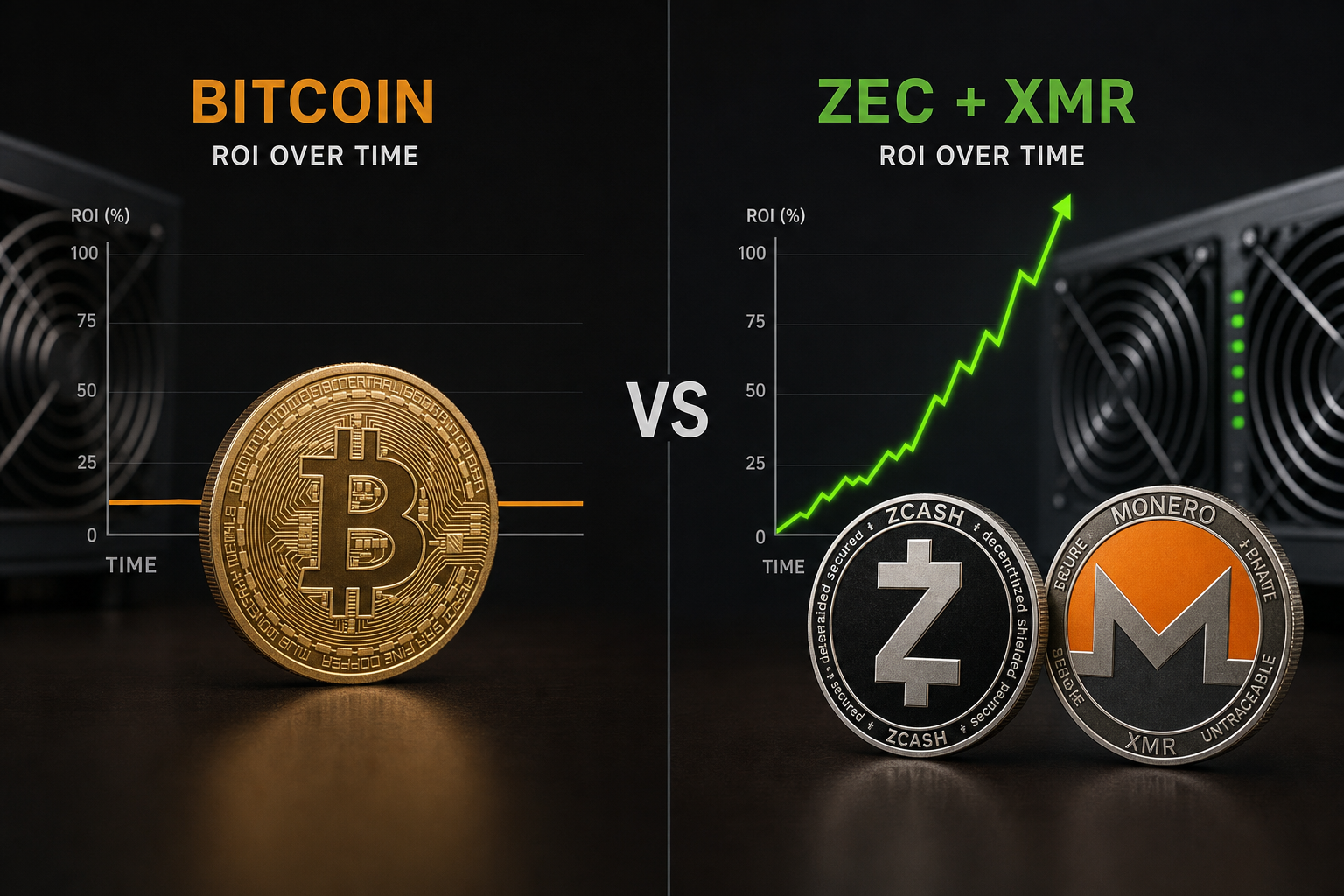
Antminer Z15 Pro (Zcash): At ZEC’s current price of $540.42, the Z15 Pro generates $39.29/day net at $0.07/kWh. With a price of $4,100, the payback period is 3.5 months at current ZEC prices.
Antminer X9 (Monero): XMR sits at $356.13 today. The X9 earns $24.25/day net at $0.07/kWh. At $5,600, payback is 7.7 months. More notable still: even at $0.15/kWh, the X9 earns $19.50/day and pays back in 9.6 months — a span most Bitcoin miners cannot match at half that electricity rate.
The table below compares all three machines across the same five electricity brackets:
| Miner | Coin | Price | $0.04 | $0.07 | $0.10 | $0.12 | $0.15 |
|---|---|---|---|---|---|---|---|
| Z15 Pro | ZEC $540 | $4,100 | 3.3 mo | 3.5 mo | 3.7 mo | 3.8 mo | 4.0 mo |
| X9 | XMR $356 | $5,600 | 7.2 mo | 7.7 mo | 8.3 mo | 8.8 mo | 9.6 mo |
| Z15 | ZEC $540 | $4,900 | 8.0 mo | 8.4 mo | 8.9 mo | 9.3 mo | 9.9 mo |
| S21 Pro+ | BTC $73K | $2,070 | 15.1 mo | 33.8 mo | – | – | – |
Note: All ROI figures based on coin prices as of May 30, 2026. Net daily income varies with market conditions.
The electricity sensitivity gap is stark. ZEC and XMR miners remain profitable across the full $0.04–$0.15/kWh range. Bitcoin miners drop off rapidly above $0.07/kWh.
How to Think About Buying Equipment During a Correction
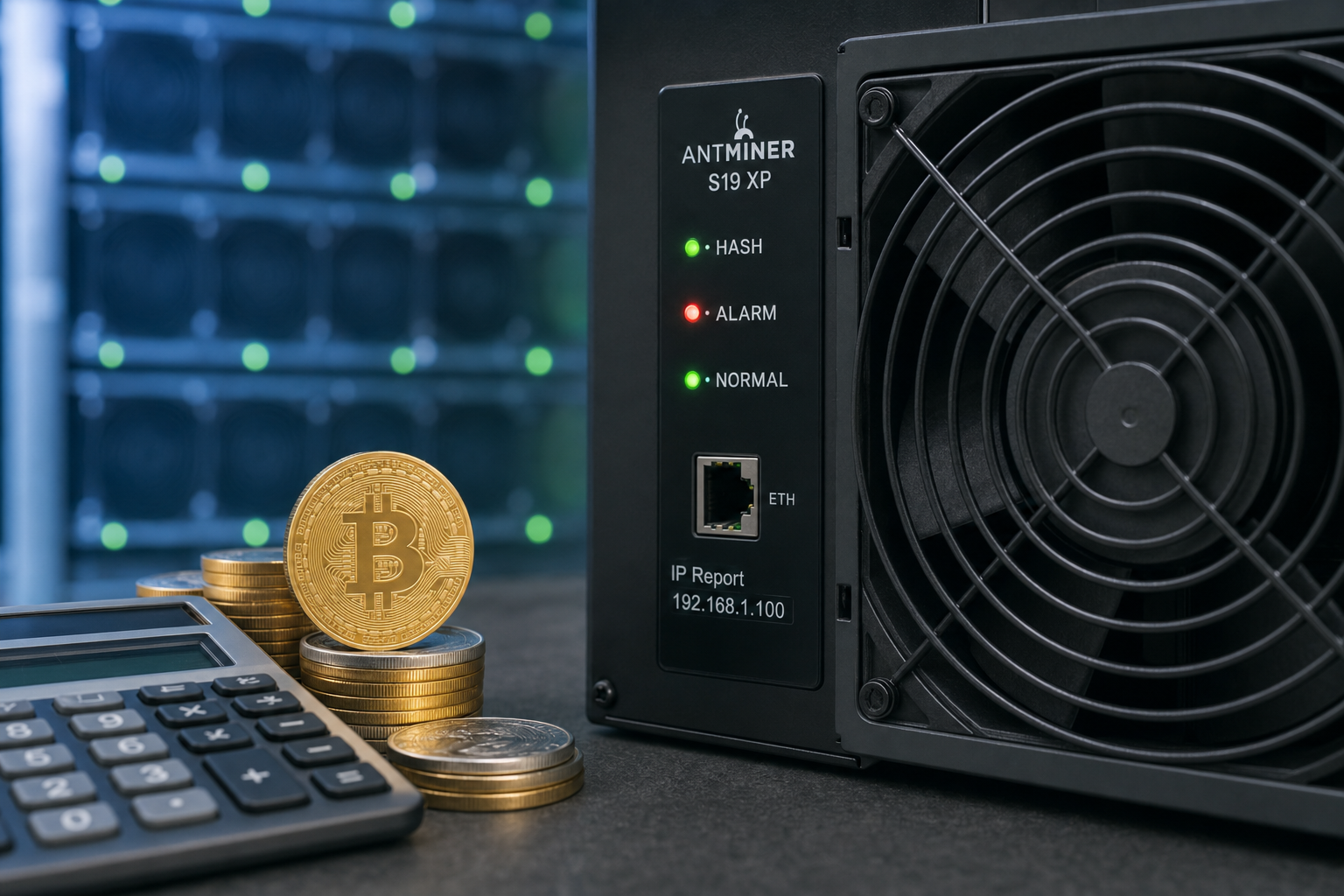
The decision to buy mining hardware during a market pullback involves two separate questions. The first is whether the equipment is profitable today. The second is whether conditions are likely to improve, stay flat, or deteriorate over the payback period.
The Case for Acting Now
Some analysts point to past BTC corrections as entry points for long-horizon miners — for example, equipment purchased during BTC’s 2025 dip below $60,000 would have seen improved economics as price recovered toward $81,000. Whether the current correction follows a similar pattern is not known in advance.
For ZEC and XMR miners specifically, the current data makes the timing argument weaker — because the ROI is already attractive regardless of where BTC goes. The Z15 Pro’s 3.5-month payback at $0.07/kWh is driven by ZEC’s price ($540), not BTC’s price. A buyer today is taking a position primarily on ZEC holding near current levels, not on Bitcoin recovery.
The Case for Waiting
Bitcoin pulling back 9% in a short window does not automatically mean the floor is in. Difficulty continues rising, which compresses revenue per terahash even if BTC stabilizes. Miners paying above $0.07/kWh for electricity should be cautious about committing to BTC-based equipment until either price recovers or equipment costs fall further.
Additionally, ZEC and XMR prices move independently and carry their own risk profile. ZEC was at $673 just ten days ago and is now at $540 — a 20% drop. A buyer who locked in hardware costs at ZEC $673 and is now running at ZEC $540 has seen ROI extend from roughly 2.5 months to 3.5 months. Still fast, but a reminder that altcoin prices are not anchored to BTC in the short term.
What the BTC Network Metrics Suggest
One data point worth noting: the BTC hashrate at 1,008.6 EH/s is not declining despite the price pullback. This suggests that large-scale miners with low-cost electricity are not turning off machines — they remain profitable at their cost basis. It also means that if BTC recovers, the per-machine revenue improvement will be shared across a large and stable hashrate base, limiting the upside for individual miners.
For context: the network needs to see sustained hashrate decline (a sign of miner capitulation) before per-machine economics improve meaningfully for mid-cost operators. That has not happened yet.
Current Market Snapshot: Where Each Coin Stands
| Coin | Price (May 30) | Recent Range | Notes |
|---|---|---|---|
| BTC | $73,300 | $60K–$81K (2026) | Correction from May highs |
| ZEC | $540 | $400–$673 (2026) | Down from May 20 peak of $673 |
| XMR | $356 | $250–$420 (est.) | Privacy coin demand stable |
| LTC | $51.69 | $40–$70 (est.) | DOGE correlation intact |
| ALPH | $0.037 | — | GPU/ASIC mining active |
Note: “Recent range” figures are estimates based on observed price levels in 2026 reporting; not a guarantee of future range.
Practical Guidance for Different Buyer Profiles
If You Have Access to Sub-If You Have Access to Sub-$0.07/kWh Power
.07/kWh Power
BTC miners become viable in this range, particularly models like the S21 Pro+ with a 15-month ROI at $0.04/kWh. The risk is BTC price — a further drop toward $60K would extend payback. ZEC and XMR miners are also strong options at this electricity tier and offer faster payback with less sensitivity to BTC price movements.
If You’re Paying If You’re Paying $0.07–$0.10/kWh
.07–If You’re Paying $0.07–$0.10/kWh
.10/kWh
This is the critical range where Bitcoin mining margins are thin or negative. ZEC miners (Z15 Pro, Z15) and the XMR-focused X9 are the logical focus. The Z15 Pro in particular earns $37.29/day net at $0.10/kWh, with a payback of 3.7 months.
If You’re on Residential Power (If You’re on Residential Power ($0.12–$0.15/kWh)
.12–If You’re on Residential Power ($0.12–$0.15/kWh)
.15/kWh)
Bitcoin mining is not viable in this bracket at current BTC prices. The Z15 Pro and X9 remain profitable — $35.95/day and $19.50/day respectively — though the decision requires confidence that ZEC and XMR prices will hold near current levels through the payback window.
The Post-Halving Lens: Why BTC Price Sensitivity Is Higher Now
One structural factor that amplifies everything above: Bitcoin is operating in a post-halving environment. The block reward is 3.125 BTC — half of the 6.25 BTC that miners received before April 2024. That means every dollar of BTC price movement has roughly twice the proportional impact on per-block revenue compared to the pre-halving era.
Before the last halving, a miner’s daily gross revenue was driven by 6.25 BTC per block. Today it’s 3.125 BTC. At the same hashrate, the same machine earns less from transaction reward per block, and price has to do more of the heavy lifting. At $73,300, the math is tight. A return to $81,000 would push BTC gross mining revenue up roughly 10.5%, which is meaningful but may not be enough to bring mid-cost operators back to profitability on BTC if electricity is above $0.08/kWh.
Altcoin ASICs are not subject to this same halving dynamic in the same way — Zcash and Monero have their own emission schedules, and their mining economics are not denominated in BTC. That insulation from BTC’s halving math is part of why ZEC and XMR miners continue to show faster payback periods this year.
Five Questions to Ask Before Committing to Equipment This Month
- What is my actual electricity rate? The single most important input. Run your specific rate through the profitability calculator before looking at anything else.
- What coin am I mining, and what is my thesis on its price over the next 3–12 months? ZEC at $540 and XMR at $356 are the current profitability leaders — but both have moved 20%+ in either direction over the past 30 days.
- Is my capital truly patient? BTC miners at $0.07/kWh have a 34-month ROI at current prices. That money is not coming back quickly if BTC stays flat or falls further.
- Can I absorb a 20–30% price drop in the mined coin without the project becoming unviable? ZEC’s recent drop from $673 to $540 extended the Z15 Pro ROI by about a month. A further drop to $420 would push it to roughly 5.5 months — still reasonable, but different from the sub-3-month scenario some buyers are modeling.
- Am I buying to mine, or to speculate on hardware resale value? These are different analyses. This article addresses the mining-to-recoup case only.
- What is my regulatory and energy policy exposure? Mining regulations vary significantly by jurisdiction — some regions have imposed restrictions or surcharges on large-scale energy consumption. Energy policy changes can affect both electricity pricing and operational legality. These risks are external to the ROI models above and should be assessed separately based on where the equipment will operate.
Bottom Line
BTC’s retreat to $73,300 tightens the case for Bitcoin mining at mid-range electricity rates and effectively eliminates it above $0.09/kWh. Zcash and Monero mining are not directly affected by BTC’s price action, and their ROI figures remain among the most compelling in the ASIC market today.
For buyers who have been waiting for a signal, the current data does not point to a clear “buy now” or “wait” answer for BTC-based equipment. It does, however, show that the altcoin ASIC case — particularly the Antminer Z15 Pro and Antminer X9 — is based on present economics rather than future price recovery. That is a different kind of risk, and for many buyers, a more manageable one.
Use the BT-Miners profitability calculator to run your specific electricity rate against any model in the catalog before committing.