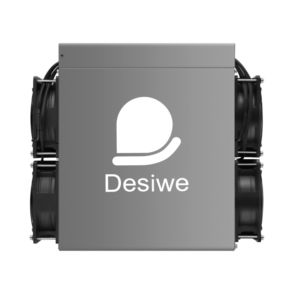
Desiwe is a niche ASIC mining hardware manufacturer focused on delivering purpose-driven devices for specific mining scenarios. Rather than competing directly in highly saturated mining segments, Desiwe positions its hardware around defined use cases where stability, compatibility, and predictable operation are more important than headline performance figures.
Desiwe miners are often considered by operators who value straightforward deployment and controlled operating behavior. These users typically run smaller or more specialized setups, where hardware is expected to integrate smoothly into existing power and cooling conditions without extensive tuning or frequent intervention.
This collection is designed for miners evaluating Desiwe hardware from a practical deployment perspective. Considerations such as sustained power draw, thermal consistency during long runtimes, and ease of operation tend to play a larger role than peak hashrate comparisons. Desiwe devices are commonly used in environments where operational clarity and repeatable results are preferred over aggressive optimization.
In real-world use, Desiwe hardware is frequently deployed in targeted mining configurations, including compact mining rooms, mixed-use facilities, or diversified operations where each device serves a specific role. This approach allows miners to manage risk by assigning hardware to clearly defined workloads rather than relying on one-size-fits-all solutions.
Rather than positioning Desiwe miners as experimental or cutting-edge, this page highlights their role in focused, reliability-oriented mining strategies. Some miners select Desiwe hardware to support particular algorithms or networks, while others integrate it alongside more established brands to balance operational needs across their mining portfolio.
The BT-MINERS team curates this Desiwe collection to help miners understand where Desiwe hardware fits best, what to expect from day-to-day operation, and how these devices align with disciplined, scenario-driven mining strategies. The emphasis is on informed selection, realistic expectations, and hardware choices that support stable, long-term operation.