Canaan Holds 1,826 BTC Worth More Than Its Market Cap: What the ASIC Giant’s Mining Pivot Tells Buyers in 2026
⚠️ Disclaimer: Mining profitability fluctuates with electricity costs, cryptocurrency prices, and network difficulty. All figures are based on market data as of May 18, 2026 (BTC: $79,126). This article is market analysis, not financial or investment advice. Always conduct your own due diligence before purchasing mining equipment or making investment decisions.
When the Coins Are Worth More Than the Company
Canaan Inc. (NASDAQ: CAN) — one of the world’s three major Bitcoin ASIC chip designers and the maker of the Avalon miner line — is sitting on 1,826 BTC as of April 2026. At today’s Bitcoin price of $79,126, that treasury is worth approximately $144.5 million.
Canaan’s total market capitalization hovers around $100 million.
The coins on Canaan’s balance sheet are worth roughly 44% more than the entire publicly traded company. Investors acquiring CAN shares at current prices are theoretically buying those 1,826 BTC at a meaningful discount — and getting the mining hardware business, the Tether supply contract, and thirteen active mining sites thrown in for free.
That arithmetic is either a straightforward value opportunity or a warning that something complicated is happening inside one of the oldest names in ASIC manufacturing. Almost certainly, it is both.
How the Hardware Market Collapse Forced Canaan Into Self-Mining
The numbers behind this pivot are stark. In 2022, Canaan generated $650 million in annual revenue, almost entirely from selling Avalon mining machines. By 2023, that figure had fallen to $210 million — a 67% collapse in a single year. Not a correction: a structural break.
ASIC hardware sales follow a predictable cycle. When BTC prices rise, miners rush to buy new equipment before network difficulty adjusts. When prices stall or fall, purchase orders dry up, inventory accumulates, and production lines sit idle. Through 2023 and into 2024, the market for new hardware simply was not there.
Canaan’s response followed a logic as old as mining itself: if you cannot sell the pickaxe profitably, go dig for gold yourself.
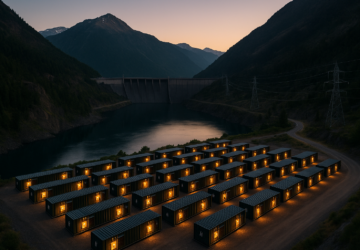
In Q1 2025, Canaan expanded its self-operated hash rate from 5.3 EH/s to 10.97 EH/s, doubling its deployed capacity in a single quarter. Three joint-venture mining farms in Texas came online simultaneously. Operations extended to five countries across thirteen sites. By April 2026, Canaan was producing 141 BTC per month.
For the first time in the company’s history, mining revenue exceeded hardware sales in a single quarter. A semiconductor design company became, at least operationally, more miner than manufacturer. Industry observers note the significance: in Q1 2025, mining income already accounted for more than half of Canaan’s total revenue — a complete reversal of the 2022 revenue mix where hardware contributed over 90%.
The 49% Structure: Smart Accounting or Strategic Caution?
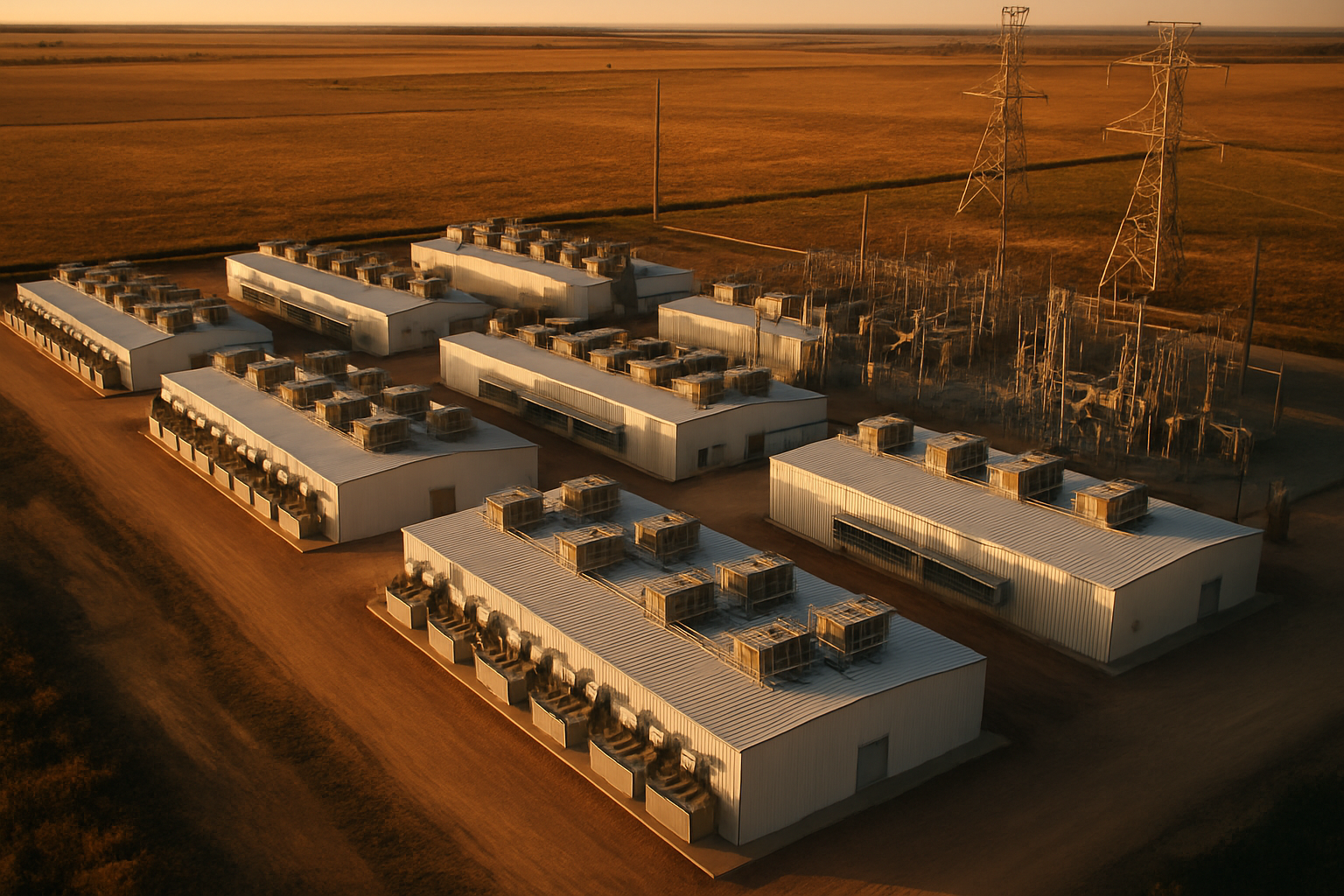
Look closely at Canaan’s Texas joint ventures and a precise financial decision emerges. Canaan holds exactly 49% stakes in its three Texas JV mining farms — one percentage point below the threshold that would require consolidating those assets onto its balance sheet under standard accounting rules.
The practical result: the JV farms’ debt, depreciation, and operating costs remain off Canaan’s reported financials. The balance sheet looks cleaner than it actually is. But the BTC production flows back in — Canaan’s 49% share of the Texas operations generated approximately 48 BTC per month in April 2026, on top of its directly owned mining output.
Risk off the books. Revenue in the pocket. It is textbook asset-light structuring, and it explains why the Texas farms consistently run at 90% utilization. Centralized management, stable Texas grid power, a single operations team overseeing three sites — efficiency follows from simplicity.
Canaan’s thirteen directly operated sites across five countries, by contrast, run at only 62% utilization. Five different regulatory environments, five grid reliability profiles, multiple local operations teams. Complexity creates friction. But analysts who follow the company closely point to a second, more strategic explanation: Canaan may be deliberately holding capacity in reserve. Running 10.97 EH/s installed capacity at 6.86 EH/s active is not obviously a failure — it can be a deliberate bet that deploying the remaining 4 EH/s is more valuable after the next leg of BTC price appreciation. In mining, this is sometimes called strategic hash rate reserve.
The 49% structure is Canaan’s safety net and its ceiling simultaneously. By staying below consolidation thresholds, the company limits how aggressively it can scale with institutional capital and full balance sheet commitment. One foot is in. One foot remains at the door.
The Tether Deal: Custom Boards and the Institutional Mining Shift

While the treasury narrative generates headlines, a quieter deal may have larger implications for Canaan’s long-term positioning.
In late April 2026, Canaan announced follow-on orders from Tether — not for complete Avalon mining machines, but for custom high-density ASIC compute board modules designed for next-generation immersion liquid cooling systems. The arrangement originated from a 2025 research collaboration between Canaan, Tether, and Swiss engineering firm ACME Swisstech.
The distinction between selling a finished miner and selling a custom compute board matters enormously. Tether wants the core component — the ASIC chip substrate with custom thermal architecture — which it will integrate directly into its own proprietary liquid cooling cabinets. Canaan goes from original equipment manufacturer to precision component supplier.
On the surface this sounds like a step down the value chain: margins squeezed by a buyer with enormous negotiating power. But the counter-argument is compelling.
The standard ASIC miner market — Bitmain’s Antminer, MicroBT’s Whatsminer, Canaan’s Avalon — is a mature commodity business. Three major vendors compete on price for customers who increasingly treat machines as interchangeable. Gross margins have compressed to single digits.
Immersion cooling compute board modules for hyperscale deployments are a different product category entirely. The engineering requirements are specialized: thermal density optimization, substrate materials compatible with dielectric fluids, form factors for custom cabinets rather than standard air-cooled rack dimensions. Very few manufacturers have both the ASIC chip design expertise and the thermal engineering capability to produce these reliably at scale. Canaan, as one of three global Bitcoin ASIC chip designers, is on a very short list.
Tether’s downstream goal is reported to be large-scale Bitcoin mining operations in South America — its own industrial build-out, financed by the world’s largest stablecoin issuer. If that program executes at scale, it represents a multi-year component supply commitment in a niche where Bitmain cannot easily compete on price alone. Canaan’s position as preferred supplier is potentially worth far more than the initial orders suggest.
What Canaan’s Pivot Signals for ASIC Buyers in 2026
For anyone evaluating mining hardware purchases today, Canaan’s trajectory carries several direct implications.
The hardware buyer’s market is real. When the world’s third-largest ASIC manufacturer has shifted its primary operational focus from selling machines to mining with them, it is because selling machines has become structurally difficult. That competitive pressure benefits buyers. Canaan’s own Avalon models — alongside the broader market — are available at prices that reflect this supply-demand reality. The Canaan AvalonMiner A16XP 300TH/s is currently priced at $5,950, with older A15-series machines available under $1,200. In a buyers’ market, asking prices are negotiable.
Institutional demand is shifting to specialized hardware. The Tether deal illustrates where large-scale capital is flowing: custom immersion-cooling systems that prioritize power density over off-the-shelf convenience. If you are evaluating mining at commercial or industrial scale, immersion cooling is increasingly the design standard for serious operators — not an optional upgrade.
The miner maker pivot validates the self-mining thesis. Canaan’s decision to mine rather than only sell is a datapoint from engineers and executives who understand Bitcoin mining economics as well as anyone alive. They are deploying capital into BTC accumulation, not just hardware sales. This mirrors what MARA, RIOT, and CleanSpark have done for years. Whether it is the right strategy for individual buyers depends on electricity costs and investment horizon — but the directional signal from experienced operators is consistent.
Network difficulty is rising. Bitcoin’s next difficulty adjustment is currently projected at +17.2% based on current block pace. Rising difficulty compresses per-machine profitability, making the efficiency gap between hardware generations wider. Use the BT-Miners daily income calculator to model your specific hardware against your electricity rate before committing capital — and factor in the upcoming difficulty change.
The Current Economics: Top Canaan Machines vs. Category Leaders
To put Canaan’s hardware in market context, here are the top-performing Canaan Avalon BTC miners currently available alongside the ROI picture at multiple electricity rates (BTC $79,126, May 18, 2026):
| Miner | Hashrate | Power | Net @$0.04 | Net @$0.07 | Net @$0.10 | Price |
|---|---|---|---|---|---|---|
| AvalonMiner A16XP 300T | 300 TH/s | 3,850W | $7.30/day | $4.53/day | $1.76/day | $5,950 |
| AvalonMiner A16 282T | 282 TH/s | 3,900W | $6.27/day | $3.78/day | $1.29/day | $4,480 |
| Avalon A15 Pro 218T | 218 TH/s | 3,662W | $4.73/day | $1.84/day | -$1.05/day | $2,400 |
Net daily = gross revenue minus electricity cost only. Net @$0.07 figures match BT-Miners API data. Gross: A16XP $11.00/day, A16 $10.25/day, A15 Pro $8.08/day. Hardware ROI not included.
At $0.07/kWh, the A16XP’s 43.8-month ROI reflects the current challenge in BTC mining economics. Miners who have access to electricity at $0.04/kWh or below find substantially better returns — the A16XP generates $7.30/day at $0.04/kWh, pointing toward a more competitive 27-month ROI. This is precisely why large-scale industrial operators — including Canaan’s own Texas JV farms — focus intensely on securing below-market power contracts.
For buyers seeking faster capital recovery, alt-coin miners with higher ROI profiles deserve serious comparison. The Antminer Z15 Pro generates $39.76/day net at $0.07/kWh mining ZEC, with hardware costs recovered in approximately 3 months at current street price. The profitability calculator can run side-by-side comparisons across coin types and electricity scenarios.
Is Canaan a Hardware Company, a Miner, or Discounted BTC?
Canaan’s current situation resists clean categorization. It is not a pure mining company like MARA — which has committed entirely to BTC treasury accumulation and runs mining as a balance sheet strategy. It is not the pure hardware company it was in 2022, when Avalon machine sales drove over 90% of its revenue. And it is not simply a components supplier, though the Tether relationship is pulling it in that direction.
In 2025, Canaan shut down its AI chip development program entirely to refocus on mining-related hardware and self-mining operations. Even with that narrowing, the company simultaneously operates thirteen mining sites in five countries, holds 49% JV stakes in three Texas farms, sells consumer home miners like the Avalon Mini 3, and engineers custom immersion compute modules for Tether’s South American expansion.
Industry observers have described this as a kind of strategic identity anxiety — not quite MARA, not quite Bitmain, not quite an institutional component supplier. The 1,826-coin BTC treasury is the most legible expression of where the company is: accumulated because hardware could not be sold fast enough to generate equivalent revenue, and now sitting on the balance sheet as both a financial reserve and a statement of conviction about Bitcoin’s long-term trajectory.
Whether the market eventually prices CAN shares to reflect the underlying BTC value — closing the current discount — depends on whether Canaan demonstrates a durable business model alongside the treasury. The Tether deal is one piece of that case. Texas JV utilization rates are another. The 4 EH/s of idle self-operated capacity is the outstanding question mark.
What is clear is that the era of comfortable ASIC hardware sales is over. Canaan’s story is the ASIC industry’s story: the manufacturers who adapt — by mining directly, by building institutional supply relationships, or both — are the ones who survive long enough to see the next cycle.
Explore Mining Hardware and ROI at BT-Miners
BT-Miners carries the full current Canaan Avalon lineup alongside the highest-ROI Bitcoin, ZEC, and XMR miners available. Whether you are evaluating the A16XP for BTC mining, comparing it against faster-payback alt-coin hardware, or modeling total cost of ownership across electricity scenarios, our team can walk through the numbers with you.
Calculate your daily profit and ROI at your electricity rate →
The buyers who understand market dynamics like Canaan’s pivot — who recognize that hardware is priced attractively precisely because the manufacturers face their own pressures — are the ones who acquire equipment at the best prices before the next difficulty surge narrows margins again. The machines do not care who made them or why they are priced the way they are. The economics are what matter.