Bitcoin Mining Difficulty and Hardware Timing: When to Buy an ASIC Miner in 2026
⚠️ Disclaimer: Mining profitability fluctuates with electricity costs, cryptocurrency prices, and network difficulty. All figures reflect conditions as of June 1, 2026 (BTC $73,300, ZEC $540.42, XMR $356.13). Past performance does not indicate future results. Conduct your own due diligence before purchasing mining equipment.
Why Difficulty Timing Is the Overlooked Variable in ASIC ROI
Most first-time ASIC buyers focus on two variables: hardware price and the current coin price. They are missing the third one — mining difficulty — which resets every two weeks and directly compresses or expands your daily earnings.
As of June 1, 2026, the Bitcoin network is running at 1,011.8 EH/s, and the next difficulty adjustment is projected to increase by +1.43% within the next ~12 days (current block height: 951,924). That adjustment is modest on its own. But a series of upward adjustments — the pattern seen since early 2026 — can quietly erode SHA-256 (Bitcoin’s proof-of-work hashing algorithm) miner margins over a quarter without any change in BTC price.
This article walks through how difficulty cycles affect the real ROI window for different ASIC categories, how to read the signals, and what the current data suggests about timing a purchase in mid-2026.
How Bitcoin Difficulty Adjustment Works
The Two-Week Recalibration
Bitcoin’s protocol automatically recalibrates mining difficulty every 2,016 blocks (roughly 14 days) to keep average block times at 10 minutes. When more hashrate joins the network — meaning more miners compete for the same block reward — the protocol raises difficulty, reducing each miner’s share of the reward.
The math is direct: if difficulty increases 5%, a miner producing the same hashrate earns approximately 5% less per day, all else equal. For a miner running thin margins at $0.07/kWh electricity and BTC at $73,300, a 5% daily income drop is significant. The 3.125 BTC block reward set at the April 2024 halving will not change until the next halving in 2028, so SHA-256 mining margins depend on BTC price growth keeping pace with difficulty growth — which has not consistently been the case in 2026.
Why 2026 Difficulty Has Trended Up
Bitcoin’s network hashrate reached a new high above 1,000 EH/s in early 2026 and has remained elevated. Contributing factors include:
- Large mining operations deploying next-generation hardware following the April 2024 halving
- Institutional mining capacity expansions (including major U.S. and Middle East operations)
- Relatively stable BTC price in the $65K–$85K range attracting continued capital into SHA-256 infrastructure
The implication: unless BTC price rises proportionally to match hashrate growth, per-unit profitability for SHA-256 miners keeps compressing. That is not a reason to avoid BTC miners — it is a reason to factor difficulty trajectory into a multi-month ROI model, not just the spot figure.
How Difficulty Affects BTC vs Alt-Coin ASIC Returns
Bitcoin’s difficulty only affects SHA-256 miners. Equihash (Zcash’s proof-of-work algorithm, used exclusively by ZEC miners) and RandomX (Monero’s memory-hard mining algorithm, designed to resist ASIC dominance but now efficiently served by purpose-built hardware like the X9) miners operate on entirely separate networks with independent difficulty adjustments. At current prices, the ROI contrast is substantial.
ROI Comparison Across Electricity Rates (June 1, 2026)
| Miner | Algo | Price | @$0.04/kWh | @$0.07/kWh | @$0.10/kWh | @$0.12/kWh | @$0.15/kWh |
|---|---|---|---|---|---|---|---|
| Antminer Z15 Pro (840KSol) | Equihash / ZEC | $4,100 | $41.29/d · 3.3mo | $39.29/d · 3.5mo | $37.29/d · 3.7mo | $35.95/d · 3.8mo | $33.95/d · 4.0mo |
| Antminer X9 (1MH/s) | RandomX / XMR | $5,600 | $26.03/d · 7.2mo | $24.25/d · 7.7mo | $22.47/d · 8.3mo | $21.28/d · 8.8mo | $19.50/d · 9.6mo |
| Antminer Z15 (420KSol) | Equihash / ZEC | $4,900 | $20.54/d · 7.9mo | $19.45/d · 8.4mo | $18.36/d · 8.9mo | $17.64/d · 9.2mo | $16.55/d · 9.8mo |
| Antminer S21 Pro+ 234TH | SHA-256 / BTC | $2,070 | $4.58/d · 15.0mo | $2.05/d · 33.7mo | −$0.48/d | −$2.02/d | −$4.28/d |
| Antminer S21+Plus 216TH | SHA-256 / BTC | $1,600 | $3.91/d · 13.6mo | $1.34/d · 39.8mo | −$1.23/d | −$2.77/d | −$5.04/d |
Note: Net daily income after electricity deduction. ROI = hardware price ÷ net daily income ÷ 30 days. Hardware prices and gross income data sourced from the bt-miners.com product API (fetched 2026-06-01). BTC miners at $0.10/kWh and above are currently running negative net at BTC $73,300 — meaning buyers at those electricity rates would be paying more for power than they earn in block rewards. Shown for reference to illustrate electricity-rate sensitivity. Model your specific scenario using the BT-Miners profitability calculator.
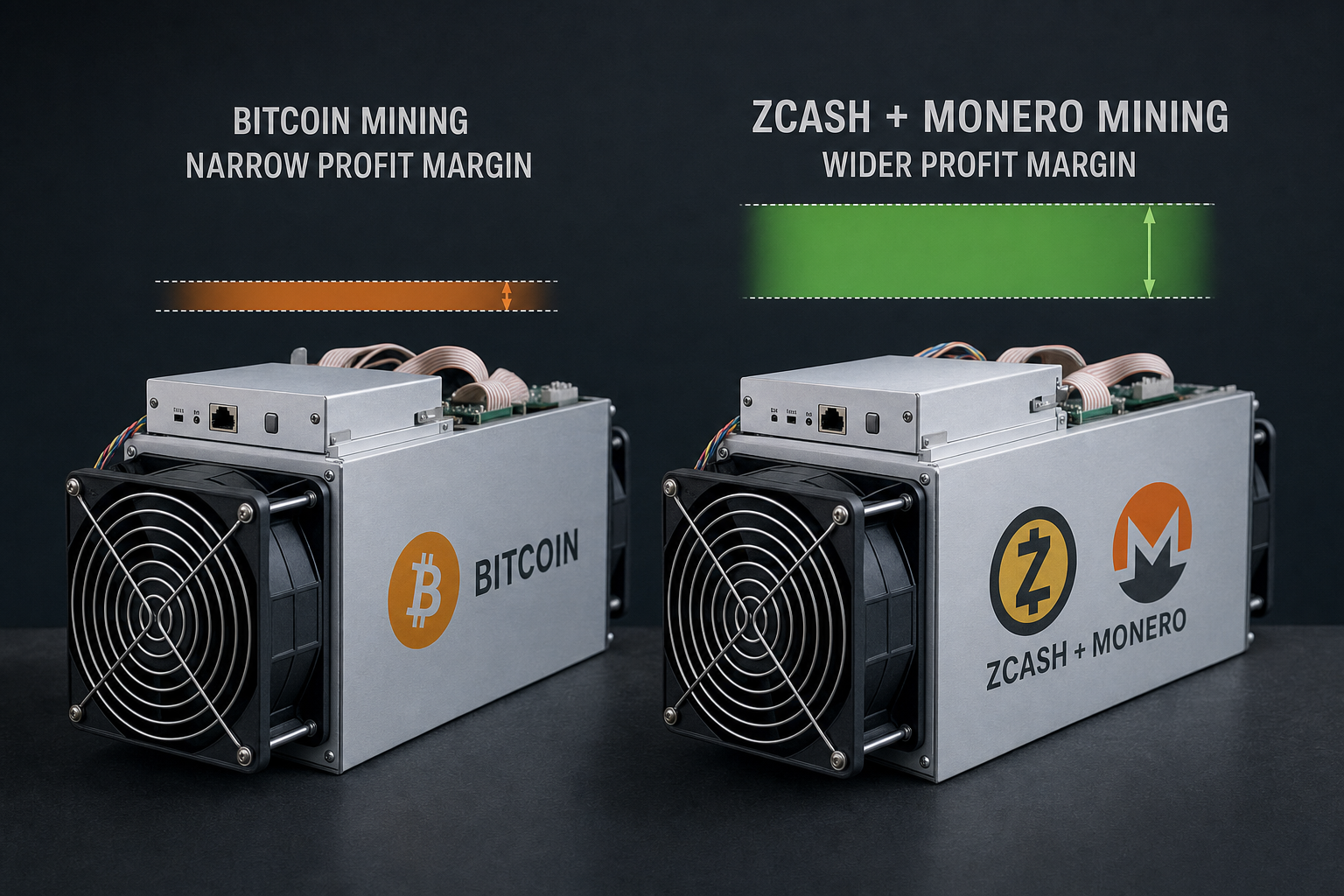
The table reveals a structural difference that difficulty trends reinforce. The Antminer Z15 Pro earns $33–$41/day across the full $0.04–$0.15/kWh range. The S21 Pro+ turns negative above $0.09/kWh. That is not a flaw in the S21 Pro+ — it reflects the thinner margins inherent in SHA-256 mining at current BTC prices and difficulty levels. Wide gross margins also mean ZEC and XMR miners absorb a difficulty increase with far less damage to their monthly returns.
Reading the Difficulty Signals: A Practical Framework
Signal 1: Difficulty Growth Rate vs. Price Growth Rate
The most actionable metric is not difficulty in isolation — it is whether BTC price is growing faster or slower than mining difficulty. When price growth outpaces difficulty growth, SHA-256 margins expand. When difficulty grows faster than price (as has been the case through much of 2025–2026), margins compress. Tracking this ratio over rolling 30-day periods gives a cleaner read than either metric alone.
Current reading (June 2026): BTC at $73,300 following a pullback from recent highs, difficulty trending up +1.43%. This is a mild compression signal. It does not indicate a crisis, but it does mean SHA-256 miners entering at today’s prices face a smaller margin cushion than they did in April or May.
Signal 2: Network Hashrate Trajectory
The 1,011.8 EH/s network hashrate is near all-time highs. Historically, when hashrate expands rapidly without a proportional price increase, multiple consecutive upward difficulty adjustments follow. Tracking the seven-day average hashrate trend (available on blockchain.com and btc.com explorers) helps anticipate whether the next several adjustments will be positive or negative. A declining hashrate trend is a signal that difficulty may drop next cycle — which creates a temporarily more favorable margin environment for SHA-256 miners.
Signal 3: Alt-Coin Mining Difficulty Is Independent
This point is worth stating plainly: a rising BTC difficulty has no direct effect on ZEC or XMR mining profitability. Equihash and RandomX networks maintain independent difficulty algorithms based on their own hashrate. When institutional capital floods into BTC mining equipment, it does not increase competition for Zcash or Monero blocks.
This independence explains why ZEC and XMR ASICs currently show 3.5–9.6 month ROIs even at elevated electricity rates, while BTC miners require $0.04–$0.06/kWh electricity to approach equivalent payback periods at today’s prices. The ZEC Equihash network is substantially smaller — and less hashrate-competitive — than Bitcoin’s SHA-256 network.
The Optimal Buy Window: A Decision Framework
For SHA-256 (BTC) Miners
Risk note: At $0.07/kWh, the S21 Pro+ currently earns $2.05/day. If BTC drops 10% to ~$66,000 and difficulty holds steady, that daily income falls to approximately $1.24/day — extending the ROI from 33 months to over 54 months. At $0.10/kWh, the same machine already runs at a loss today. Buyers should model downside scenarios explicitly before committing capital to SHA-256 hardware.
Buying just before a large upward difficulty adjustment is the least favorable timing — you lock in hardware cost at the moment daily income is about to fall. More defensible approaches:
- Buy after a negative adjustment: Network hashrate occasionally drops (equipment outages, seasonal power cost increases in certain regions, or large farms going offline). A negative difficulty adjustment expands margins temporarily and is a cleaner entry point.
- Buy during a hardware price correction: Hardware prices have softened alongside BTC’s pullback from highs. Paying less for the machine compensates for an expected continued difficulty increase — but requires running the math assuming difficulty increases 1–2% per month over the first two quarters of ownership.
- Model forward, not backward: Use the current daily income figure as a starting point, then reduce it by your expected quarterly difficulty growth rate. A BTC miner that earns $2.05/day at $0.07/kWh today earns approximately $1.84/day if difficulty increases 3% over the next 6 weeks — and the ROI timeline extends accordingly.
For Equihash / RandomX Alt-Coin ASICs
BTC difficulty is irrelevant to the timing decision here. The relevant variables are the ZEC or XMR price trend and each network’s own difficulty trajectory — both of which have been more stable than BTC’s in 2026. At current prices:
- Z15 Pro at $4,100 and $39.29/day net earns back its hardware cost in 3.5 months at $0.07/kWh — even after ZEC pulled back from its May high of $673 to the current $540.
- X9 at $5,600 and $24.25/day net returns in 7.7 months. XMR is at $356, well below its historical highs; the X9 still delivers positive returns across the full electricity rate range.
- Neither of these machines is exposed to BTC difficulty compression, which is the dominant near-term risk for SHA-256 buyers.
90-Day Scenario Planning
Buyers committing capital today should model their first quarter under a range of assumptions, not just spot data. A conservative framework:
| Category | Conservative Difficulty Assumption (Q3) | Impact on Daily Income | Extended ROI Estimate |
|---|---|---|---|
| SHA-256 (BTC) | +2% per adjustment × 6 adjustments = ~12% over 90 days | S21 Pro+: ~$1.80/d → $1.58/d by Sept | ~38mo at $0.07/kWh |
| Equihash (ZEC) | +0.5–1% per month (gradual) | Z15 Pro: ~$39.29/d → ~$38.10/d by Sept | ~3.6mo at $0.07/kWh |
| RandomX (XMR) | +0.5–1% per month (gradual) | X9: ~$24.25/d → ~$23.52/d by Sept | ~7.9mo at $0.07/kWh |
Note: These are illustrative projections, not predictions. Difficulty and coin price can move in either direction. All scenarios assume stable coin prices — a coin price increase would improve returns; a decline would worsen them. Conduct your own analysis using the profitability calculator before purchasing.
The projection table highlights the asymmetry clearly: even under a conservative difficulty growth scenario, ZEC and XMR ASICs remain within a range that most buyers consider acceptable. The BTC SHA-256 scenario extends the payback period meaningfully even under a modest +12% difficulty assumption over 90 days.
Current Window Assessment (June 2026)
| Category | Current ROI Attractiveness | Key Risk | Timing Signal |
|---|---|---|---|
| SHA-256 (BTC) | Marginal at $0.07+/kWh | Continued difficulty growth compresses thin margins | Neutral-to-cautious; strongest case for buyers with $0.04–$0.06/kWh electricity |
| Equihash (ZEC) | Strong — Z15 Pro at 3.5mo ROI | ZEC price dip (currently $540 vs. $673 peak in May) | Favorable; ZEC gross margins thick enough to absorb further pullback |
| RandomX (XMR) | Solid — X9 at 7.7mo ROI | XMR price currently below earlier 2026 highs | Favorable for buyers with $5,600 budget; demonstrated multi-year profitability |
Common Questions on Difficulty and Timing
Does a rising BTC difficulty affect ZEC or XMR miners?
No. Each PoW network maintains an independent difficulty algorithm. BTC hashrate growth has no effect on Equihash or RandomX networks.
Is a +1.43% adjustment a warning sign?
At this level, it is a directional signal rather than a crisis. The concern is the cumulative trend over multiple adjustments — not any single +1.43% event. Model the next two quarters with continued upward adjustments before committing to SHA-256 hardware.
When is the best time to buy a Bitcoin ASIC miner?
The most defensible entry points historically have been during negative difficulty adjustments or during BTC price corrections when hardware prices soften. Buying into an upward difficulty trend at a price plateau carries the most margin risk. No single best moment exists — the question is whether your electricity rate and ROI horizon accommodate the expected trajectory.
Which current miners perform across the widest electricity rate range?
The Antminer Z15 Pro and Antminer X9 both remain net-positive at $0.15/kWh — a rate at which most SHA-256 miners are significantly unprofitable. These machines are better candidates for buyers in regions with commercial electricity rates above $0.10/kWh.
What to Do With This Information
The difficulty timing framework does not eliminate uncertainty — it structures it. Before purchasing any ASIC miner, run three inputs through your model: today’s daily net income at your electricity rate, your expected difficulty growth rate over the first two quarters of ownership, and the price you are paying for the hardware relative to that compressed earnings trajectory.
For SHA-256 miners at current BTC prices and difficulty levels, the numbers favor buyers with low electricity costs ($0.04–$0.06/kWh) and long time horizons who can ride out margin compression. For buyers with average commercial rates ($0.07–$0.10/kWh) and shorter payback expectations, ZEC and XMR ASICs present a structurally stronger entry point — they are not immune to difficulty growth, but their gross margins absorb it with far less damage.
Use the BT-Miners profitability calculator to model your specific electricity rate, hardware cost, and expected difficulty trajectory. For hardware options, current pricing and specifications are on the Z15 Pro, X9, and Z15 product pages.
Sources Checked
- mempool.space Bitcoin difficulty adjustment data
- CoinWarz Bitcoin difficulty chart
- Blockchain.com Bitcoin difficulty chart
- BTC.com mining difficulty statistics
Market and profitability figures can change quickly. Treat this article as an educational framework and rerun profitability calculations before purchasing hardware.