Bitcoin Mining Demand Response: Flexible Power Guide 2026
Bitcoin mining demand response is becoming a practical operating strategy in 2026, not just an energy-market buzzword. When hashprice is compressed and network difficulty keeps adjusting upward and downward, the miners with flexible power arrangements can protect margin better than miners that simply run every ASIC at full load all the time.
The clearest signal is that mining software and energy-market operators are moving closer together. In July 2026, Enel North America announced a demand response collaboration with Braiins that focuses on helping Bitcoin miners participate in grid programs while managing mining operations. That does not mean every miner should shut down during every high-price hour. It means power strategy is now part of ASIC ROI.
For BT-Miners customers, the question is simple: when you buy or host a Bitcoin miner in 2026, should you evaluate only hashrate and efficiency, or should you also evaluate how easily that machine can be curtailed, restarted, underclocked, and managed during high-power-cost windows? The second answer is safer.
Why Demand Response Matters for Bitcoin Miners
Demand response is a grid program or operating practice where electricity users reduce or shift load when the grid needs relief or when power prices become unattractive. Bitcoin mining is unusually suited to this idea because ASIC fleets can be turned down faster than many industrial processes, and because miners do not need to keep producing a physical good every minute.
That flexibility has value in two ways. First, it can reduce exposure to expensive electricity hours. Second, it can create a revenue or credit opportunity if the local market pays flexible loads for curtailment. The details vary by region, utility, interconnection agreement, and hosting contract, but the direction is clear: power flexibility can become a financial input, not only an operational backup plan.
This matters more when mining revenue per unit of hashrate is under pressure. Public tools such as Hashrate Index and mempool.space make it easy to watch hashprice, difficulty, and network hashrate move over time. When those indicators tighten, a miner that can pause the weakest hours may outperform a miner that only calculates average electricity cost.
The 2026 Shift: Power Flexibility Is Becoming Part of Mining Software
The Enel North America and Braiins announcement is important because it points to a more integrated model. Historically, many operators treated mining software, pool selection, and power-market participation as separate decisions. In practice, they are connected. If a fleet can receive a signal, reduce load safely, avoid repeated manual intervention, and return online cleanly, the operator has more control over realized margin.
That does not remove risk. Demand response depends on local rules, contract terms, meter configuration, communication reliability, and the cost of downtime. A poor implementation can create failed restarts, stale shares, thermal cycling problems, or missed payout windows. But a well-designed implementation gives miners one more lever when the market is thin.
For small and mid-size buyers, the practical lesson is not to copy a grid-scale operator. The lesson is to ask better questions before buying hardware or signing a hosting agreement.
How to Set a Curtailment Threshold
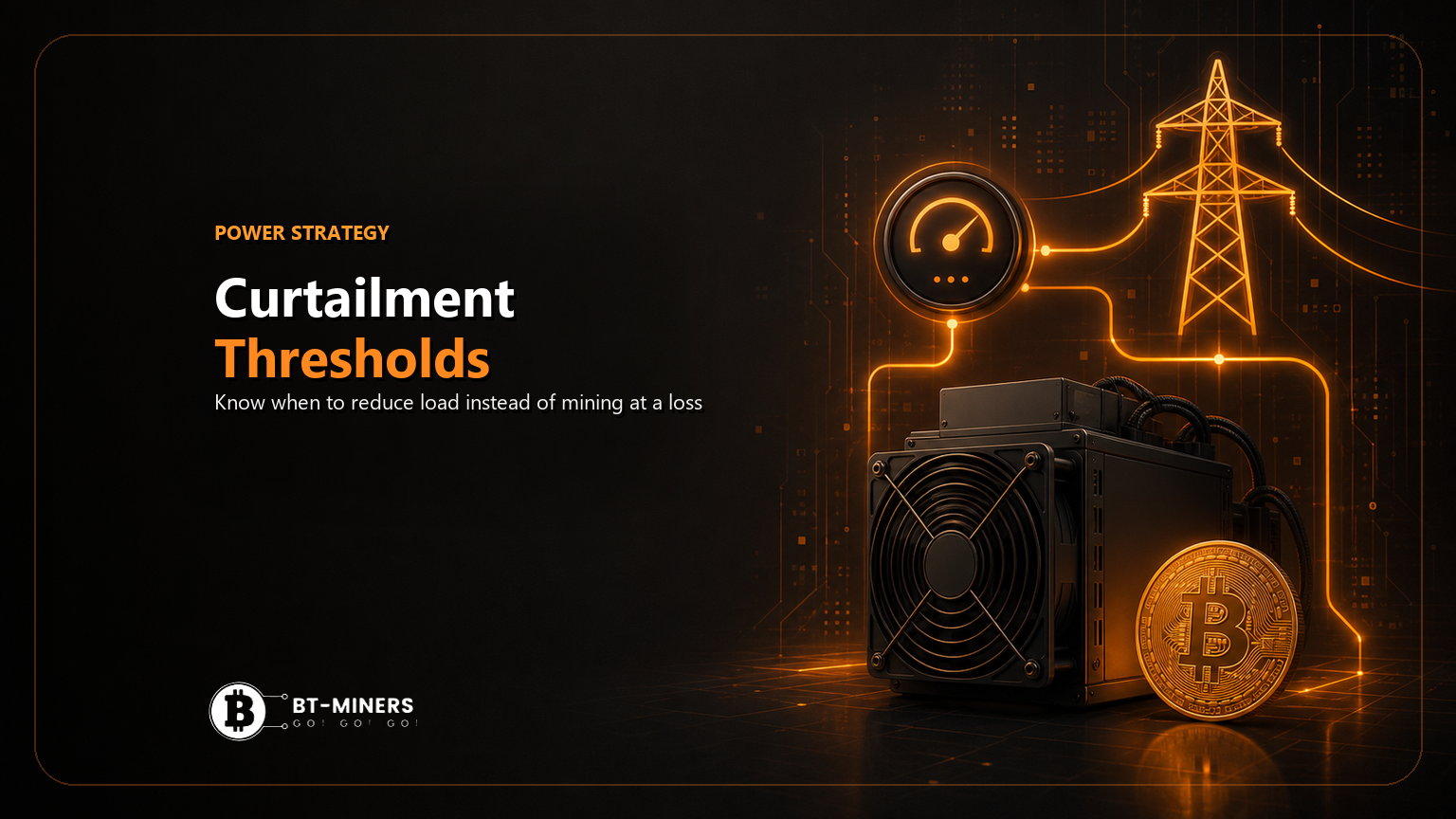
A curtailment threshold is the power price or operating condition where a machine should slow down, underclock, or turn off. The threshold should be based on expected mining revenue, real wall power, hosting fees, pool fees, and the value of preserving machine life.
A simplified daily framework looks like this:
| Input | Why it matters | What to check |
|---|---|---|
| Hashprice | Shows expected revenue per unit of hashrate | Track it daily during volatile periods |
| Machine efficiency | Lower J/TH gives a wider power-cost buffer | Compare real wall power, not only nameplate specs |
| Electricity price | Determines when gross revenue turns into negative margin | Use time-of-use or hosting pass-through rates if applicable |
| Downtime cost | Frequent shutdowns can reduce realized payout | Measure restart reliability and pool reconnect behavior |
| Demand response credit | Can offset lost mining revenue if available | Confirm eligibility and settlement terms |
The mistake is using one average electricity rate for every hour of the month. If your facility has flat power and no curtailment option, that may be unavoidable. If the contract includes variable rates, curtailment credits, or utility signals, then average cost can hide the exact hours that damage margin.
What This Means for ASIC Buyer Decisions

ASIC buyers still need to start with hashrate, efficiency, price, warranty, and delivery timing. But in 2026, the better question is how the machine behaves inside a power strategy.
A high-efficiency Bitcoin miner such as the Bitmain Antminer S21 Pro gives operators more room before power cost eats the gross mining reward. Newer efficiency tiers such as the Bitmain Antminer S23 can widen that buffer further when the purchase price, shipping, deployment cost, and hosting terms make sense.
That does not mean the newest miner is automatically the best buy. A cheaper unit can still be attractive if the buyer has very low fixed power, strong uptime, and a realistic payback model. The point is that power flexibility changes the ranking. A miner with slightly lower headline hashrate can be more resilient if it runs efficiently through weak hashprice periods and restarts cleanly after curtailment events.
Before ordering from the BT-Miners Bitcoin miner collection, buyers should compare live income estimates on the BT-Miners daily income tracker, then model three cases: normal operation, weak hashprice, and curtailment-heavy operation.
Hosting Contracts Need a Power Clause, Not Just a Price
Many buyers focus on the quoted hosting rate and ignore the curtailment language. That can be expensive. A hosting contract should explain who controls shutdowns, how customers are notified, how uptime is calculated, whether demand response credits are shared, and whether underclocking or firmware changes are allowed.
Important questions include:
- Can the host curtail machines without customer approval during emergency or high-price events?
- Are curtailment hours excluded from uptime guarantees?
- Does the customer receive any benefit from demand response payments?
- Can the miner run custom performance profiles or only default firmware?
- How are pool settings protected during restarts?
- What happens if repeated cycling creates hardware instability?
These details decide whether demand response helps or hurts the customer. A transparent host can turn flexibility into a margin tool. A vague contract can turn it into surprise downtime.
When Full-Time Mining Still Makes Sense
Demand response is not always superior. Some miners should simply run full-time. If the power rate is fixed and low, facility uptime is high, machine efficiency is strong, and there is no meaningful curtailment payment, constant operation can be the better path.
The right strategy depends on the relationship between mining revenue and power opportunity cost. If turning off a machine saves more money or earns more credit than the expected mining reward for that period, curtailment deserves consideration. If the credit is small, restart risk is high, or the machine is highly profitable at the current rate, staying online may be better.
This is why the decision should be modeled, not guessed. A flexible strategy should have clear rules before the market becomes stressful.
Practical Checklist for This Week
- Track hashprice, difficulty, and network hashrate before changing fleet settings.
- Calculate machine-level power break-even instead of only fleet average margin.
- Separate older, less efficient units from current-generation ASICs in the model.
- Ask hosts how curtailment is triggered, measured, and credited.
- Test restart reliability and pool reconnect behavior before large curtailment events.
- Use conservative ROI assumptions when buying hardware during hashprice compression.
The deeper takeaway is that Bitcoin mining is becoming more power-aware. ASIC efficiency still matters, but the best operators increasingly combine efficient machines, careful pool setup, clean firmware practices, and flexible power rules.
FAQ
What is Bitcoin mining demand response?
Bitcoin mining demand response means reducing, shifting, or pausing mining load when power prices or grid conditions make full operation less attractive. It can help miners manage electricity cost and may create credits in some markets.
Does demand response make Bitcoin mining more profitable?
It can improve realized margin when curtailment savings or credits are larger than the mining revenue lost during those hours. The result depends on hashprice, electricity rate, machine efficiency, contract terms, and restart reliability.
Which ASIC miners are best for flexible power strategies?
Efficient Bitcoin miners with strong restart reliability and clean operating profiles are usually better suited. Buyers should compare J/TH, real wall power, firmware stability, warranty, hosting terms, and expected resale value.
Should home miners use demand response?
Home miners can use the same concept in a simpler way by avoiding expensive time-of-use hours, managing heat, and tracking daily mining revenue. Utility programs and rules vary, so home miners should check local terms first.
What should ASIC buyers ask before signing a hosting agreement?
Ask who controls curtailment, how uptime is calculated, whether demand response credits are shared, how pool settings are protected, and whether performance profiles or firmware changes are allowed.
Sources Checked
- Enel North America: Braiins demand response collaboration announcement
- Hashrate Index: Bitcoin mining hashprice and market indicators
- mempool.space: Bitcoin hashrate and difficulty graph
- U.S. Energy Information Administration: electricity use from cryptocurrency mining
- Research paper: hashprice and miner electricity demand response
This article is educational and does not provide financial advice. Mining revenue changes with Bitcoin price, transaction fees, network difficulty, pool performance, power cost, hosting terms, and hardware availability.