April 2026 Crypto Mining Market Update: BTC Network Hits 995 EH/s, KAS Miners Struggle, ZEC and XMR Lead ROI Rankings
⚠️ Disclaimer: Mining profitability estimates are based on current coin prices, network difficulty, and $0.07/kWh electricity cost. These figures change daily. Always conduct your own research before purchasing mining equipment.
April 2026 has delivered a split-screen moment for crypto miners: Bitcoin’s network hashrate is brushing up against the historic 1 exahash milestone while BTC price consolidates just below $75,000 — squeezing margins on older machines. Meanwhile, a quiet ROI crisis is unfolding in Kaspa, where most KAS ASICs are running at a loss at standard electricity rates. Against that backdrop, ZEC and XMR miners are posting the strongest net returns in the market. Here’s the full April 2026 mining market update.
Bitcoin Network Hits 995 EH/s — The Hashrate Milestone Nobody Is Talking About
As of April 18, 2026, the Bitcoin network hashrate stands at 995 EH/s — effectively on the doorstep of 1 ZH/s (zettahash per second), a milestone that would have seemed impossible just a few years ago. The network has continued growing its security even as BTC price sits at $74,740, well below recent peak levels.
Key Bitcoin network stats as of April 18, 2026:
- Network hashrate: 995 EH/s
- Current difficulty: ~32.65 trillion
- Next difficulty adjustment: +1.9% (estimated)
- Block height: 945,543
- Block reward: 3.125 BTC (post-halving)
- BTC price: $74,740
What does this mean in practice? Rising difficulty at a roughly flat price is a direct squeeze on BTC mining margins. The network is not pulling back — institutional and large-scale miners continue adding hash power — which pushes breakeven points higher for less efficient machines. A projected +1.9% difficulty increase on the next adjustment will further compress per-unit revenue for all BTC miners.
For buyers considering BTC miners in April 2026, the ROI math has become demanding. Here’s how the numbers look across the BTC models BT-Miners currently carries:
BTC Mining Economics in April 2026: What You’re Actually Making Per Machine
Data as of April 18, 2026. BTC price: $74,740. Electricity cost: $0.07/kWh. Hardware prices subject to change.
| Miner | Hashrate | Power | Gross Daily | Elec Cost/day | Net Daily | Price | ROI |
|---|---|---|---|---|---|---|---|
| Antminer S23 Hyd 3U | 1,160 TH/s | 11,020W | $12.97 | $18.51 | -$5.54 | $29,800 | N/A (loss at $0.07/kWh) |
| Antminer S23e U2H | 865 TH/s | 8,650W | $8.63 | $14.53 | -$5.90 | $19,030 | N/A (loss at $0.07/kWh) |
| Antminer S21 XP+ Hyd | 500 TH/s | 5,500W | $3.79 | $9.24 | -$5.45 | $12,700 | N/A (loss at $0.07/kWh) |
The table tells a stark story: at $0.07/kWh, BTC-only miners are running at a net loss in April 2026. The Antminer S23 Hyd 3U’s 11,020W draw costs $18.51/day in electricity against just $12.97 in gross revenue — a daily loss of $5.54. These machines require either sub-$0.04/kWh power rates, or co-location hosting arrangements that bundle bulk power pricing, to turn a profit.
If you’re evaluating BTC miners, the BT-Miners profitability calculator lets you model your specific electricity rate and see exact net figures for any machine. BT-Miners’ co-location hosting service is worth evaluating for BTC miners who need industrial power pricing.
Kaspa Mining Reality Check: Most KAS ASICs Are Underwater at $0.07/kWh
Kaspa (KAS) was one of the defining stories in ASIC mining through 2024 and early 2025. Dedicated hardware launched, multiple manufacturers entered the space, and ROI projections looked compelling. In April 2026, the picture has shifted considerably. KAS now trades at $0.0339, and the profitability math for most KAS miners has turned negative at standard electricity costs.
Real-world operators running multiple KAS5 Pro units at $0.07/kWh are absorbing daily losses — each machine costs more in electricity than it generates in gross mining revenue. The hardware investment that looked compelling at higher KAS prices is now a liability for miners without access to below-market power rates.
Data as of April 18, 2026. KAS price: $0.0339. Electricity cost: $0.07/kWh. Hardware prices subject to change.
| Miner | Hashrate | Power | Gross Daily | Elec Cost/day | Net Daily | Price | Verdict |
|---|---|---|---|---|---|---|---|
| Antminer KS7 | 36 TH/s | 2,772W | $7.69 | $4.66 | +$3.04 | $1,700 | Marginally positive (~559-day ROI) |
| ICERIVER KS7 | 30 TH/s | 3,500W | $6.41 | $5.88 | +$0.53 | $1,990 | Barely breaking even |
| Antminer KS5 Pro | 21 TH/s | 3,150W | $4.49 | $5.29 | -$0.80 | $1,450 | At a loss |
| Antminer KS5 | 20 TH/s | 3,000W | $4.27 | $5.04 | -$0.77 | $350 | At a loss |
| ICERIVER KS5M | 15 TH/s | 3,400W | $3.21 | $5.71 | -$2.51 | $490 | At a loss |
Only the Antminer KS7 generates meaningful positive cash flow at $3.04/day net — though at that rate, its $1,700 price tag implies a 559-day (~18.6 month) ROI under current conditions. The honest assessment: unless you have access to sub-$0.04/kWh power, most KAS miners in April 2026 are not viable new investments at current KAS prices. This does not mean Kaspa has no upside — a KAS price recovery could flip these numbers — but buyers should model multiple KAS price scenarios before committing capital.
ZEC and XMR: The Clear ROI Leaders in April 2026
The sharpest contrast to BTC and KAS is found in ZEC and XMR mining. Both coins benefit from persistent demand for privacy-preserving transactions, and both have efficient ASIC hardware available through BT-Miners. The ROI timelines are dramatically shorter than anything in the BTC space right now — and orders of magnitude better than KAS at current prices.
Data as of April 18, 2026. ZEC price: $334.03. XMR price: $345.27. Electricity cost: $0.07/kWh. Z15 Pro price reflects second-lowest available tier. Hardware prices subject to change.
| Miner | Coin | Power | Gross Daily | Elec Cost/day | Net Daily | Price | Est. ROI |
|---|---|---|---|---|---|---|---|
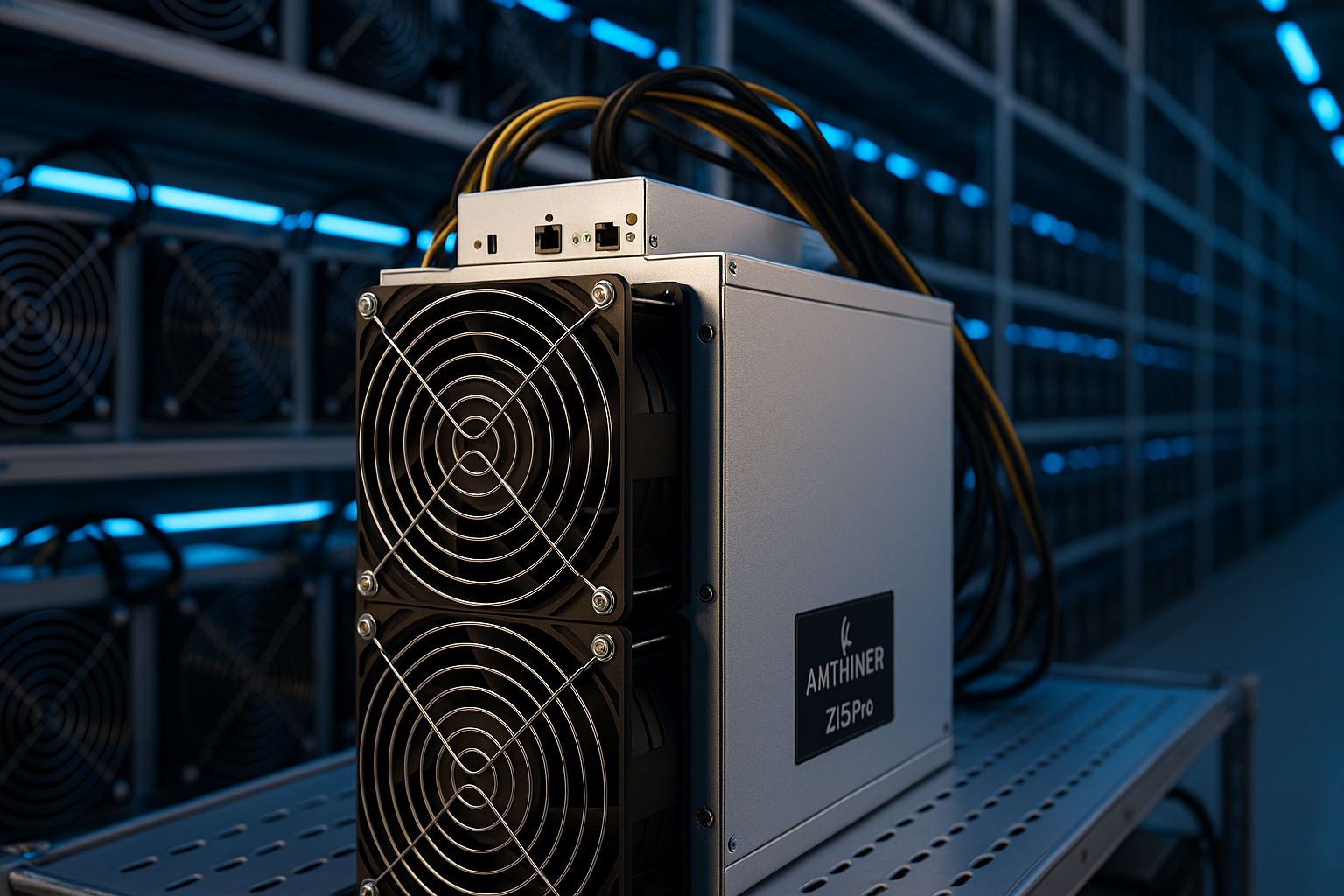
| Antminer Z15 Pro (840 KSol/s) | ZEC | 2,780W | $38.11 | $4.67 | $33.44 | $3,700 | ~3.7 months |
| Antminer Z15 (420 KSol/s) | ZEC | 1,510W | $19.06 | $2.54 | $16.52 | $2,800 | ~5.7 months |
| Antminer X9 (1 MH/s) | XMR | 2,472W | $21.87 | $4.15 | $17.72 | $5,600 | ~10.5 months |
| Matches INIBOX PRO (2.4 GH/s) | INITVERSE | 1,280W | $39.58 | $2.15 | $37.43 | $7,300 | ~6.5 months |
| Matches INIBOX (850 MH/s) | INITVERSE | 500W | $13.91 | $0.84 | $13.07 | $2,820 | ~7.2 months |
The Antminer Z15 Pro stands out as April 2026’s top performer by net daily income per dollar invested: $33.44/day net at $0.07/kWh, with an estimated ROI of approximately 3.7 months at current pricing. The Matches INIBOX PRO, mining the INITVERSE coin, posts the highest absolute gross revenue at $39.58/day — with $37.43/day net and an estimated 6.5-month ROI at $7,300.
For context: these ROI timelines are 5–15x faster than anything in the BTC mining stack at current prices and difficulty. The divergence between BTC and alt-coin ASIC returns in April 2026 is among the most pronounced in recent memory.
Browse the full ZEC and XMR hardware lineup on the BT-Miners product catalog or run your own profitability calculation here to see exact numbers at your electricity rate.
April 2026 Mining Strategy Recommendations by Buyer Profile
Based on the live data, here is how BT-Miners frames the current landscape for different buyer profiles:
Buyers Prioritizing Fast ROI
The Antminer Z15 Pro (ZEC, ~3.7-month estimated ROI) and Matches INIBOX PRO (INITVERSE, ~6.5-month estimated ROI) offer the strongest net daily returns and sub-7-month payback at $0.07/kWh. These are the machines to evaluate first if capital recovery speed is the priority. Review the Antminer Z15 Pro product page for current availability.
Buyers With Sub-$0.04/kWh Power Access
Large-scale BTC miners (S23 Hyd 3U, S21 XP+ Hyd) become viable at very low industrial electricity rates. These units are suited for purpose-built facilities. BT-Miners’ co-location hosting service provides access to favorable power pricing for buyers who want BTC exposure without managing residential power costs.
Existing KAS Miners
Unless KAS price recovers materially above current levels, adding KAS mining capacity at standard electricity rates is difficult to justify in April 2026. If you already own KAS hardware, running it on the cheapest power available and monitoring KAS price for a potential recovery is the rational approach.
New Entrants Evaluating Their First ASIC
The Antminer Z15 is an accessible entry point: lower power draw (1,510W), a $2,800 price point, and $16.52/day net income. At 5.7 months estimated ROI, it offers strong fundamentals for first-time operators. Read the BT-Miners ZEC Mining Guide 2026 before purchasing.
For personalized purchasing advice or to inquire about hosting options, contact the BT-Miners team directly.
Frequently Asked Questions
Is Bitcoin mining profitable in April 2026?
At standard residential electricity rates ($0.07–$0.10/kWh), most BTC ASICs are operating at a net loss in April 2026. The Bitcoin network hashrate near 995 EH/s and an expected +1.9% difficulty increase are compressing per-unit returns even as BTC price holds at $74,740. Profitability typically requires industrial power pricing below $0.04/kWh or co-location arrangements with bulk rate access.
Which ASIC miners have the best ROI in April 2026?
The Antminer Z15 Pro (ZEC, ~3.7-month estimated ROI at $3,700 and $0.07/kWh), Antminer Z15 (ZEC, ~5.7-month ROI), and Matches INIBOX PRO (INITVERSE, ~6.5-month ROI at $7,300) rank highest for capital recovery speed. All calculations assume current coin prices and network difficulty, which fluctuate daily.
Is Kaspa (KAS) mining still worth it in April 2026?
At current KAS price ($0.0339), most KAS ASICs generate negative net income at $0.07/kWh. Only the Antminer KS7 produces meaningful positive cash flow ($3.04/day net), but its implied ROI of roughly 18+ months is not competitive with ZEC or XMR alternatives at today’s prices. Buyers should model multiple KAS price recovery scenarios before investing in new hardware.
What is the Bitcoin network hashrate in April 2026?
As of April 18, 2026, the Bitcoin network hashrate stands at approximately 995 EH/s — approaching the historically significant 1 ZH/s (1,000 exahash per second) milestone. The next difficulty adjustment is projected to increase by approximately 1.9%, which will modestly reduce per-unit mining revenue for all BTC miners.
Where can I calculate my exact mining profitability?
BT-Miners provides a real-time profitability calculator covering all miners in our inventory. Enter your electricity rate to see net daily income, monthly totals, and ROI projections for any machine. For personalized purchasing advice, contact our team directly.