
Antminer X9 Review 2026: Does Dedicated Monero Hardware Beat CPU Mining?
⚠️ Disclaimer: Mining profitability estimates are based on current coin prices, network difficulty, and $0.07/kWh electricity cost. These figures change daily. Always conduct your own research before purchasing mining equipment.
A question keeps surfacing in Monero mining communities: “Should I mine XMR on my existing server hardware, or invest in dedicated mining equipment?” With XMR trading at $392.57 and the Antminer X9 delivering $27.31 in net daily profit at $0.07/kWh electricity, the answer deserves a rigorous look. The math is more decisive than most CPU advocates expect.
This Antminer X9 review 2026 covers verified hardware specifications, profitability calculations based on live market data, a direct head-to-head comparison against CPU server mining, and what the emerging RandomX v2 discussion means for anyone considering this purchase today.
Antminer X9 Review 2026: Specifications and What the Hardware Delivers
The Bitmain Antminer X9 is purpose-built for the RandomX algorithm used exclusively by Monero. Unlike traditional ASICs that perform a single fixed computation, the X9 is engineered around fast random memory access — the core challenge that RandomX was designed to favor CPUs on. Bitmain’s hardware implementation delivers a hashrate that no consumer CPU can match economically on a per-dollar-invested basis.
| Specification | Antminer X9 |
|---|---|
| Algorithm | RandomX (Monero / XMR) |
| Hashrate | 1,000,000 H/s (1 MH/s) |
| Power Consumption | 2,472W |
| Daily Electricity Cost (@$0.07/kWh) | $4.16/day |
| Gross Daily Revenue (XMR @ $392.57) | $31.47/day |
| Net Daily Profit (@$0.07/kWh) | $27.31/day |
| Hardware Price | $5,600 |
| Estimated ROI (@$0.07/kWh) | ~205 days (~6.8 months) |
Data as of April 27, 2026. XMR price: $392.57. Network difficulty current as of data pull date. Hardware prices subject to change — see the BT-Miners profitability calculator for live figures.
A few numbers deserve emphasis. The X9’s 1 MH/s hashrate is approximately 4.7× more powerful than the Antminer X5 (212 KH/s) while consuming less than double the power. That efficiency advantage drives dramatically different ROI between the two models. The electricity cost calculation breaks down cleanly: 2,472W × 24 hours ÷ 1,000 × $0.07 = $4.15/day in power costs, subtracted from the $31.47 gross daily revenue to yield $27.31 net.
For context: most Bitcoin miners in 2026 are running 2–4 year payback periods at the same electricity rate. The X9 belongs to a small group of mining hardware currently offering genuinely fast capital recovery, making Monero one of the more compelling ASIC mining opportunities available right now.
CPU Mining for Monero in 2026: What the Numbers Actually Show

Monero was deliberately designed to be CPU-friendly. The RandomX algorithm requires fast random memory access — a characteristic of modern CPUs — specifically to prevent ASICs from dominating the network. The intent was to keep mining decentralized across consumer hardware. In practice, this has created a widespread but financially damaging misconception: that CPU mining is economically competitive with dedicated hardware for anyone making a fresh hardware investment.
Here is how several CPU configurations perform at current XMR prices ($392.57):
| Hardware | Est. Hashrate | Power Draw | Gross/Day | Elec. Cost/Day | Net/Day | Approx. Cost | Est. ROI |
|---|---|---|---|---|---|---|---|
| Intel i5-6500 (single PC) | ~1 KH/s | 65W | $0.03 | $0.11 | -$0.08 | ~$150 | Never (net negative) |
| Ryzen 9 5950X (16-core desktop) | ~13 KH/s | 140W | $0.41 | $0.24 | $0.17 | ~$700 (CPU only) | ~11 years |
| AMD EPYC 9654 (96-core server) | ~250 KH/s | 600W | $7.87 | $1.01 | $6.86 | ~$9,000+ (CPU only) | ~44 months |
| Antminer X9 (dedicated) | 1,000 KH/s | 2,472W | $31.47 | $4.16 | $27.31 | $5,600 | ~6.8 months |
Data as of April 27, 2026. XMR price: $392.57. Electricity: $0.07/kWh. CPU hashrates are community benchmark estimates with optimized XMRig settings and huge pages enabled. CPU hardware costs are approximate retail prices for the processor only — full system costs are higher. Individual results will vary by configuration and cooling.
The key insight: a $5,600 investment in the Antminer X9 returns capital in 6.8 months. A $9,000 investment in just an EPYC 9654 CPU returns capital in 44 months — and that’s before accounting for the motherboard, RAM, PSU, and cooling infrastructure costs.
An older PC such as an Intel i5-6500 is net-negative at $0.07/kWh — it costs more to power than it earns. Miners operating these machines are effectively subsidizing the XMR network at their own expense. On the other end of the spectrum, even a high-end 96-core server CPU offers 6.5× worse ROI than the X9 at 1.6× the upfront hardware cost (CPU alone).
The one scenario where CPU mining remains financially justifiable: you already own the hardware and run it for another primary purpose. Mining XMR on otherwise-idle CPU cycles adds meaningful income at near-zero marginal cost. But purchasing CPUs or servers specifically to mine Monero in 2026 does not pencil out compared to the dedicated hardware alternative.
Use the BT-Miners daily income calculator to model these numbers against your specific electricity rate and hardware configuration.
Antminer X9 vs Antminer X5: Choosing the Right Monero Hardware
BT-Miners carries two dedicated Monero mining options. The comparison is more straightforward than it might appear:
| Metric | Antminer X9 | Antminer X5 |
|---|---|---|
| Hashrate | 1,000 KH/s (1 MH/s) | 212 KH/s |
| Power Consumption | 2,472W | 1,350W |
| Gross Daily Revenue | $31.47 | $6.67 |
| Net Daily (@$0.07/kWh) | $27.31 | $4.40 |
| Hardware Price | $5,600 | $3,199 |
| ROI (@$0.07/kWh) | ~6.8 months | ~24.2 months |
| Revenue per Watt | $0.011/W | $0.0033/W |
Data as of April 27, 2026. XMR price: $392.57. Electricity: $0.07/kWh.
The X9 returns capital 3.5× faster per dollar invested. Its revenue-per-watt ratio is 3.3× superior to the X5. For any miner optimizing for ROI, the X9 is the correct choice. The X5 has a narrow use case: electrical infrastructure that cannot support a 2.5 kW sustained draw, or buyers wanting a lower initial commitment to test Monero mining economics before scaling up. At $3,199 with a 24-month ROI, the X5 significantly increases exposure to price and difficulty risk compared to its more powerful sibling.
RandomX v2 and the Antminer X9: What Miners Need to Know
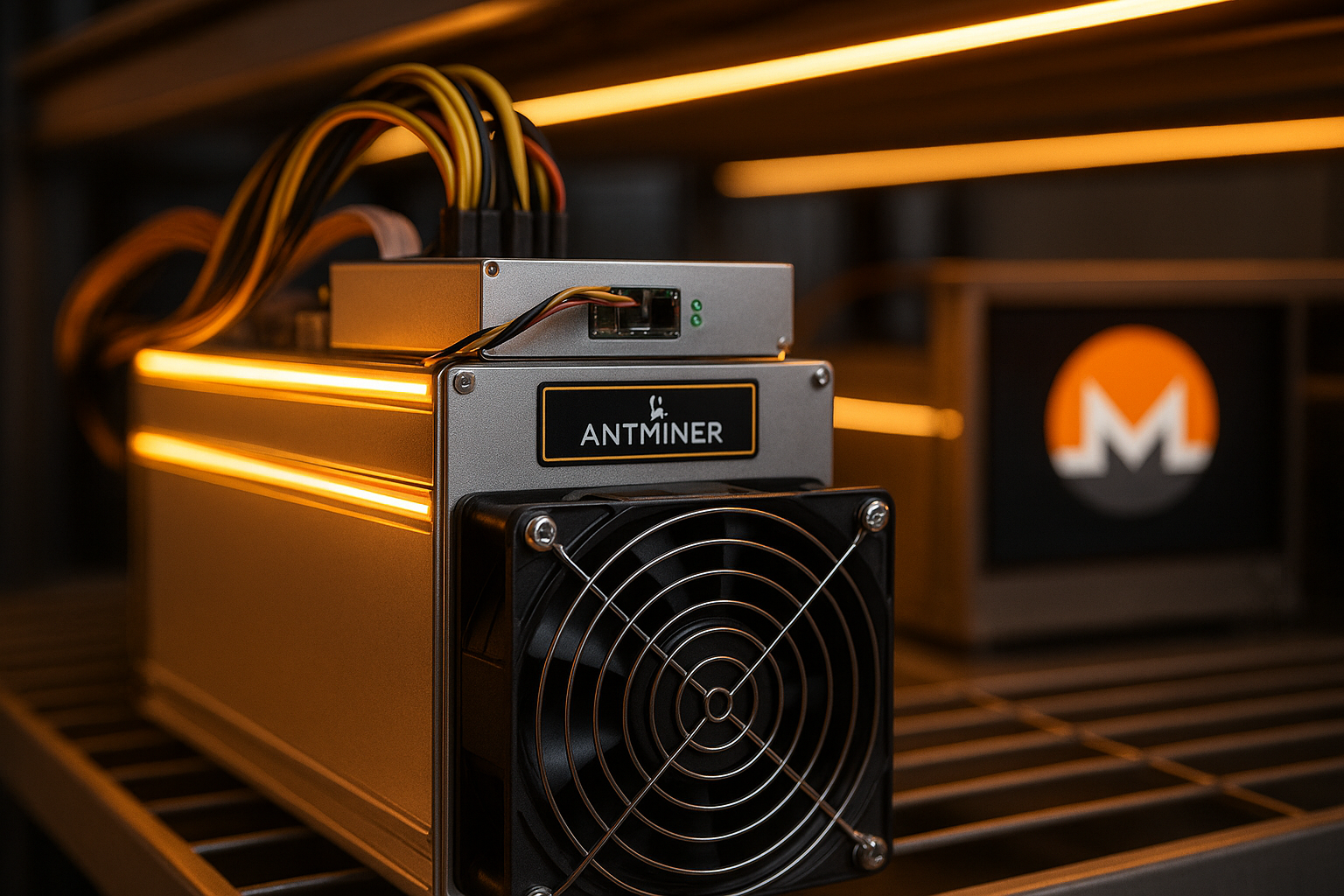
In April 2026, XMRig released version 6.26.0 with support for RandomX v2 — a protocol update generating real debate in Monero mining communities. This is a legitimate consideration for anyone evaluating the X9 today.
The current situation as of April 27, 2026:
- RandomX v2 has not been activated on Monero mainnet. XMRig’s v6.26.0 support is preparatory — the software is ready, but no hard fork date has been officially confirmed by Monero’s core development team.
- Monero has historically used hard forks to preserve CPU-mining accessibility. Each fork resets hardware-specific optimizations, maintaining a degree of mining decentralization.
- The X9’s hardware is optimized for the current RandomX implementation. A significant algorithm revision could require a firmware update from Bitmain — or potentially new hardware in a more extreme change scenario.
- CPU miners benefit from software adaptability. When RandomX updates, XMRig typically issues a software patch and general-purpose hardware continues mining without hardware replacement.
This is a risk factor worth pricing in. However, context matters: at a 6.8-month ROI, an X9 purchased today fully recovers its capital well before most protocol changes are proposed, debated, governance-approved, and activated on mainnet. Monero’s fork process — including community discussion, miner signaling, and implementation — typically takes months to years from initial proposal to live activation.
Recommendation: watch official Monero project announcements and the XMRig repository for any confirmed RandomX v2 mainnet timeline. If no imminent hard fork is scheduled, the X9’s economics remain among the strongest available in the current mining market. If a fork is confirmed for the near term, delay the purchase until Bitmain’s hardware response is known.
Who Should Buy the Antminer X9 in 2026?
After examining the hardware specs, the CPU comparison, and the current protocol landscape, here is the practical verdict:
The X9 is the right purchase if you:
- ✅ Have electricity at or below $0.10/kWh — net profit remains meaningful up to approximately $0.12/kWh before margins compress significantly
- ✅ Want to mine Monero with purpose-built hardware rather than repurposing servers
- ✅ Can provide a dedicated 240V circuit and adequate ventilation for a 2.5 kW machine
- ✅ Are comfortable with XMR’s privacy-coin positioning and regulatory environment
- ✅ Want a sub-12-month ROI window in the current altcoin mining climate
The X9 is not ideal if you:
- ❌ Pay more than $0.12/kWh for electricity — margins thin substantially above that level
- ❌ Want zero exposure to Monero protocol-change risk (consider Bitcoin or Zcash ASICs instead)
- ❌ Need to run the miner in a noise-sensitive residential environment — 2.5 kW of mining hardware generates significant fan noise and heat requiring dedicated ventilation
If electrical infrastructure is a constraint, BT-Miners’ co-location hosting service places your miner in a professional facility with power rates optimized for mining operations — often significantly below residential tariffs. For X9 operators looking to maximize the 6.8-month ROI window without home installation complexity, hosting is worth evaluating seriously.
Ready to run the numbers for your specific situation, or want to discuss whether the X9 fits your mining goals? Contact the BT-Miners team — we work with buyers at every scale, from single-unit home setups to multi-unit hosted deployments.
Frequently Asked Questions
Is the Antminer X9 profitable in 2026?
Yes. At XMR’s current price of $392.57 and $0.07/kWh electricity, the Antminer X9 earns approximately $27.31/day in net profit, with an estimated payback period of 6.8 months. Profitability remains positive up to approximately $0.12/kWh electricity cost at current XMR prices. Above that level, daily margins thin and the ROI window extends significantly.
Is CPU mining for Monero still worth it in 2026?
Only if you are mining on hardware you already own for another purpose. Running XMR on idle CPU cycles adds income with no additional hardware cost. However, purchasing CPUs or servers specifically to mine Monero is not economically competitive with the Antminer X9 — even high-end EPYC server CPUs show ROI windows of 3–4 years versus 6.8 months for the X9 at the same electricity rate.
What will RandomX v2 do to the Antminer X9?
That depends on the scope of algorithm changes and Bitmain’s firmware response. As of April 2026, RandomX v2 has not been activated on Monero mainnet and no official timeline has been confirmed. The X9’s sub-7-month ROI means most buyers would recover their capital before a hard fork is likely to be implemented and finalized through Monero’s governance process.
How does the Antminer X9 compare to the Antminer X5?
The X9 (1 MH/s, $5,600, ~6.8-month ROI) significantly outperforms the X5 (212 KH/s, $3,199, ~24-month ROI) on every financial metric. The X9 returns capital 3.5× faster per dollar invested. The X5’s only advantage is lower upfront cost and lower power draw for operations with strict electrical infrastructure limits.
Does BT-Miners offer co-location hosting for the Antminer X9?
Yes. BT-Miners’ co-location hosting service accepts the Antminer X9 and offers professional facility power rates that improve on most residential electricity costs. Contact us for current availability and pricing details.