Hydro-Cooled Bitcoin Miner Buying Guide 2026: When S21 Hyd and S23 Hyd Models Make Sense
⚠️ Disclaimer: Mining profitability fluctuates with electricity costs, cryptocurrency prices, and network difficulty. All figures reflect conditions as of June 24, 2026. Past performance does not indicate future results. Conduct your own due diligence before purchasing mining equipment.
Hydro-cooled ASIC miners attract strong interest from commercial operators — but they also generate persistent misconceptions about who they are actually suited for. This guide covers the practical decision framework: what hydro cooling requires, which models are currently available, and the specific operational scenarios where the infrastructure investment is justified. If you are evaluating hydro miners for a home or small-scale setup, read the final section first.
How Hydro Cooling Works in ASIC Miners
Hydro-cooled ASIC miners replace the industrial fans found in conventional units with water blocks that press directly against the hashboards and control boards. Coolant circulates through a closed loop — from the miner to an external cooling distribution unit (CDU) or cooling tower — dissipating heat through a heat exchanger rather than through airflow.
Key operational differences from air-cooled units include:
- No air flow dependency — the miner does not require ventilated space or raised-floor airflow paths
- Higher sustained hashrate — thermal throttling under heavy load is reduced or eliminated
- Lower internal operating temperatures — contributes to longer hashboard lifespan under sustained operation
- Near-silent operation — industrial fans are largely eliminated; the CDU produces some noise but far less than air-cooled equivalents
- Higher power density per rack unit — more hashrate fits into a given rack footprint
The tradeoff is significant: hydro miners require a permanent water infrastructure that air-cooled units do not. A CDU, piping, manifolds, and leak detection add $15,000 to $60,000 or more in upfront capital depending on deployment scale, and must be factored into total cost of ownership before any profitability analysis.
Key Hydro-Cooled Bitcoin Miners Available in 2026
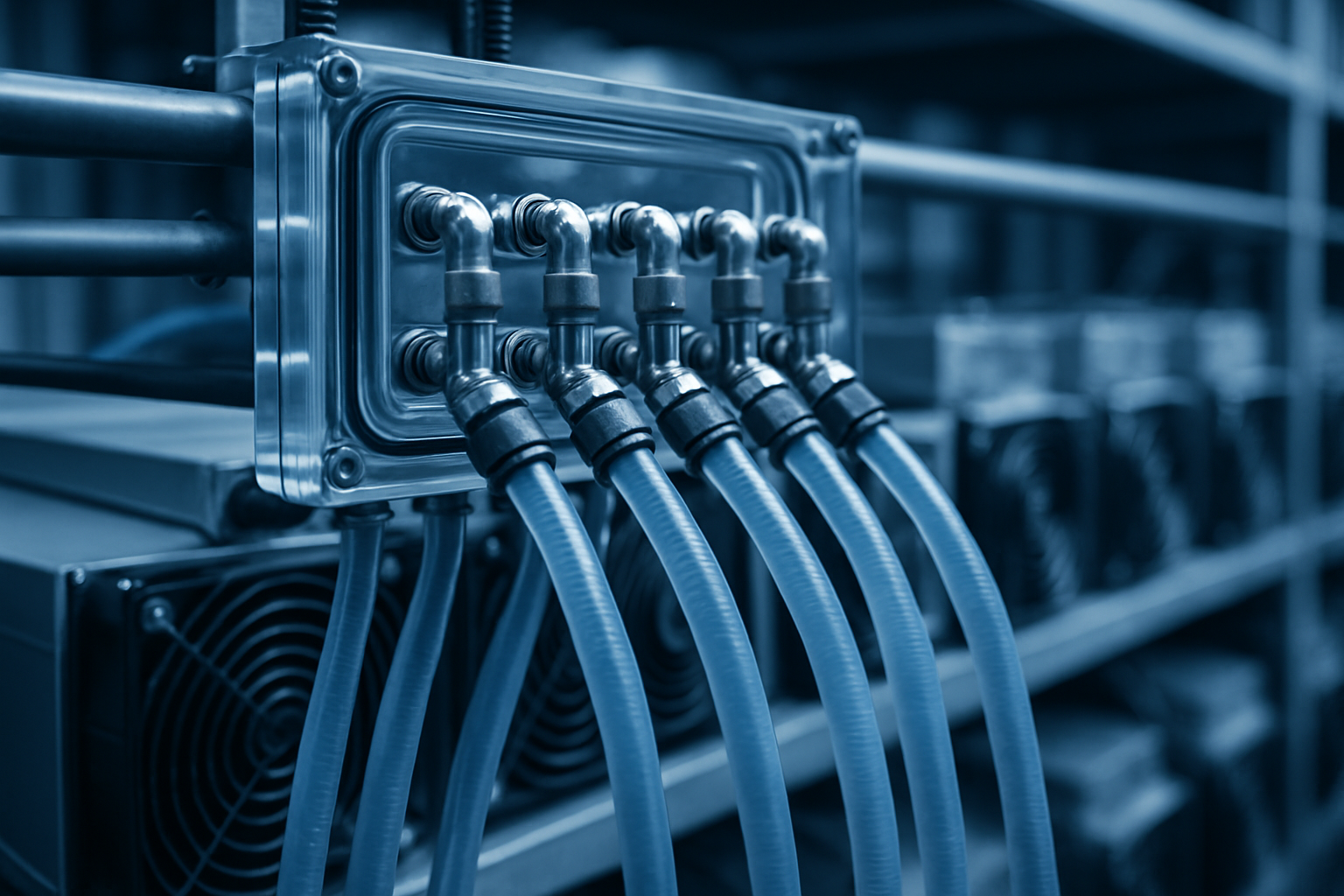
Bitmain Antminer S21 Hyd
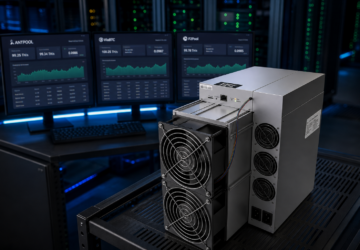
The Antminer S21 Hyd is Bitmain’s primary liquid-cooled Bitcoin miner for the current generation. The flagship configuration delivers 335 TH/s at 5,360W, an efficiency of approximately 16.0 J/TH (joules per terahash — a measure of power efficiency where lower values indicate less energy consumed per unit of hashing work).
| Specification | Antminer S21 Hyd 335T |
|---|---|
| Hashrate | 335 TH/s (±3%) |
| Power Consumption | 5,360W (±5%) |
| Chip Efficiency | 16.0 J/TH |
| Cooling Method | Liquid-cooled (water blocks) |
| Noise Level | <45 dB |
| Water Inlet Temperature | 5–40°C |
| Form Factor | 2U rack-mountable |
| Algorithm | SHA-256 (Bitcoin) |
Note: Verify current pricing and availability at the BT-Miners S21 Hyd product page. Specifications subject to firmware revisions.
The S21 Hyd succeeds the S19 Hyd in Bitmain’s lineup. Operators running an existing water cooling loop from previous-generation deployments can generally integrate S21 Hyd units without significant infrastructure modifications, provided CDU capacity is sufficient.
Bitmain Antminer S23 Hyd 3U
The Antminer S23 Hyd 3U represents Bitmain’s high-density enterprise tier. The 3U form factor delivers more hashrate per rack unit than the standard 2U S21 Hyd, reducing per-unit overhead in management, cabling, and PDU circuit consumption. At a current retail price of approximately $29,800, this unit targets institutional procurement rather than independent operators.
The S23 Hyd 3U requires dedicated high-amperage power infrastructure — typically 240V or higher three-phase distribution — in addition to the liquid cooling loop. Buyers should model the total per-rack capital requirement (miner cost plus amortized CDU and power infrastructure) before comparing ROI against lower-cost alternatives. Use the BT-Miners profitability calculator to run current revenue projections at your electricity rate.
MicroBT Whatsminer M66S Hydro
MicroBT’s hydro offering for 2026, the M66S Hydro, runs at approximately 298 TH/s with 5,412W power draw (~18.2 J/TH). On a raw chip efficiency basis it trails the S21 Hyd, but MicroBT maintains a stronger service and parts network in Southeast Asia and parts of the Middle East — a relevant consideration for operators in those regions. Buyers with an existing Whatsminer management software ecosystem may also prefer this unit to avoid mixing control platforms.
Efficiency Comparison: Hydro vs Air-Cooled
A common assumption is that hydro cooling delivers meaningfully better chip efficiency than air-cooled units. The data shows a more nuanced picture.
| Model | Cooling Type | Hashrate | Power Draw | Efficiency (J/TH) |
|---|---|---|---|---|
| Antminer S21 Hyd 335T | Hydro | 335 TH/s | 5,360W | 16.0 |
| Antminer S21 Pro 234T | Air-cooled | 234 TH/s | 3,510W | 15.0 |
| Antminer S21+ 216T | Air-cooled | 216 TH/s | 3,564W | 16.5 |
| Whatsminer M66S Hydro | Hydro | 298 TH/s | 5,412W | 18.2 |
| Whatsminer M63S+ 390T | Air-cooled | 390 TH/s | 6,435W | 16.5 |
Note: Efficiency figures are manufacturer-rated at standard test conditions. Real-world efficiency varies with inlet water temperature (hydro) or ambient temperature (air-cooled), voltage calibration, and load profile. Model your specific scenario using the BT-Miners profitability calculator.
Bitmain’s air-cooled S21 Pro achieves 15.0 J/TH — meaningfully better than the S21 Hyd’s 16.0 J/TH on raw efficiency. The hydro advantage is not chip efficiency. It is thermal stability, operational density, and performance consistency in environments where air cooling is constrained.
Infrastructure Requirements: The Full Cost Picture
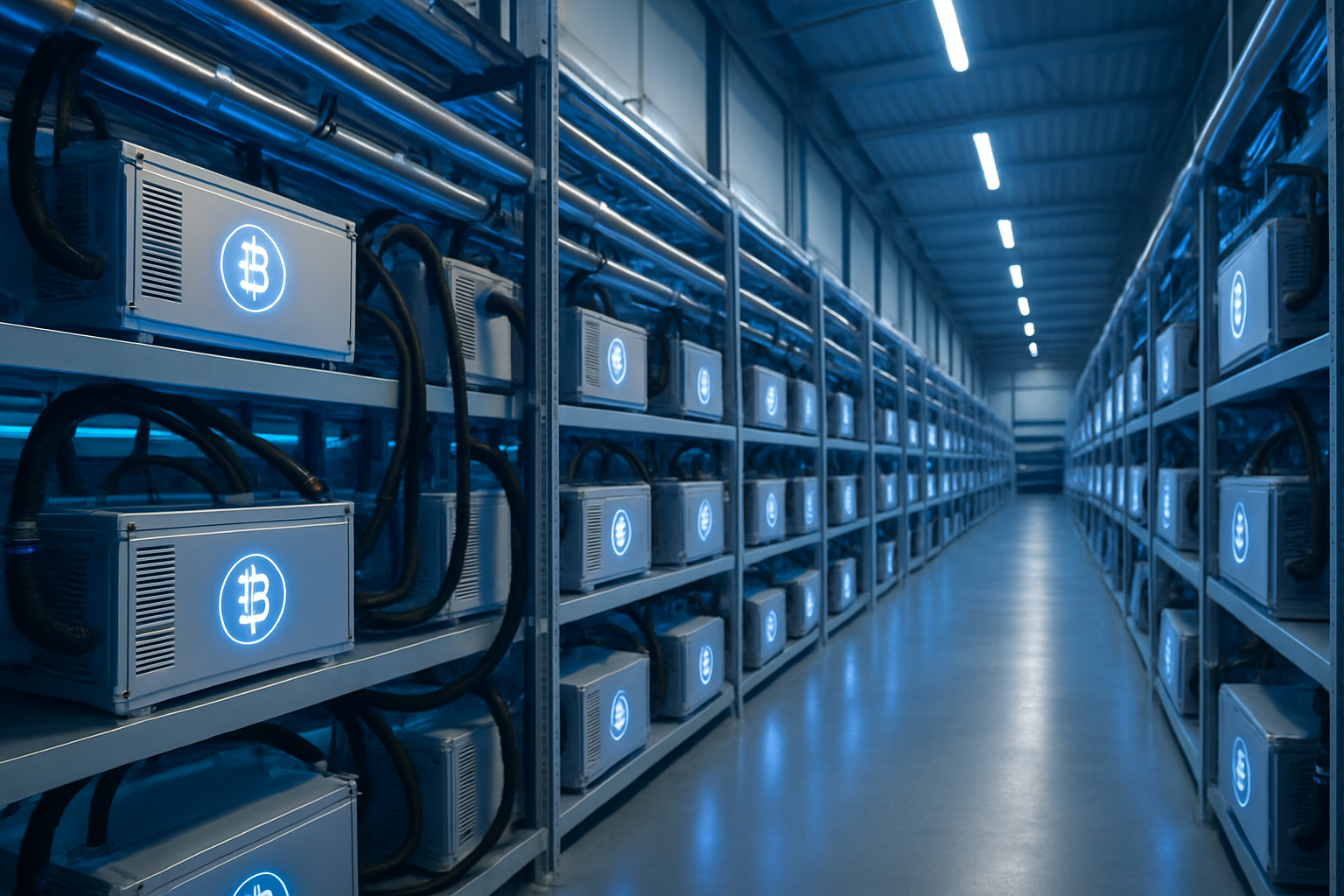
No evaluation of hydro miners is complete without accounting for the full infrastructure stack. The following are representative ranges for a mid-scale deployment (10–50 units). Costs vary significantly by location, facility condition, and contractor rates.
Cooling Distribution Unit (CDU)
A CDU manages coolant temperature, flow rate, and pressure across the cluster. For a 10-unit deployment, a suitable CDU costs approximately $8,000–$20,000. Enterprise CDUs supporting 50+ units typically run $30,000–$70,000.
In-Rack Plumbing and Manifolds
Supply/return manifolds, flexible hose connections, and leak-detection sensors add $3,000–$15,000 per rack depending on configuration. Leak detection is not optional: a single undetected plumbing failure can destroy an entire rack of hardware.
Heat Rejection
The CDU must reject heat to an external system — a cooling tower, dry cooler, or facility chiller. In hot climates where air-cooled miners require significant HVAC investment, this infrastructure is sometimes already available or cheaper to build than dedicated HVAC for air-cooled deployments.
Power Distribution
Hydro miners draw 5,000W or more per unit. A 10-unit deployment requires 50–60 kW of dedicated electrical capacity, typically requiring 3-phase distribution at 208V–480V. PDU (power distribution unit) costs at this scale run $5,000–$15,000 before installation.
Decision Framework: When Hydro Cooling Is Justified
Hydro cooling is economically justified when operators can confirm most of the following conditions:
- Minimum scale of 10+ units: CDU and plumbing costs are largely fixed. Below 10 units, the amortized infrastructure cost per miner is difficult to justify versus current-generation air-cooled efficiency gains.
- Ambient temperature consistently above 35°C: Air-cooled miners throttle or shut down in hot environments. Hydro miners maintain rated performance at water inlet temperatures up to 40°C — the practical choice for facilities in the Middle East, Southeast Asia, or any region without industrial HVAC.
- Rack space or PDU circuits are a binding constraint: If you are maximizing hashrate within a fixed rack footprint or electrical panel capacity, hydro miners deliver approximately 35–40% more hashrate per rack U than comparable air-cooled units.
- Planned operational horizon of 2+ years: Infrastructure capital recovers over time. Operators planning to cycle hardware every 12 months may not recover upfront infrastructure costs.
- Noise is a facility constraint: Industrial air-cooled miners operate at 75–82 dB. Hydro miners are near-silent at the chassis. For co-location facilities with noise restrictions, this may be a non-negotiable requirement.
| Scenario | Recommended Approach | Reasoning |
|---|---|---|
| Dedicated facility, 20+ units, hot climate | Hydro | Density, thermal stability, no HVAC overhead |
| Co-location, 5–20 units, temperate climate | Air-cooled | No CDU infrastructure, lower upfront cost |
| Home or small office, 1–5 units | Air-cooled only | Hydro infrastructure not feasible or safe in residential settings |
| Existing water-cooled facility expanding capacity | Hydro | CDU already amortized; incremental unit addition is efficient |
| High-density rack maximization, limited space | Hydro | ~35–40% more TH/s per rack U vs air-cooled |
Who Should Not Buy Hydro Miners
Hydro-cooled miners are not appropriate for home mining or operations with fewer than 5–10 units. The reasons are practical:
- CDU infrastructure is not feasible in residential settings
- Plumbing modifications typically violate residential lease agreements and building codes
- Water in proximity to high-voltage equipment is a serious safety and property risk
- The per-unit economics do not work at small scale — infrastructure cost exceeds any operational savings
For independent miners and small-scale operators, current air-cooled units in the 15–17 J/TH range provide strong performance without the infrastructure requirement. The decision should be based on verifiable operational conditions, not on the appeal of a technically impressive product.
Conclusion: A Tool for the Right Operating Environment
Hydro-cooled miners like the Antminer S21 Hyd and S23 Hyd 3U are established products with available manufacturer support and parts networks. For commercial operators building or scaling a dedicated facility — particularly in hot climates or high-density rack configurations — they are a deployable option for 2026 builds where those conditions are met. The chip efficiency advantage over current air-cooled alternatives is modest, but the density, thermal stability, and operational noise benefits can offset the higher upfront infrastructure cost over a multi-year deployment horizon — though this depends on actual electricity rates, hardware utilization, and hardware longevity.
For operators who do not meet the infrastructure prerequisites, the same capital deployed into current-generation air-cooled hardware will generally produce a better net outcome. Use the BT-Miners profitability calculator to compare scenarios at your electricity rate before committing.
View current pricing and availability for the Antminer S21 Hyd and Antminer S23 Hyd 3U on BT-Miners, or contact the team to discuss commercial procurement and infrastructure planning support.