Bitcoin Mining in the AI Era: The Buyer of Last Resort for Stranded Energy
⚠️ Disclaimer: Mining profitability fluctuates with electricity costs, cryptocurrency prices, and network difficulty. Past performance is not indicative of future results. Always conduct your own due diligence before purchasing mining equipment. Energy cost estimates in this article assume $0.07/kWh unless otherwise noted.
A quiet structural shift is reshaping the global energy landscape — and Bitcoin mining sits at its center in a way most analysts have not yet fully mapped. As artificial intelligence data centers race to lock up every megawatt of reliable, grid-connected electricity they can find, a different question is emerging for Bitcoin miners: what happens to all the electricity nobody else wants?
The answer may define the next decade of the mining industry.
Table of Contents
- Two Industries With Completely Different Power Requirements
- How AI Is Restructuring the Global Electricity Market
- Bitcoin Mining as Energy Monetization — Not Storage
- Three Real-World Scenarios Where This Already Works
- The Future Mining Operation: Energy Arbitrageur, Not Machine Room Owner
- What This Means for Your Mining Strategy
Two Industries With Completely Different Power Requirements
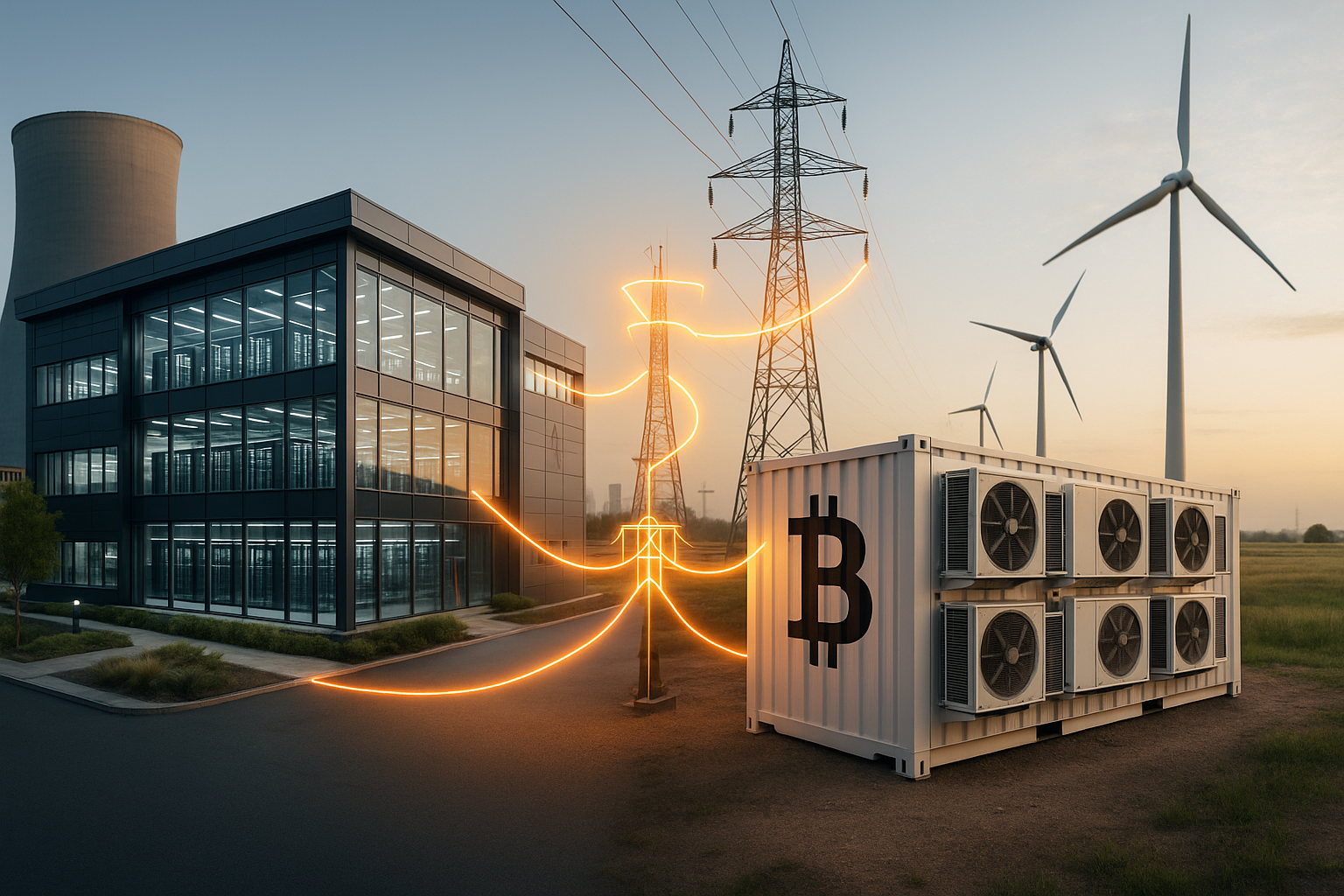
Bitcoin mining and AI data centers are both electricity-intensive industries. The comparison mostly ends there. Their requirements for what kind of power they need are almost structurally opposite — and that difference will increasingly determine which industry gets which electrons.
AI data centers require:
- Continuous, uninterrupted, high-reliability power supply
- Low-latency fiber network access
- Proximity to technical talent, regulatory frameworks, and cooling infrastructure
- Long-term, predictable power contracts — training runs and inference workloads cannot simply pause
- Location near population centers for workforce access
Bitcoin mining can operate with:
- Full flexibility to power on or off at any moment, with no data loss or performance consequence
- No geographic constraints — a mine in a remote mountain valley is as economically valid as one in a tech corridor
- Near-zero sensitivity to network latency (mining communicates only kilobytes per minute with pool servers)
- Below-market electricity, curtailed power, or stranded energy that cannot be economically transmitted elsewhere
- The operational capacity to voluntarily curtail load when grids need relief, then restart when conditions normalize
This is not a minor operational difference. It is a structural divergence that will grow more pronounced as AI’s appetite for premium power intensifies.
How AI Is Restructuring the Global Electricity Market
According to the International Energy Agency’s 2026 data center electricity report, global data center power demand grew approximately 17% in 2025, with AI-focused facilities growing at roughly 50% year-over-year. Infrastructure buildout at that pace does not slow down quickly once it reaches critical mass.
What happens when one category of buyer grows that fast and has highly specific quality requirements? The price of premium power rises. Grid operators near major technology corridors face capacity constraints. Power purchase agreements for reliable, location-advantaged electricity get signed years in advance at increasingly competitive rates.
The result is an emerging stratification of global electricity:
| Power Type | Best Suited For |
|---|---|
| Stable, urban-adjacent, grid-reliable | AI data centers, cloud computing |
| Remote, intermittent, curtailed, or stranded | Bitcoin mining |
| Peak-hour scarce supply | Industrial, residential, AI priority |
| Off-peak surplus generation | Bitcoin mining as flexible demand |
This stratification is not theoretical. It is already observable in Texas, Scandinavia, Sichuan, and across Central Asian hydropower corridors. AI occupies the premium tier. Bitcoin mining increasingly absorbs what remains.
Importantly, this dynamic does not represent a competition between industries for the same resource. It represents a division of resources by quality — a market sorting process where each industry gravitates toward the power type that best matches its operational profile.
Bitcoin Mining as Energy Monetization — Not Storage
Traditional battery storage works like this:
Electricity → Battery → Electricity (retrieved later)
Bitcoin mining works differently:
Electricity → Hash rate → Bitcoin → Globally liquid asset
The distinction matters. Bitcoin mining does not store energy to be released later. It monetizes energy in real time, converting local electrons into a globally fungible asset with 24-hour settlement and near-zero friction for cross-border transfer. The output is immediately tradeable on global markets regardless of where the mine is physically located.
Consider what this means for an energy asset that is otherwise difficult to monetize. A remote hydroelectric plant with limited transmission capacity can convert surplus generation into Bitcoin rather than curtailing it. A natural gas wellhead operator can use associated gas that cannot be economically pipelined to generate electricity and run mining hardware. A wind or solar developer facing negative spot prices during oversupply windows can deploy flexible mining load to absorb excess generation.
In each case, electricity that would have been wasted — or that would have required expensive transmission infrastructure to reach demand centers — gets converted into a liquid global asset instead. The mine’s geographic isolation, which would be a fatal constraint for almost any other industrial use, becomes economically irrelevant.
Three Real-World Scenarios Where This Already Works
Scenario A: Hydropower Curtailment Windows
Seasonal hydropower in regions like Sichuan, Yunnan, the Pacific Northwest, and parts of Scandinavia regularly generates more electricity than local grids can absorb during peak flow periods. Transmission bottlenecks mean that surplus power cannot economically reach demand centers. Mining operations co-located with these facilities have historically accessed electricity in the sub-$0.03/kWh range during curtailment windows — cost levels where virtually any modern ASIC delivers strong margins.
The key characteristic: these mines do not need to run year-round. During curtailment season, they operate at maximum capacity. During dry seasons when hydropower output drops, they can curtail or relocate. This flexibility is not a weakness of the mining model — it is precisely what makes the model viable where traditional industrial users could not operate at all.
Scenario B: Associated Gas at Oil and Gas Wellheads
Oil and gas extraction produces associated natural gas as a byproduct. In geographically isolated fields, this gas is frequently uneconomical to pipeline — the distance to processing infrastructure makes the capital investment prohibitive. Historically, operators flared this gas, releasing energy without any productive output.
Purpose-built mining containers powered by wellhead generators convert this stranded fuel into hash rate. Several operators in North Dakota, Texas, Oman, and Kazakhstan have demonstrated this model at commercial scale. When the effective electricity cost from converted wellhead gas is near zero, even hardware running at lower efficiency levels delivers compelling economics.
Scenario C: Wind and Solar Curtailment Events
Intermittent renewable generation’s core challenge is the mismatch between peak output and peak demand. During periods of high generation and low demand — common in wind-heavy grids overnight or in solar-heavy grids at midday — spot electricity prices can fall sharply or even turn negative. Grid operators are effectively paying industrial users to consume.
Flexible Bitcoin mining operations can absorb this curtailed generation and reduce negative price events. Texas’s ERCOT market has recognized Bitcoin miners as a meaningful contributor to grid demand response, with large miners voluntarily curtailing during scarcity events in exchange for favorable baseline contracts. The mine’s ability to respond within minutes to price signals — something almost no other industrial load can match — makes it uniquely valuable as a grid balancing tool. ERCOT itself has cited demand response as an important mechanism for improving grid reliability and reducing price spikes.
The Future Mining Operation: Energy Arbitrageur, Not Machine Room Owner
If the scenarios above describe where Bitcoin mining is heading, then the competitive advantage of tomorrow’s mining operation has relatively little to do with warehouse management. It has almost everything to do with energy access, operational flexibility, and financial sophistication.
The competitive miner of 2026 and beyond likely combines three distinct capabilities:
1. Energy Access
Direct control over low-cost, stranded, or flexible electricity sources. This means power purchase agreements with hydro or wind developers, co-location arrangements with oil and gas producers, or participation in grid demand-response programs that compensate miners for load flexibility. The ability to identify and secure non-standard power assets — ones that AI data centers and traditional industry cannot or will not use — is a durable competitive moat.
2. Hardware Efficiency and Flexibility
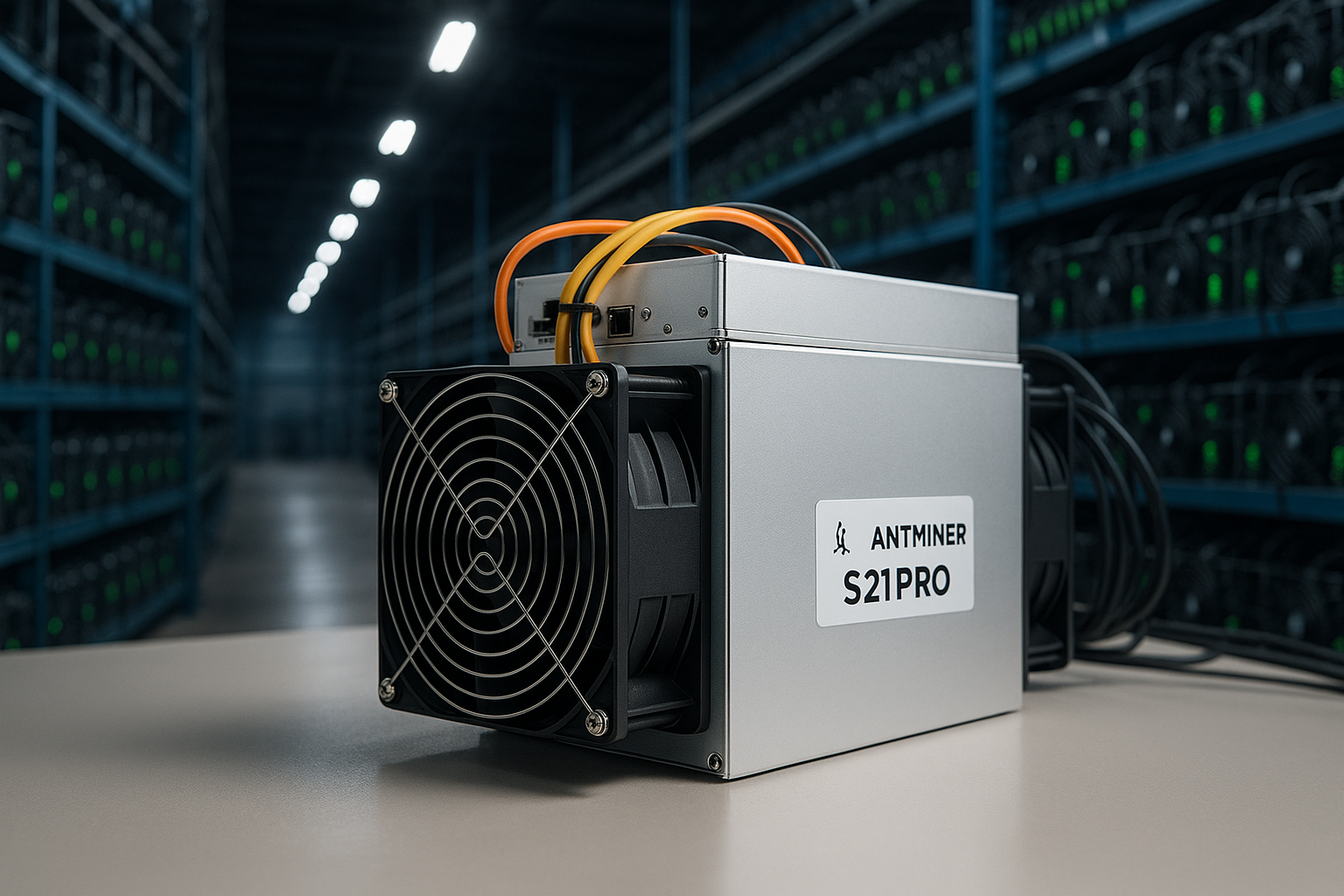
Older-generation ASICs require sub-$0.04/kWh electricity to remain profitable at current difficulty. Newer-generation machines like the Antminer S21 Pro (234 TH/s, 17.5 J/TH) and Antminer S21 XP (270 TH/s, 13.5 J/TH) expand the addressable energy pool by operating profitably at a wider range of electricity costs — opening access to a much larger set of potential power sources. The ability to rapidly deploy, relocate, or curtail machines is as strategically important as the machines’ efficiency ratings.
3. Financial Sophistication
Mining profitability is a function of four interacting variables: electricity cost, hardware efficiency, Bitcoin price, and network difficulty growth. Operators who can model ROI across realistic scenario ranges, manage hardware lifecycle and depreciation, and understand their operation’s financial profile will consistently outperform those who simply acquire machines without this analytical framework. The mine that understands its own economics as a financial instrument — not just a mechanical operation — is the one positioned to survive difficulty spikes and price drawdowns.
The mining operation that combines these three capabilities looks less like a traditional machine room and more like a hybrid of an energy trading desk, an equipment fleet operator, and a Bitcoin treasury operation. This is not the traditional image of a “crypto miner” — but it increasingly reflects what the economics of the industry require.
What This Means for Your Mining Strategy
The stranded energy thesis has direct implications for hardware selection, regardless of whether you are a first-time buyer or an operator scaling an existing fleet.
If you have access to sub-$0.05/kWh electricity — from hydro curtailment, wellhead gas, wind or solar PPAs, or industrial surplus — nearly any modern ASIC becomes viable. Hardware selection at this electricity cost is primarily about reliability, service support, and deployment speed. Use the BT-Miners profitability calculator to model your specific power rate against current Bitcoin price and difficulty.
If your electricity cost is $0.06–0.08/kWh — a range that covers many industrial tariffs, favorable grid contracts, and some renewable PPAs — hardware efficiency becomes the critical variable. Only the newest generation machines deliver sufficient margin to absorb difficulty growth at this cost level.
If your goal is to monetize a stranded energy asset — a small hydro project, a remote generation source, or an industrial site with surplus power — the conversation starts with the electricity asset, not the hardware. The hardware selection follows from the energy profile: cost, reliability, seasonality, and available infrastructure all shape which machines and deployment model make sense. Contact the BT-Miners team to discuss site-specific configurations.
Analyst note: The stranded energy thesis identifies a structural trend — the separation of AI power demand from Bitcoin mining power demand — that may expand the addressable market for certain types of electricity assets. Whether any particular operation is profitable depends entirely on site-specific electricity costs, hardware efficiency, BTC price, and difficulty trajectory. Model your specific assumptions carefully before making capital commitments.
Frequently Asked Questions
Will AI data centers compete with Bitcoin miners for the same electricity?
Likely not in a meaningful way. AI data centers require stable, grid-reliable, location-advantaged power near technical infrastructure. Bitcoin mining can operate on curtailed, stranded, or intermittent electricity that AI data centers cannot use. The two industries appear to be sorting into different segments of the global power market rather than competing for the same resources.
What is stranded energy and why is it relevant to Bitcoin mining?
Stranded energy refers to electricity that cannot be economically transmitted to demand centers due to geographic isolation, transmission constraints, or intermittency mismatches. Examples include remote hydropower surplus, wind and solar curtailment during low-demand periods, and wellhead gas that cannot be economically pipelined. Bitcoin mining can monetize these energy sources by converting electricity to Bitcoin at the generation site, without requiring transmission infrastructure.
What electricity cost is needed for Bitcoin mining to be profitable?
Profitability depends on both electricity cost and hardware efficiency. At current Bitcoin prices and difficulty, newer generation ASICs can operate profitably at electricity costs up to approximately $0.08–0.10/kWh, while older generation hardware typically requires sub-$0.05/kWh to generate meaningful margin. Use the BT-Miners profitability calculator to model specific machines against your electricity rate.
Is Bitcoin mining a form of energy storage?
Not in the traditional sense. Battery storage converts electricity into stored charge and retrieves it later as electricity. Bitcoin mining converts electricity into hash rate, which produces Bitcoin — a globally liquid asset. The output is not stored energy but monetized value. This means the mine’s geographic isolation is irrelevant, because Bitcoin can be transferred globally at negligible cost regardless of where it was mined.