Beyond Litecoin and Dogecoin: A Deep Dive into Antminer L9 Merged Mining Strategy and Profit Outlook for 2026
As global macro uncertainty continues to shape the cryptocurrency market — from tariff policy ambiguity to tightening liquidity — traditional “HODL and wait” strategies are facing increasing pressure.
At BT-Miners, our operations team continuously monitors real-time miner sentiment across X (formerly Twitter), Reddit, and multiple professional mining communities. One trend has become increasingly clear:
Capital is rotating toward predictable, infrastructure-backed cash flow — and Antminer L9 has emerged as a focal point of that shift.
Why is demand for Antminer L9 strengthening during periods of market hesitation instead of weakening?
This article explores the answer through technical fundamentals, community consensus, and real-world profitability modeling, with a particular focus on merged mining under the Scrypt algorithm.
1. Technical Fundamentals: Understanding the Real Value of Merged Mining
(Expertise)
Many miners still associate Scrypt mining with a simplified idea: mine Litecoin (LTC) and receive Dogecoin (DOGE) as a byproduct.
With Antminer L9 operating at 16–17 GH/s, that narrative no longer reflects reality.
AuxPoW and Parallel Revenue Generation
Antminer L9 fully utilizes the Auxiliary Proof-of-Work (AuxPoW) protocol, enabling miners to compute hashes for multiple Scrypt-based blockchains simultaneously, without reducing hashrate allocated to the primary chain (Litecoin).
In practical terms:
- One electricity input: ~3500W
- One hashrate stream: up to 17 GH/s
- Multiple reward outputs: earned in parallel, not as “bonus payouts”
This is no longer about receiving DOGE “for free.”
It is about converting the same computational work into multiple probabilistic revenue streams.
From our technical observations, Antminer L9 is currently the only Scrypt ASIC capable of running merged mining at this scale while maintaining an efficiency of approximately 0.21 J/MH. Compared with the previous-generation Antminer L7, the improvement in revenue density per kilowatt is substantial.
2. Why Merged Mining Matters More in Sideways Markets
Merged mining becomes increasingly valuable when the market shifts into a defensive or range-bound phase.
During strong bull markets, raw hashrate expansion often dominates returns.
In contrast, uncertain market conditions place greater emphasis on output efficiency and downside protection.
Antminer L9 structurally excels in this environment. Because merged mining via AuxPoW does not dilute Litecoin hashrate, miners are effectively converting idle probabilistic capacity into additional exposure across smaller PoW networks — without increasing operational cost or risk.
In this sense, L9 functions less like a single-coin miner and more like a multi-asset production engine.
3. Community Consensus: The “L9 Narrative” on X and Reddit
(Experience & Authority)
Through ongoing sentiment monitoring on X and Reddit (r/LitecoinMining), several clear shifts have emerged as miners enter 2026.
3.1 The Rise of Mineable Meme Assets
Discussion surrounding $BEL (Bells) and $PEP (Pepecoin, Layer-1 PoW) has increased notably. Experienced miners and industry KOLs have publicly shared Antminer L9 deployment strategies and merged-mining pool configurations.
Community perspective:
Antminer L9 is increasingly viewed not only as an LTC/DOGE miner, but as a tool for capturing early-stage PoW narratives.
Its high hashrate materially improves block discovery probability on lower-difficulty networks — something smaller Scrypt ASICs struggle to achieve.
Operational insight:
Many miners describe this as a “lottery premium” strategy:
- LTC and DOGE provide stable baseline output
- BEL or PEP occasionally deliver asymmetric upside when narratives rotate
This layered structure balances consistency with optionality.
3.2 Infrastructure-Grade Reliability
On Reddit, veteran miners frequently refer to Antminer L9 as server-grade infrastructure, not consumer hardware.
Bitmain’s track record for thermal stability, firmware maturity, and long-term uptime plays a decisive role here. Even during price pullbacks, L9 spot inventory remains constrained, reflecting preference for reliability over short-term speculation.
4. Profitability Modeling: Looking Beyond Static ROI
(Trustworthiness)
At BT-Miners, we encourage miners to evaluate hardware beyond simple “days to break even.” Risk resistance and survivability across cycles are equally important.
4.1 Assumptions
- Electricity cost: $0.06–$0.08 / kWh (typical hosting environment)
4.2 Layered Revenue Structure
Base Layer — LTC + DOGE
- Generally covers electricity costs
- Produces 15%–25% net operating margin, depending on difficulty and pool conditions
- Provides a natural downside buffer
Growth Layer — Merged Mining Assets
- By selecting AuxPoW-enabled pools (ViaBTC, F2Pool, or niche BEL/PEP pools), Antminer L9 can accumulate additional tokens without increasing power draw
Current observation:
Based on hashrate conditions as of January 30, a fully loaded 17G Antminer L9 continues to lead the Scrypt category in daily net profitability under reasonable electricity pricing.
4.3 Risk Considerations
While Antminer L9 hardware performance is stable, small-cap PoW assets remain volatile. A blended strategy — partially selling rewards to lock in cash flow while retaining some exposure — is generally more sustainable than pure accumulation.
5. Antminer L7 vs Antminer L9: A Practical Comparison for 2026
| Specification | Antminer L7 | Antminer L9 |
| Generation | Previous | Latest |
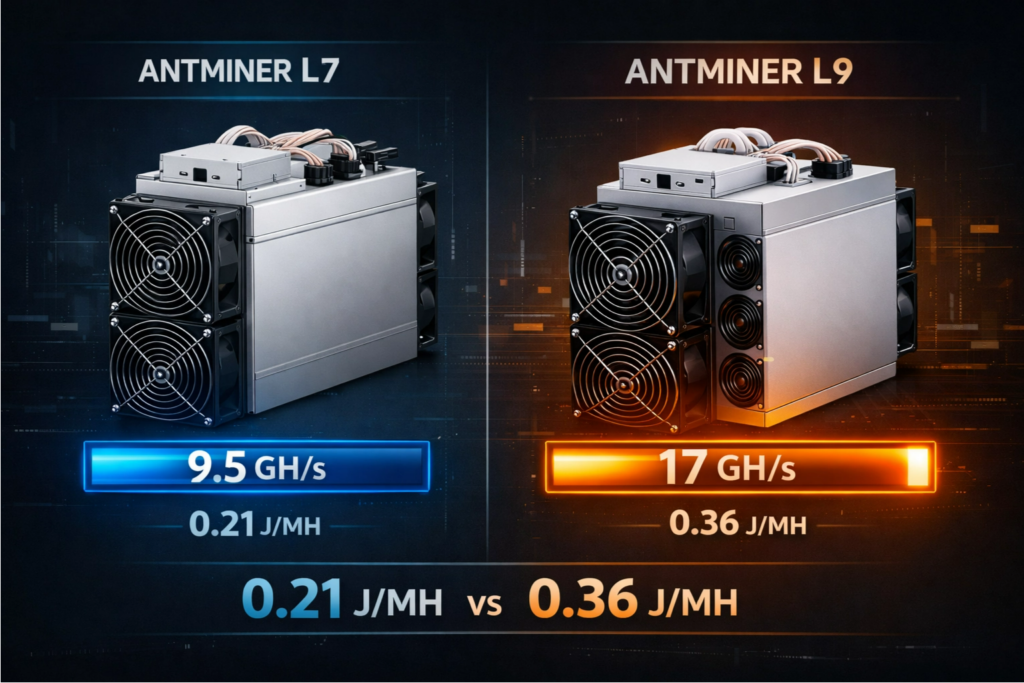
| Hashrate | ~9.5 GH/s | 16–17 GH/s |
| Power Consumption | ~3425W | ~3500W |
| Energy Efficiency | ~0.36 J/MH | ~0.21 J/MH |
| Merged Mining Support | Limited | Full AuxPoW Optimization |
| Revenue Density | Moderate | Significantly Higher |
| Exposure to Small PoW Assets | Low | High (BEL, PEP, etc.) |
| Hosting ROI Stability | Medium | High |
| Long-Term Infrastructure Value | Declining | Server-grade, future-oriented |
Conclusion:
While Antminer L7 remains functional, its efficiency ceiling and limited merged-mining leverage increasingly restrict upside. Antminer L9 offers higher hashrate density, stronger downside protection, and materially better exposure to merged-mining alpha — making it the preferred choice for professional operations in 2026.
6. Final Thoughts: Antminer L9 as the “All-Terrain” Scrypt Miner
Antminer L9’s popularity is not accidental. It aligns closely with today’s miner priorities:
- Predictable cash flow: Litecoin and Dogecoin
- Asymmetric optionality: BEL, PEP, and other merged PoW assets
- Operational reliability: proven Bitmain infrastructure
For miners approaching mining as a long-term infrastructure investment, Antminer L9 currently offers one of the highest tolerance profiles in the Scrypt ecosystem.
About BT-Miners
BT-Miners is a leading global distributor of cryptocurrency mining hardware, headquartered in New York, USA. We provide Antminer L9 spot inventory and professional consultation for mining hosting solutions.
🔗 Check real-time Antminer L9 availability and pricing: https://bt-miners.com/products/bitmain-antminer-l9-litecoin-dogecoin-miner-bt-miners/
👉 Visit our store:https://bt-miners.com/
✅ Real & Trustworthy stock in BT-MINERS

Frequently Asked Questions (FAQ)
1. Is Antminer L9 more profitable than Antminer L7?
In most hosting environments, yes. Antminer L9 delivers significantly higher hashrate with only marginally higher power consumption, resulting in better energy efficiency and higher long-term profitability.
2. What coins can Antminer L9 mine?
Antminer L9 primarily mines Litecoin (LTC) and Dogecoin (DOGE), while supporting merged mining for other Scrypt-based PoW coins such as BEL (Bells) and PEP (Pepecoin) through AuxPoW-compatible pools.
3. What is merged mining and why is it important?
Merged mining allows miners to earn rewards from multiple blockchains simultaneously without increasing power consumption or reducing primary-chain hashrate. It improves capital efficiency and risk-adjusted returns.
4. Is Antminer L9 suitable for long-term hosting?
Yes. Antminer L9 is widely regarded as server-grade hardware designed for continuous operation in professional hosting environments.
5. How much electricity does Antminer L9 consume?
Antminer L9 consumes approximately 3500W under full load. In hosting environments with electricity costs around $0.06–$0.08 per kWh, base-layer mining often covers power expenses.
6. Are BEL and PEP mining rewards guaranteed?
No. Small-cap PoW assets are volatile. While merged mining increases exposure probability, price and reward levels can fluctuate significantly.
7. Does Antminer L9 still make sense if LTC or DOGE prices decline?
In many cases, yes. LTC and DOGE typically provide baseline revenue that offsets operating costs, while merged mining introduces optional upside that improves resilience during market downturns.