Zcash NU7 è attivo: cosa significano i blocchi da 25 secondi per i miner
Zcash NU7 activated on November 6, 2026, at mainnet block 3,543,405. The network now targets a block every 25 seconds, down from 75. For someone waiting to see a ZEC payment land, that means a shorter expected wait for the first confirmation. For someone running a miner, the headline is different: each block carries one-third of the previous subsidy, and the rules for collecting transaction fees have changed.
What 25-second blocks look like over a day
Picture a pool operator watching the chain for five minutes. At the old target, the whole network would produce about four blocks in that window. At the new target, it would produce about twelve. A screen showing the latest block height should move more often, even if the pool has added no machines. Individual intervals still vary because finding a valid proof of work involves chance.
| Misura di rete | Before NU7 | After NU7 |
|---|---|---|
| Target time between blocks | 75 secondi | 25 secondi |
| Expected blocks per 24 hours at target | 1,152 | 3,456 |
| Scheduled subsidy per block, relative to the old rate | 1 | ⅓ |
The arithmetic explains why tripling yesterday’s mining revenue would give a misleading forecast. Three times as many blocks multiplied by one-third as much subsidy yields the same scheduled subsidy over a day. Actual pool credits can still move with the pool’s share of network work, fees, luck and payout method. A calculator that updates only the block interval will overstate the subsidy. One that updates only the reward per block will understate it.
Where the fees go under Zcash NU7
A block can pay its producer from two sources: newly issued ZEC and fees attached to transactions. NU7 treats those two amounts separately. Under the Network Sustainability Mechanism, 40% of transaction fees are available to the current block producer and 60% are set aside for future block rewards. That percentage applies to the transaction fees alone.
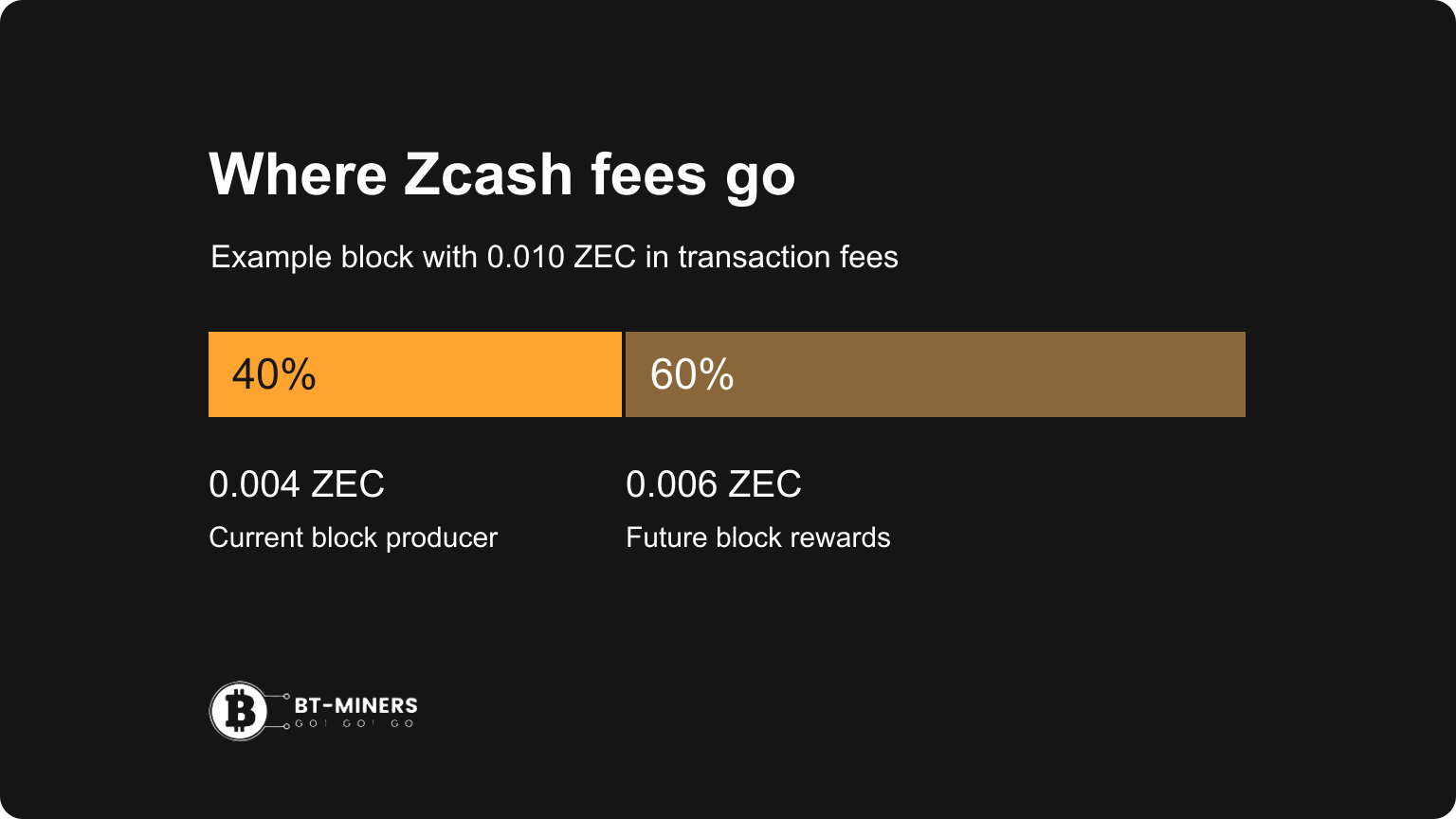
A pool can also charge its customers a service fee. That is a separate line in a miner’s accounts. To reconcile a payout, start with the pool’s published reward method and the work it credited to your account. Applying another 60% deduction to the entire payout would count the protocol rule against the wrong amount.
What to check on an existing ZEC mining rig
ZEC mining continues to use Equihash. The software that builds and validates blocks needs to understand NU7. For a pool customer, that software usually runs at the pool. For a solo miner operating a node, it runs on infrastructure the miner controls. The Zcash Foundation identified Zebra 7.0.0 as its first stable release with NU7 mainnet support.
- Pool customers: Check that the pool is following blocks above the activation height, then open your worker record. Compare accepted shares and stale or rejected shares with a comparable period before activation. A normal hashrate on the machine alone cannot tell you whether the pool credited its work.
- Solo miners and pool operators: Check the node version, compare its recent block hashes with an independent explorer and confirm that your software is issuing fresh jobs as the tip advances. A height that keeps rising is more informative when the corresponding block hash also agrees.
- Anyone checking a payout: Distinguish the pool’s payment schedule, the transaction’s first on-chain confirmation and the receiving service’s deposit policy. A pool that pays once a day can continue doing so even when blocks arrive more often.
What the change means for an ASIC buyer
Take the 840 kSol/s version of the Bitmain Antminer Z15 Pro. At its listed 2,780 W, a full day at rated power uses about 66.72 kWh. At an illustrative electricity rate of US$0.10 per kWh, that comes to US$6.67 per day before external cooling or hosting charges. Faster blocks change neither side of that electricity calculation.
For a useful post-upgrade comparison, record the ZEC credited over a full pool accounting period, the worker’s uptime and the electricity consumed over those same hours. A payout received today may include work from yesterday. Match the time windows before attributing a change to NU7. Buyers comparing hardware can use the BT-Miners ZEC miner collection and enter their own power rate in the product calculator.
One change that matters to longtime wallet users
NU7 also disables legacy version 4 transactions. As a result, ZEC still held in Sprout, the original shielded pool, can no longer be spent under the active rules. Here, “pool” means a part of the protocol that holds shielded funds. A miner who sees an unpaid balance on a mining pool dashboard should check with that operator about its payout status. The Sprout change concerns where coins were held on-chain.
Domande frequenti
When did Zcash NU7 go live?
The activation block was 3,543,405 on November 6, 2026. Earlier notices estimated November 5 because the upgrade was scheduled by block height and actual block times vary.
How long should three ZEC confirmations take?
At the new target, three block intervals average about 75 seconds. A transaction first has to be included, and the receiving wallet or exchange decides how many confirmations to require before crediting a deposit.
Does a ZEC miner need a new ASIC for NU7?
An existing compatible Equihash ASIC can continue mining through a pool that supports NU7. Check the worker’s accepted shares after activation. Operators who run their own nodes must also verify that their software follows the upgraded chain.