
قفل مكافأة تعدين XBT لمدة 180 يومًا: شرح عقدة البيتكوين 29.4.3
XBT miners are about to face a very different cash-flow cycle. The earlier 45-day reward window was already long enough to change how operators budgeted for power. The latest Bitcoin Knots upgrade extends the wait for newly mined rewards to approximately six months.
The change is easy to describe badly. It is often called an “180-day lock,” but it does not lock every XBT coin, wallet or exchange account. It changes the نضج كوين بيس of mining rewards created from a specific block height. Those rewards can be received and tracked, but they cannot be spent until 25,920 more blocks have been added.
This article explains the exact rule in Bitcoin Knots 29.4.3, the developers’ stated reasons for adopting it, and the likely long-term effects on miners, pools, liquidity and the credibility of the XBT/BTCB2 network.
XBT’s 180-Day Rule in Plain English
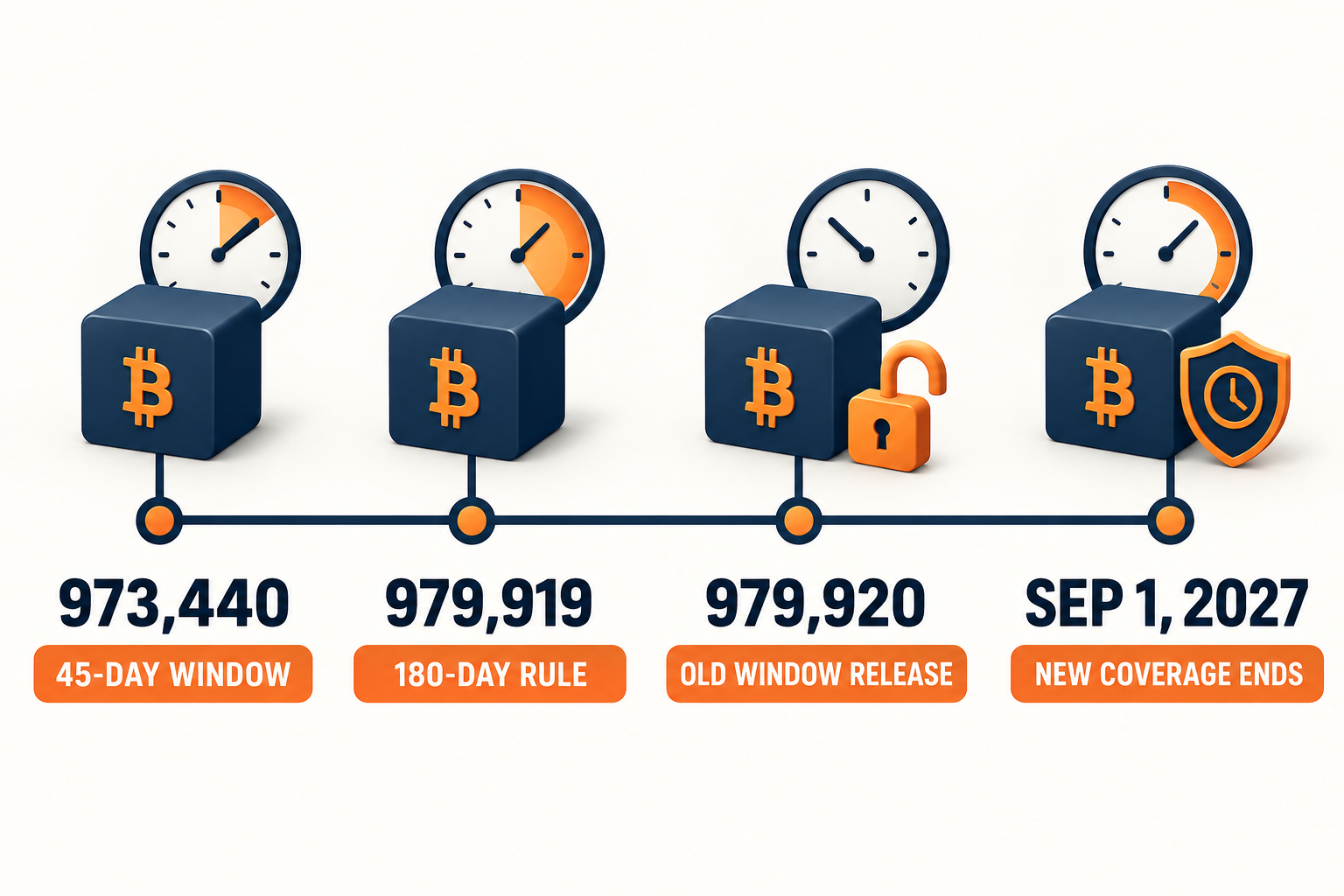
وفقًا official Bitcoin Knots 29.4.3 release notes و طلب سحب # 468, a mainnet coinbase output created at height 979,919 أو أحدث يجب الإنتظار كتل 25,920 before it can be spent. At a ten-minute target interval, that is approximately 180 days.
It is a block-count rule, not a six-month wall-clock timer. If blocks arrive faster or slower than ten minutes on average, the real wait changes with them. The first affected reward, mined at height 979,919, becomes spendable at height 1,005,839.
The new coverage is scheduled to continue until the RDTS deployment expires on September 1, 2027. A reward mined before that expiry still completes its full 25,920-block wait. Rewards mined at or after expiry return to the normal 100-block consensus maturity unless the rules change again.
What is affected—and what is not?
- متأثر: every coinbase output created in a covered block, including the block subsidy and transaction fees.
- Not retroactively affected: rewards mined before height 979,919 do not suddenly receive a new 180-day consensus lock.
- Not affected by this consensus rule: ordinary non-coinbase XBT outputs that are already spendable.
- Still possible: an exchange, pool or wallet provider may apply its own withdrawal hold while upgrading or managing chain risk.
This distinction matters. A user saying “XBT withdrawals are locked” may be describing a real service-level restriction, but that is different from the network’s new coinbase maturity rule.
How the 45-Day Window Transitions to 180 Days
The previous Bitcoin Knots 29.4.2 release covered coinbase rewards from height 973,440 through 979,918 with a 6,480-block maturity period, or roughly 45 days. Version 29.4.3 keeps that rule for those rewards and introduces the 25,920-block rule for new rewards beginning at 979,919.
There is no single date when all old and new rewards become available. Each affected coinbase output has its own maturity height. That creates a rolling unlock schedule rather than one giant release event.
There is one technical wrinkle. From height 979,920, the old 45-day outputs no longer require 6,480 blocks under the consensus rule and instead require the standard 100 confirmations, although wallet and relay policy may continue treating them more conservatively. Operators should therefore distinguish between consensus validity, wallet behavior و pool payout policy.
Why Bitcoin Knots 29.4.3 Matters Beyond the Lock
Node compatibility is the immediate operational issue. The release notes advise nodes and miners to upgrade before block 979,919. Nodes remaining on 29.4.2 may begin accepting blocks that 29.4.3 rejects from height 980,019, and miners on 29.4.2 may produce blocks rejected by upgraded nodes from height 986,399. A late upgrade on a pruned node may require a full resynchronization.
That means this is not merely a wallet display change. If a meaningful portion of economic nodes, pools or miners stays on incompatible rules, the network can experience rejected blocks, inconsistent balances and confusion over which chain exchanges should credit.
The release also includes broader data-carrier filters, BLAKE2b peer-handling changes and an AssumeUTXO snapshot. Those updates deserve attention, but the reward-maturity change has the largest direct effect on mining economics.
Why Did the Project Choose 180 Days?
The developers describe the rule as a defense against “blind hashing” and short-term, mercenary hashrate. Their argument is that miners who can sell rewards after only 100 blocks can move into XBT when returns look attractive, liquidate quickly and leave without carrying much long-term network exposure. A six-month maturity period forces new mining revenue to remain tied to the chain for longer.
There are three intended effects:
- Reduce immediate miner selling. New supply cannot reach the market as quickly.
- Encourage longer-term participation. Miners have more reason to follow upgrades, run compatible infrastructure and care about the network’s condition months later.
- Make opportunistic attacks more expensive. A miner cannot immediately realize the value of a covered block reward.
These are the project’s stated goals, not guaranteed outcomes. A maturity rule can delay spending, but it cannot create demand, guarantee loyal hashrate or prevent miners from redirecting their machines to Siacoin. It also does not distinguish today between a miner using DATUM and one submitting work through a conventional pool: all covered coinbase outputs wait the same 25,920 blocks.
The Largest Cost for Miners Is Working Capital
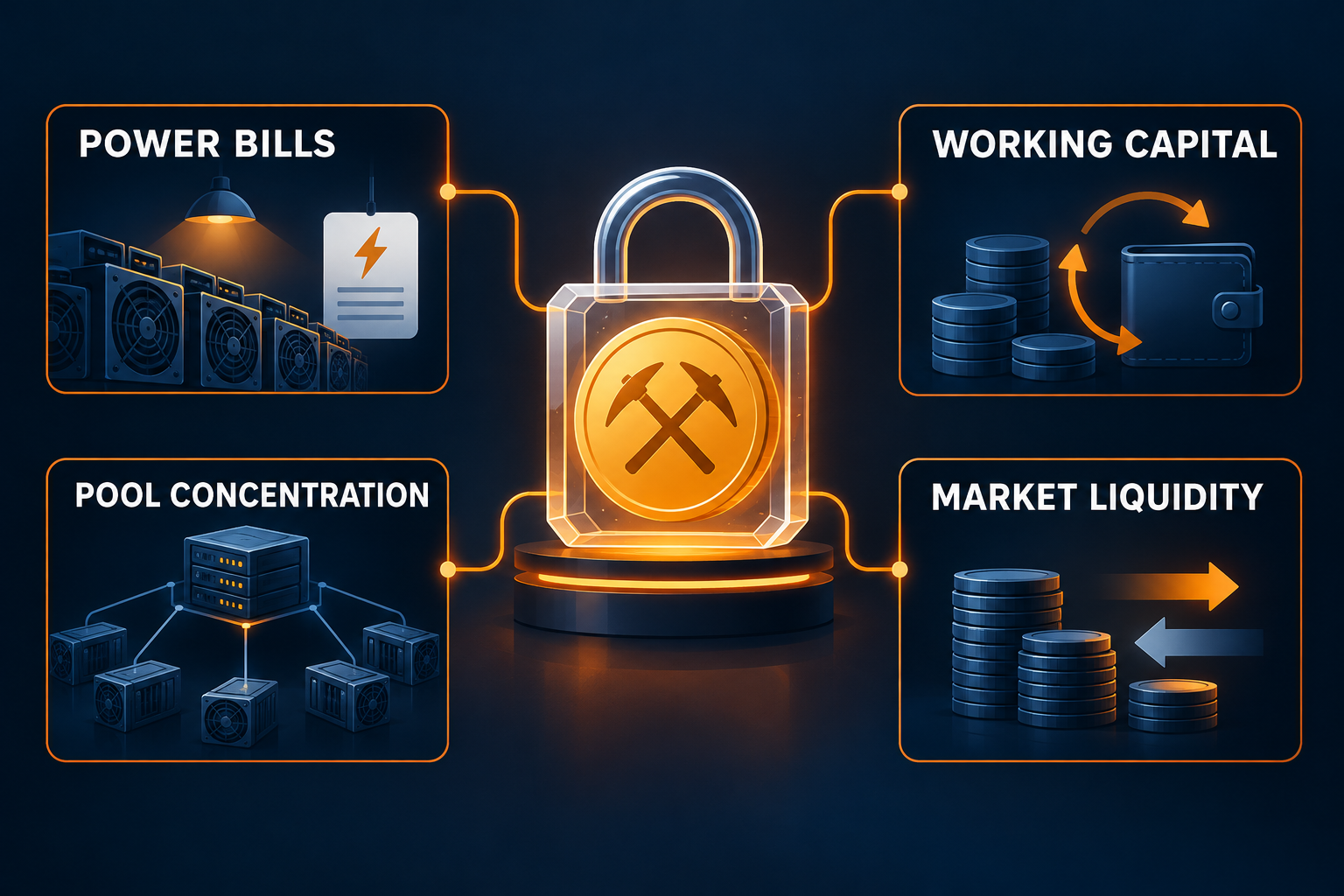
A miner can be profitable on paper and still run out of cash. Power companies and hosting providers normally bill monthly; the network now asks the operator to wait approximately six months before spending each newly mined reward.
The following table uses nameplate power and an illustrative electricity price of $ 0.07 / كيلوواط ساعة. It shows only the electricity that must be financed for 180 days. Cooling, hosting, pool fees, downtime, debt service and financing costs are excluded.
| عامل منجم | تصنيف السلطة | تكلفة الطاقة/يوم | احتياطي الطاقة لمدة 180 أيام |
|---|---|---|---|
| ايبيلينك BM-S3+ | 3,400 W | $5.71 | $1,028.16 |
| آي بيلينك BM-S3 | 3,100 W | $5.21 | $937.44 |
| جولدشيل إس سي 5 برو 2 | 3,300 W | $5.54 | $997.92 |
| جولدشيل SC5 برو | 2,820 W | $4.74 | $852.77 |
| غولدشيل SC لايت | 950 W | $1.60 | $287.28 |
الصيغة بسيطة: kW × 24 hours × $0.07 × 180 days. The operating decision is not. One hundred BM-S3+ units would need roughly $102,816 for electricity alone over 180 days at this rate. A hosted farm may need substantially more once monthly service charges are included.
There is also a rolling effect. After activation, miners do not wait six months once and then return to normal daily liquidity. Each day’s reward begins its own 25,920-block clock. Unless a pool advances funds, the operator needs a continuing working-capital bridge until the first rewards mature and a daily flow begins.
Could the Rule Increase Pool Concentration?
Yes. A direct-coinbase payout gives miners custody of their reward, but it cannot bypass consensus maturity. A conventional pool can make balances feel liquid only by paying miners from older reserves or external capital while its own coinbase rewards remain immature.
That creates a financing advantage for the largest pools. A well-capitalized operator may offer predictable daily payouts, while a smaller independent pool must make miners wait. Operators who need monthly cash may consolidate around the pool that provides the best credit terms, not the one that best supports decentralization.
The result could be the opposite of the policy’s intention: fewer opportunistic miners, but more hashrate controlled by a small number of treasury-rich intermediaries. Miners should ask whether a payout is a direct coinbase output, a matured payment, or an advance from the pool’s own balance sheet. Our XBT mining pool decentralization guide explains why the distinction matters.
Liquidity May Look Stronger Before It Becomes More Fragile
Less immediate miner supply can reduce short-term selling pressure. That may support the market price, especially on thin order books. It can also create a misleading signal. A higher quoted price is not the same as deeper liquidity, and an immature reward cannot be used to pay today’s power bill.
Because rewards unlock on a rolling basis, there is no single cliff where every six-month reward becomes spendable. Still, the first maturity wave can matter. Miners that financed operations for months may sell a meaningful share of rewards as soon as they mature. If trading volume remains low, even a gradual increase in available supply can widen spreads and increase volatility.
The healthiest outcome would be deeper exchange liquidity and more genuine end-user demand before the first 180-day rewards mature. Without that, the lock mainly postpones price discovery.
Possible Effects on Hashrate and Network Security
The rule can improve security if it attracts miners willing to stay for the long term and discourages hashrate that disappears after a brief profitability spike. Stable participation makes capacity planning easier and reduces the temptation to attack a chain for a quick reward.
But the same rule can lower security if miners cannot finance the wait. BLAKE2b ASIC owners have another established option in Siacoin. If XBT’s expected return does not compensate for six months of illiquidity, some operators will switch chains or power off. A smaller hashrate base is cheaper to disrupt and more dependent on the remaining large farms.
The important metric is therefore not only headline hashrate. Watch the number of independent pools, the distribution of block production, the share of upgraded nodes and whether smaller miners can participate without accepting expensive pool financing.
The Long-Term Governance Question
Mining equipment and hosting contracts are long-lived assets. Operators can price a strict rule if it is stable and announced clearly. They struggle when reward access changes faster than their capital commitments.
The 29.4.3 release gives precise heights and a defined expiry, which is better than an informal withdrawal restriction. However, the move from roughly 45 days to roughly 180 days in a short period raises a fair question: what level of reward maturity should miners assume for the next hardware cycle?
Long-term trust will depend on four things:
- القدرة على التنبؤ: sufficient notice before consensus-affecting upgrades.
- تبني: visible agreement among miners, pools, exchanges and economic nodes.
- الحياد: rules that do not quietly privilege one pool or access model.
- قياس: public evidence showing whether concentration, hashrate stability and security actually improve.
A lock can buy time, but it cannot substitute for governance. If the project publishes clear metrics and revisits the policy based on evidence, the experiment could strengthen credibility. If rules keep extending without broad coordination, the market may apply a larger risk discount to XBT rewards and compatible mining hardware.
Three Long-Term Scenarios
| سيناريو | What would need to happen | Likely long-term effect |
|---|---|---|
| البناء | Nodes upgrade cleanly, hashrate remains diverse, liquidity deepens and the first rolling unlocks are absorbed. | A more committed miner base and a stronger security narrative. |
| حالة القاعدة | Some miners move to Siacoin, larger pools finance payouts and XBT trading remains thin. | A smaller network with less immediate selling but more concentration and financing friction. |
| معاكس | Node adoption fragments, miners reject the cash-flow burden and immature rewards trade at a heavy discount. | Lower trust, weaker hashrate, pool centralization and possible exchange retrenchment. |
ما يجب على مُعدّني عملة XBT فعله الآن
- Upgrade before relying on new payouts. استخدم الرسمي Bitcoin Knots 29.4.3 downloads, verify signatures and check
getdeploymentinfoلـlong_coinbase_maturity. - Budget for 180 days of operations. Include power, cooling, hosting, pool fees, financing and a safety margin.
- Do not count immature XBT as cash. Track each reward’s maturity height and separate it from spendable balances.
- Ask the pool who finances early payouts. A smooth payout schedule may represent credit risk rather than protocol liquidity.
- Keep a tested Siacoin configuration. Compatible BLAKE2b ASICs can switch, but firmware, pool settings and economics should be verified before an emergency.
- Spread operational risk. Avoid placing an entire farm behind one pool, one node or one exchange.
- Follow heights and official releases. Social-media countdowns can be wrong when block intervals vary.
For node and payout setup, see our دليل عقدة XBT DATUM و Shrike wallet setup guide. Operators evaluating hardware can compare the BT-ماينرز BTCمجموعة عمال المناجم B2.
الأسئلة الشائعة
Are all XBT coins locked for 180 days?
No. The consensus change applies to covered coinbase outputs created from height 979,919. Ordinary spendable outputs are not given a new 180-day lock by this rule.
Can a mining pool unlock rewards early?
No pool can override coinbase maturity. It can pay miners early only by using already-spendable reserves or borrowed capital, taking the timing and price risk onto its own balance sheet.
Does the rule apply only to direct pool or Stratum mining?
No. The current rule applies to all covered coinbase outputs. Discussion about DATUM and block construction is part of the broader policy rationale, not an exemption from the 25,920-block maturity rule.
When does the first 180-day reward unlock?
The reward created at height 979,919 becomes spendable at height 1,005,839. The calendar date depends on actual block production.
Will the 180-day rule increase the XBT price?
It may reduce near-term miner supply, but price also depends on demand, exchange depth, confidence and future unlocks. A maturity rule cannot guarantee a higher price or realizable liquidity.
الحد الأدنى
The XBT 180-day mining reward lock is a major economic change even though it is narrower than a universal withdrawal freeze. It asks miners and pools to finance approximately six months of operations while each new reward matures.
The policy may discourage short-term hashrate and reduce immediate selling. It may also push smaller operators off the network, strengthen treasury-rich pools and postpone rather than solve liquidity problems. The long-term result will depend on node adoption, pool concentration, stable hashrate and whether the market develops enough genuine demand to absorb rolling unlocks.
For miners, the practical answer is conservative: upgrade, verify the chain, model working capital instead of headline revenue, and keep a tested alternative for BLAKE2b capacity. For the project, the next six months will be a governance test as much as a mining test.
المصادر الأولية
- Bitcoin Knots v29.4.3 release notes
- Bitcoin Knots PR #468: Extend long coinbase maturity
- Official Bitcoin Knots 29.4.3 downloads
تنويه: BT-Miners sells the mining hardware linked above. This article is operational analysis, not financial advice or a guarantee of compatibility, revenue, liquidity or payback. Network rules, pool policies and exchange access can change quickly. Facts were checked October 31, 2026.