⚠️ 免责声明: Mining profitability fluctuates with electricity costs, cryptocurrency prices, and network difficulty. All figures reflect conditions as of June 18, 2026. Past performance does not indicate future results. Conduct your own due diligence before purchasing or selling mining equipment.
Most guides focus on when to 购买 an ASIC miner. Fewer address the question every miner eventually faces: when is the right time to sell? Getting this decision wrong — holding too long or exiting too early — can erase months of accumulated profit. This guide covers the mechanics of ASIC depreciation, the three clearest signals that it is time to sell, and how to define an exit strategy before making a purchase.
How ASIC Miners Lose Value — and Why It Happens Faster Than You Expect
Unlike general-purpose servers, ASIC miners are purpose-built for a single task. That specificity makes them highly efficient — and also means their value is almost entirely tied to how much they can earn today versus what alternatives exist. Three forces work together to erode that value.
The Three Depreciation Forces
- Rising network difficulty. As more hashrate comes online globally, each unit of hashrate earns proportionally less. A BTC miner earning $0.050 per TH/s per day in early 2026 may earn $0.032 per TH/s per day by late 2027 if global hashrate grows at its historical pace.
- Next-generation hardware. Manufacturers release more efficient designs every 12–18 months. When a new generation arrives at lower cost per TH — or better joules per TH — the previous generation’s income advantage shrinks, and resale prices follow. The window between announcement and mass shipment is often the last moment to sell at a reasonable valuation.
- Coin price volatility. Daily income is directly proportional to coin price. A 30% drop in BTC from $66,000 to $46,000 reduces gross BTC mining income by roughly 30%. Resale value tracks that decline because buyers price based on forward earnings potential.
These forces compound. A mid-range BTC ASIC purchased for $5,000 today will typically trade for $2,500–$3,200 in 18 months and $1,200–$2,000 in 36 months under stable conditions — and faster if a major efficiency jump arrives in the interim.
Depreciation Rates by Coin Type
BTC mining sees the most competitive manufacturer landscape — Bitmain, MicroBT, Bitdeer, and Canaan all ship new generations on relatively short cycles. ZEC and Scrypt (LTC/DOGE) equipment faces less frequent product iterations, which tends to slow secondary market price erosion somewhat.
| Coin / Algorithm | Est. Year-1 Value Loss | Est. Year-2 Value Loss | 主要驾驶员 |
|---|---|---|---|
| BTC (SHA-256) | 35-55% | 55-75% | Dense manufacturer competition; frequent new generations |
| ZEC (Equihash) | 20-35% | 40-60% | Fewer manufacturers; value tracks ZEC price closely |
| LTC/DOGE (Scrypt) | 25-40% | 45-65% | Moderate competition; LTC halving cycles affect income |
Note: These are general estimates based on observed secondary market patterns. Actual depreciation depends on the specific model, network conditions at time of sale, and secondary market demand. Use the BT-Miners 盈利能力计算器 to track current daily income before listing any hardware.
Three Signals That Tell You It Is Time to Sell
Signal 1: A Next-Generation Model Offers 25% or Greater Efficiency Improvement
Efficiency — measured in joules per terahash (J/TH) for BTC miners or joules per kilohash (J/KSol) for ZEC — determines how much a miner earns per watt consumed. When a new generation offers a material efficiency gain (typically 25% or more), two things happen: the newer model outcompetes your unit on daily income at the same electricity rate, and the pool of buyers for your older hardware shrinks rapidly.
The optimal window to sell is typically the 30–60 days after a new model is announced but before it ships in volume. During this window, secondary market supply of the older generation has not yet spiked, and buyers who cannot yet access the new hardware are still transacting at near-current prices. Once new units ship at scale, prices on the preceding generation commonly drop 20–30% within weeks.
Signal 2: Net Daily Income Has Fallen Below a Sustainable Level
Electricity sensitivity varies significantly by miner design. High-power BTC miners are more vulnerable to electricity rate increases or coin price declines than efficient ZEC or Scrypt hardware. The table below illustrates the difference at current market conditions (BTC $66,328, ZEC $524.85, June 18, 2026):
| 矿工 | 算力 | 电力 | 净值 0.07 美元 | 净值 0.10 美元 | 净值 0.12 美元 | 净值 0.15 美元 |
|---|---|---|---|---|---|---|
| Bitdeer A4 Pro Hydro | 680 TH / s | 7,412W | $10.41 | $5.07 | $1.51 | − $ 3.82 |
| Bitdeer A4 Ultra Hydro | 886 TH / s | 8,372W | $15.73 | $9.70 | $5.68 | − $ 0.35 |
| 蚂蚁矿机Z15 Pro | 840 KSol/秒 | 2,780W | $31.89 | $29.89 | $28.55 | $26.55 |
Note: The A4 Pro Hydro and A4 Ultra Hydro both turn negative at electricity rates above $0.13–0.15/kWh. The Z15 Pro remains profitable across all rates shown due to its lower power draw relative to income. Model your own scenario at the BT-Miners 盈利能力计算器.
When net daily income drops below approximately $2/day at your actual electricity cost, you are effectively running on the expectation of a coin price recovery rather than on current income fundamentals. That is a speculative position. For most operators, this is the clearest practical signal to review the hold-versus-sell decision seriously.
Signal 3: Repair and Maintenance Costs Are Approaching Resale Value
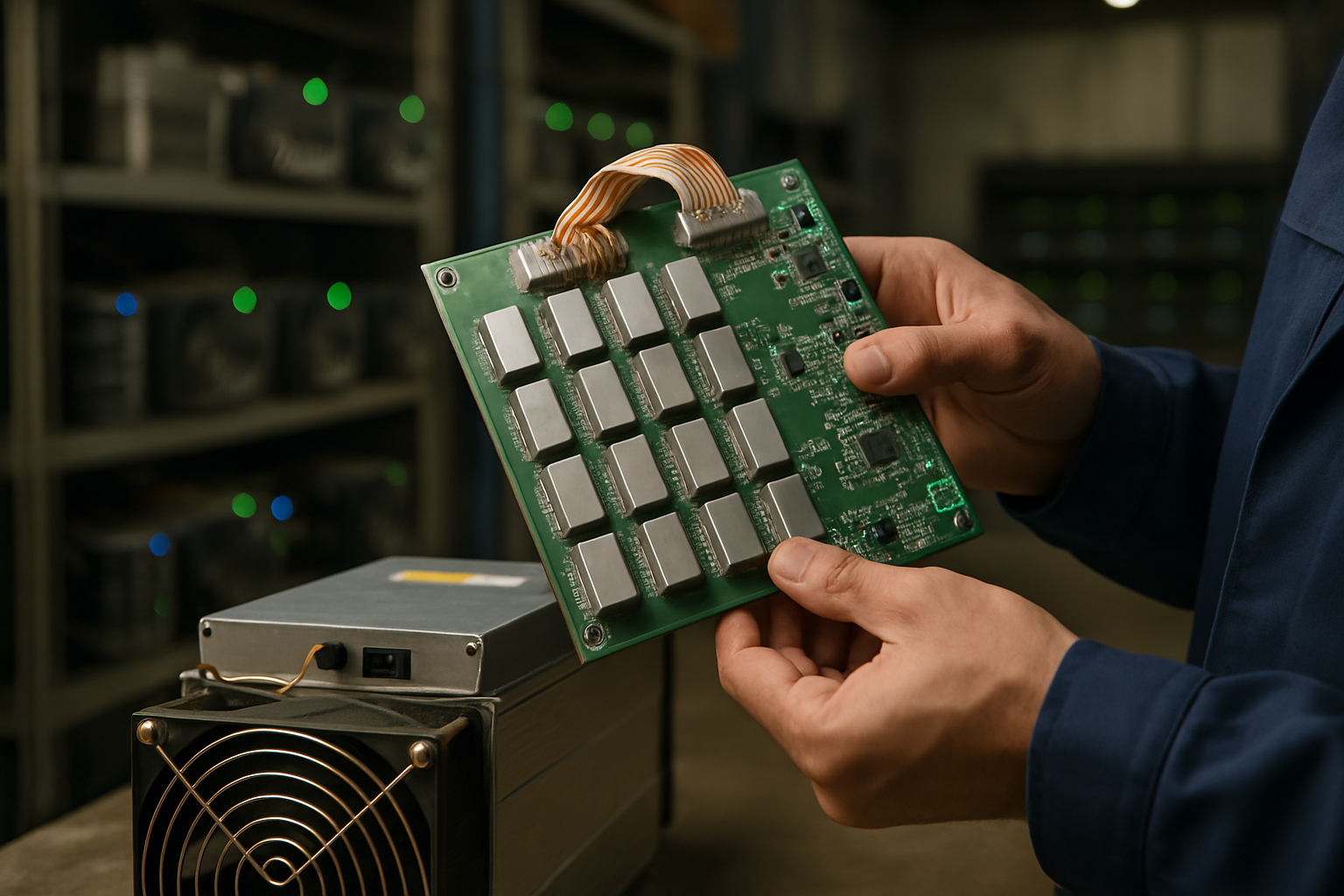
ASIC hardware degrades with use. Hash boards fail, fans wear out, and power supplies develop faults. When the cost of keeping a unit operational approaches 20–25% of its current resale value, the repair calculus often does not hold up. A miner that would sell intact for $2,000 but needs a $500 hash board repair nets only $1,500 — comparable to what an informed buyer might offer for a clearly worn, partially working unit anyway.
Selling while the unit is still fully functional typically produces a better outcome than attempting to extend operational life through repeated repairs on aging hardware.
How to Calculate Your Break-Even Sell Price
Before accepting any offer, establish a floor below which selling is not financially rational. A straightforward method:
- Estimate your forward income horizon. How many more days do you expect to earn at or near your current net rate before a meaningful decline — whether from a new generation shipping, a difficulty jump, or a price drop?
- Sum the expected income over that horizon. If your miner earns $8/day net and you expect 90 days before a significant income reduction, the income at stake is approximately $720.
- Apply a risk discount. Mining income is uncertain. Discounting forward estimates by 20–30% is reasonable, bringing the floor in this example to roughly $500–$580.
- Compare to the offered price. If a buyer offers more than your floor, selling is financially rational. If not, hold — until conditions change enough to reassess.
This approach does not capture every variable (opportunity cost, time value of capital, tax treatment), but it provides a defensible minimum threshold for evaluating offers.
Where to Sell a Used ASIC Miner in 2026
The secondary market for ASIC hardware has several active channels with different trade-offs between liquidity and recovery price:
- Hardware resellers and dealers. Specialist retailers typically purchase used units at 60–75% of current market value for confirmed-working hardware. The main advantage is speed — transactions often close within days, with no need to source and vet individual buyers.
- Mining community forums. Direct peer-to-peer sales via Bitcointalk’s hardware section or community-specific marketplaces can achieve 75–85% of market value. The trade-off is a longer sales cycle and the need to establish credibility with prospective buyers.
- Parts sales. Miners with failed components sometimes generate more total revenue by selling functional hash boards, control boards, and PSUs individually than by listing the damaged unit as a whole at a steep discount. This path requires more time but maximizes recovery from hardware that can no longer run reliably.
- Local buyers and farm operators. Mining operations expanding capacity sometimes prefer local sourcing to avoid international shipping costs and import duties. Local pricing can diverge from global secondary market rates in either direction.
In all channels, documenting the miner’s actual hashrate and error log before listing produces measurably better outcomes. Buyers consistently pay a premium for hardware with a clean, verifiable operational record over unverified units of unknown condition.
Build Your Exit Strategy Before You Buy
The most effective exit strategies are set before the purchase, not after the hardware is deployed. Two specific thresholds to define upfront:
- ROI milestone or target hold period. Will you sell after recovering 100% of initial investment? 70%? After 18 months regardless of ROI status? Setting this in advance removes anchoring bias from a future decision under pressure. Miners with fast payback — such as the 蚂蚁矿机Z15 Pro, currently estimated at 4.8-month ROI at prevailing ZEC prices — give you capital back quickly, preserving the option to upgrade when the next generation ships.
- Minimum daily income floor. The net income level at your actual electricity rate below which you will sell rather than continue operating. Setting this before purchase prevents the common mistake of continuously lowering the threshold as conditions deteriorate.
A Practical Decision Reference
| Condition | 建议回应 |
|---|---|
| ROI recovered; next-gen announced with >25% efficiency gain | Sell within 30–60 days of announcement |
| Net income below $2/day at your electricity rate | Evaluate sell vs. hold against your forward price outlook |
| Repair cost exceeds 20% of current resale value | Sell intact while working, or part out the hardware |
| Payback horizon has extended beyond 36 months at current rates | Revisit original thesis; consider partial or full exit |
| Payback horizon under 12 months, income stable | Hold — current economics favor continued operation |
Note: This framework is a general reference, not financial advice. Electricity rate, hosting arrangement, tax treatment, and individual risk tolerance all affect the optimal decision for a specific situation.
结语
Depreciation in ASIC mining is structural, not exceptional. Networks grow, efficiency improves, and new generations arrive on a predictable cadence. Miners who define exit criteria before purchase and monitor the three key signals — efficiency displacement from next-gen hardware, income floor relative to electricity cost, and repair economics — tend to preserve more capital across hardware cycles than those who hold indefinitely waiting for a price recovery to bail out a deteriorating position.
To track your miner’s current net daily returns as market conditions evolve, use the BT-Miners 盈利能力计算器. If you are evaluating which miners currently offer the shortest payback horizons — and therefore the most strategic optionality — browse the full BT-Miners inventory for current pricing and ROI estimates.